



الصفحة 2
الصفحة 2
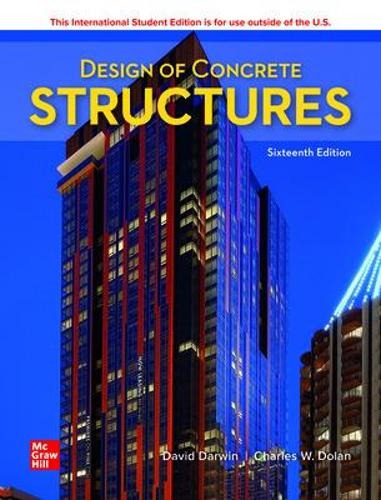
Design of Concrete Structures
Presents the basic mechanics of structural concrete and methods for the design of individual members subjected to bending, shear, torsion, and axial forces. It additionally addresses in detail applications of the various types of structural members and systems, including an extensive presentation of slabs, beams, columns, walls, footings, retaining walls, and the integration of building systems

Design examples for high strength steel reinforced concrete columns : A Eurocode 4 approach
SRC column subjected to axial compression -- SRC column with normal strength material -- SRC column with high strength concrete -- SRC column with high strength steel -- SRC column with high strength concrete and steel -- SRC column subjected to combined compression and bending -- SRC column with normal strength material -- SRC column with high strength concrete -- SRC column with high strength steel -- SRC column

Design a govermental reinforced concrete building in damascus
This calculation sheet is done to study 5 story building by using reinforced concrete, this sheet analysis the building according to horizontal loads and vertical by slabs ripped and solid beams dropped or hidden shear walls and columns stairs and elevators core and as an foundation system this sheet will analysis 3type pad and strip and also a partial rafter. In this build it has a shelter in its basement and it should be surrounded by walls work as rati9ng wall.

Corrosion of Steel in Concrete : Understanding, Investigation and Repair
A guide for designing, constructing and maintaining reinforced concrete structures, such as buildings and bridges which are subject to reinforcement corrosion. It presents the basics of theory and practice in steel corrosion in concrete and reviews the latest research and developments, such as progress on measuring the corrosion threshold for chloride-induced corrosion.

Corrosion and protection of reinforced concrete
This book surveys deterioration of concrete, particularly corrosion of the steel reinforcement, and the various chemical, biological, physical and mechanical causes of deterioration. It outlines condition survey and diagnosis techniques by on-site and laboratory measurements. It sets out mechanical methods of protection and repair, such as patching, inhibitors, coatings, penetrants and structural strengthening as well as cathodic protection and other electrochemical methods.

Control of cracking in reinforced concrete structures
Provides guidelines which can extend the existing standards and codes to cover these types of special works, especially those which are massive in nature, taking account of their specific behaviour in terms of cracking and shrinkage together with other important properties such as water/air leak tightness

Concrete structures deteriorated by delayed ettringite formation and alkali-silica reactions
Discusses the behaviour of isolated concrete bottle-shaped struts affected by internal expansion reactions (ISR). For that purpose, the numerical modelling of damaged concrete was performed using the Concrete Damaged Plasticity Model (CDPM) implemented in ABAQUS and validated the model through Sankovich's tests.

Concrete permeability and durability performance: from theory to field applications
Durability and service life design of concrete constructions have considerable socio-economic and environmental consequences, in which the permeability of concrete to aggressive intruders plays a vital role.Concrete Permeability and Durability Performance provides deep insight into the permeability of concrete, moving from theory to practice, and presents over 20 real cases.

Concrete composite columns : Behavior and design
Moves beyond existing resources, to study the relationship between existing composite structures and design methods for the sectional form of concrete composite structure. Chapters cover the failure criteria of concrete; confined concrete types; models including axial stress prediction, analysis oriented constitutive, and design-oriented constitutive models; the design and analysis of section form; double confined concrete; seismic behaviors of concrete composite columns; and the seismic design of concrete composite columns.

Computational Structural Concrete : Theory and Applications
Concrete is by far the most used building material due to its advantages: it is shapeable, cost-effective and available everywhere. Combined with reinforcement it provides an immense bandwidth of properties and may be customized for a huge range of purposes. Thus, concrete is the building material of the 20th century. To be the building material of the 21th century its sustainability has to move into focus. Reinforced concrete structures have to be designed expending less material whereby their load carrying potential has to be fully utilized.
LRFD Bridge Design : Fundamentals and Applications
Examines and explains material from the 9th edition of the AASHTO LRFD Bridge Design Specifications, including deck and parapet design, load calculations, limit states and load combinations, concrete and steel I-girder design, bearing design, and more. With increased focus on earthquake resiliency, two separate chapters– one on conventional seismic design and the other on seismic isolation applied to bridges– will fully address this vital topic. The primary focus is on steel and concrete I-girder bridges, with regard to both superstructure and substructure design. / Includes several worked examples for a project bridge as well as actual bridges designed by the author / Examines seismic design concepts and design details for bridges / Presents the latest material based on the 9th edition of the LRFD Bridge Design Specifications / Covers fatigue, strength, service, and extreme event limit states / Includes numerous solved problems and exercises at the end of each chapter to illustrate the concepts presented

CEB-FIP Model code 1990 : Design code
This document is a comprehensive design code for concrete. It is the result of a comprehensive revision to the original model code of 1978, which was produced jointly by the Comite Euro-International du Beton (CEB) and the Federation Internationale de la Precontrainte (FIP). Model Code 1990 has more detailed guidelines and explanations than national codes and can be used as a basis for them. It has already influenced the codification work that is being carried out both nationally and internationally and will continue to do so. With the publication of Eurocode 2: Part 1 as a draft pre-standard, this document is a useful reference during the consultative period before Eurocode 2 becomes a European standard. It may be of use to anyone involved in codification work on concrete.
Cathodic protection for reinforced concrete structures
For specialist contractors, large consultants and owners of corrosion damaged structures, and looks at international experience with this technique. It examines why corrosion is occurring, the differences in the application of CP with the stark dichotomy in its success and failure, and finally ways in which its performance can be improved on future installations.

Blast effects on buildings
Provides the latest practical guidance on designing buildings to optimise their resilience to blast loading. Focused specifically on the design of commercial buildings, it is an indispensible guide to help engineers reduce the risks posed to building occupants and businesses from terrorist and other explosions. This book provides the engineer with a single and comprehensive source of reference for all the main elements of blast engineering design in modern practice. Industry-accepted methods for the design of glazing to resist blast loading are published for the first time, as well as a new chapter on hostile vehicle mitigation techniques. Guidance on structural steelwork and reinforced concrete design is extended and enhanced, supplemented with material on design in new materials such as steel-concrete-steel composites, this latter addition being published for the first time.
Artificial neural network-based optimized design of reinforced concrete structures
Introduces AI-based Lagrange optimization techniques that can enable more rational engineering decisions for concrete structures while conforming to codes of practice. It shows how objective functions including cost, CO2 emissions, and structural weight of concrete structures are optimized either separately or simultaneously while satisfying constraining design conditions using an ANN-based Lagrange algorithm. Any design target can be adopted as an objective function. Many optimized design examples are verified by both conventional structural calculations and big datasets. Uniquely applies the new powerful tools of AI to concrete structural design and optimization Multi-objective functions of concrete structures optimized either separately or simultaneously Design requirements imposed by codes are automatically satisfied by constraining conditions Heavily illustrated in color with practical design examples
Analytical approaches for reinforced concrete
Applies deductive reasoning, logic and mathematics to RC. Laying out, deductively, the principles of RC, it encourages researchers to re-imagine and innovate using a solid conceptual framework. Sections consider the reasoning behind key theories, as well as problems that remain unsolved.
Alternative concrete - geopolymer concrete : Emerging research and opportunities
Focuses on fly ash-based alkali-activated geopolymer concrete, its production and characteristic properties. The re-use of waste materials and industrial by-products, such as fly ash, is not only economically of interest but also helps to reduce carbon dioxide emissions. The carbon footprint of these materials is much lower than that of concrete using ordinary Portland cement. They thus offer new sustainable solutions to the construction industry.

Advances in Construction Materials 2007
A compilation of recent research results on building construction materials. The construction industry consumes extreme volumes of material, and the growing demand for quality and safety require continuous improvement of materials and material compositions. A deep understanding of material behavior is essential to enable efficient construction: light-weight or heavily burdened structures ask for the development of innovative composites or new material compositions.
