



الصفحة 2
الصفحة 2

Complex for studies and research on building rubble recycling
يهدف هذا البحث إلى دراسة وتحليل مركز البحثي التطويري لتدوير ركام المباني الناتجة عن الحرب ومخالفات المباني حيث يقع في المنطقة الصناعية في ريف دمشق وتحديداً في مدينة عدرا الصناعية، يتناول المشروع الدور الإيجابي الذي سوف يوفره هذا المركز في إيجاد طرق للاستفادة من ركام المباني في إعادة تدوير هذا الركام ليحقق فائدة تنعكس على المجتمع من خلال تقليل تكاليف مواد البناء أولاً، معالجة مشكلة التلوث الناتجة عن هذا الركام والاستفادة منه ثانياً، حيث تنعكس هذه الدراسات إيجاباً في توفير كلفة إعادة الإعمار وتقوم على دعم الاقتصاد والصناعة بشكل مبتكر ومستدام، حيث يسعى هذا المشروع إلى حل أزمة عانت ولا زالت تعاني منها البلاد ألا وهي التكاليف الكبيرة في عملية إعمار المدن التي دُمرت جراء الحرب بالإضافة إلى وضع دراسات تطويرية للمخلفات لكي تكون صديقة للبيئة ومقاومة للزلازل .
Climate Change and Technological Options : Basic facts, Evaluation and Practical Solutions
climate change focussing on technical solutions for the most important and climate relevant economic sectors is presented. It is intended for key decision makers, and administrators within industry, agricultural and energy sectors, as well as masters students and post graduates. The first of three sections covers the scientific basis of climate change and the instruments to prevent or reduce negative climate effects. It includes a survey covering current practices at different levels.It discusses evaluation methods for climate impacts from industrial processes. Climate relevant processes and measures to reduce their impact such as sequestration are defined in the final section, with the main focus being on renewable resources. Details are given on climate impacts of waste prevention, recycling and waste management as well as are proposals for every day solutions.
Catalyst separation, recovery and recycling : Chemistry and process design
This book looks at new ways of tackling the problem of separating reaction products from homogeneous catalytic solutions. The new processes involve low leaching supported catalysts, soluble supports such as polymers and dendrimers and unusual solvents such as water, fluorinated organics, ionic liquids and supercritical fluids. The advantages of the different possibilities are discussed alongside suggestions for further research that will be required for commercialisation.

Cancer cell biology : methods and protocols
Provides detailed methods on the mechanisms of underlying cancer cell biology. Chapters guide readers through techniques for culturing cancer cell lines, xenografts, cryopreservation of tumor cells, analyzing the co-culture of breast cancer cells, protein secretion by ELISA, flow cytometry-based, multi-parametric immunofluorescence analysis, protein expression by western blot, analysis of surface protein levels, protein recycling by biotinylation assay, and proteomics analysis by liquid chromatography-mass spectrometry.
Building from waste : Recovered materials in architecture and construction
"Reduce, Reuse, Recycle, and Recover" is the sustainable guideline that has replaced the "Take, Make, Waste" attitude of the industrial age. Based on their background at the ETH Zurich and the Future Cities Laboratory in Singapore, the authors provide both a conceptual and practical look into materials and products which use waste as a renewable resource. It looks into innovative concepts of how materials usually regarded as waste can be processed into new construction elements. The products are organized along the manufacturing processes: densified, reconfigured, transformed, designed and cultivated materials.
Automation in construction toward resilience : Robotics, smart materials and intelligent systems
Presents all aspects of automation in construction pertaining to the use of information technologies in design, engineering, construction technologies, and maintenance and management of constructed facilities. The broad scope encompasses all stages of the construction life cycle from initial planning and design, through the construction of the facility, its operation, and maintenance, to the eventual dismantling and recycling of buildings and engineering structures
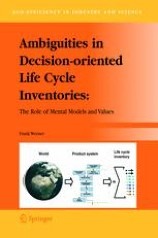
Ambiguities in Decision-oriented Life Cycle Inventories: The Role of Mental Models and Values
Shows for the first time how mental models and values influence this attribution in the life cycle inventory step of LCA. One of the key findings is that the different management rules for a sustainable use of materials must be taken into account for the attribution of material and energy flows to a product. Otherwise, improvement options recommended by an LCA might turn out to even worsen the environmental situation if reassessed from a meta-perspective. As a consequence of this book, the claim of unambiguitiy (‘objectivity’) of the life cycle inventory must be abandoned. A group-model building process for LCA is developed that allows one to grasp the decision makers' mental models and values in the inventory analysis on a case- and situation-specific basis. Only by this, LCA results will become relevant in a decision-making process. Two case studies on the modelling of recycling and other end-of-life options of aluminium windows and beech wood railway sleepers in LCA complement the methodological part.

Advances in the toxicity of construction and building materials
Presents the potential and toxic effects of building materials on human health, along with tactics on how to minimize exposure. Chapters are divided into four sections covering the toxicity of indoor environments, fire toxicity, radioactive materials, and toxicity from plastics, metals, asbestos, nanoparticles and construction wastes. Key chapters focus on the reduction of chemical emissions in houses with eco-labelled building materials and potential risks posed by indoor pollutants that may include volatile organic compounds (VOC), formaldehyde, semi-volatile organic compounds (SVOC), radon, NOx, asbestos and nanoparticles.
Advanced bioceramics : Properties, processing, and applications
Offers a comprehensive view of properties and processing of bioceramics. Highlights applications in dentistry, orthopaedic and maxillofacial implants, and regenerative and tissue engineering. Covers ISO/ASTM specifications such as processing, clinical applications, recycling/reuse and disposal standards.
