



الصفحة 2
الصفحة 2

Mobile Information Systems II ; IFIP Working Conference on Mobile Information Systems, MOBIS 2005, Leeds, UK, December 6-7, 2005
Contains the proceedings of the second IFIP TC8 Working Conference on Mobile Information Systems which was held in December 2005 in Leeds, UK and sponsored by the International Federation of Information Processing (IFIP). Mobile Information Systems II aims to: · Clarify differences and similarities between the development of mobile and more traditional information systems. · Investigate the organizational impact of mobile information systems. · Investigate the 'e to m shift' , for example in m-Commerce relative to e-Commerce. · Investigate mobile commerce applications combined with the advantages of mobile communications technologies, the drivers of which have been identified as ubiquity, accessibility, security, convenience, localization, instant connectivity, and personalization. · Evaluate existing and newly developed approaches for the analysis, design, implementation, and evolution of mobile information systems. · Investigate technical issues and the constraints they impose on mobile information systems functionalities and design.

Mobile health technologies for ambient assisted living and healthcare
The use of telemedicine and mobile devices is growing, and sensors might aid in creating creative solutions. Developing these solutions is crucial for monitoring senior citizens, lifestyles, and medical procedures. The development of assistive technology for various users to follow sports and other activities is strongly tied to this study area. Data protection is crucial, and the development of these solutions for medical uses should be verified. The security and privacy of the information may be tied to other recognized research projects for their acceptability. ICT research has considerably improved quality of life and has fully assimilated all citizens into society through medical rehabilitation and assistive technology. The technologies and research fields that influence medical informatics include databases, networking, graphical user interfaces, data mining, machine learning, intelligent decision support systems, and specialized programming languages.
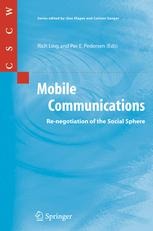
Mobile Communications : Re-negotiation of the Social Sphere
Mobile Communications: Renegotiation of the Social Sphere surveys some of the broader issues associated with the adoption and use of mobile communication, and explores developing areas of inquiry. Mobile communications are looked at in the context of other types of mediated interaction (e-mail, instant messaging, Wi-Fi, landline telephone etc.), thus demonstrating the uniqueness of this form of communication and how it is influencing the renegotiation of the social sphere. A truly international set of contributors consider how mobile communication has impacted on society and reflect on how it is used (and sometimes resented) in various public and private spaces. They provide an in-depth analysis of specific areas which complement our understanding of the phenomena including: • The psychological dimensions of mobile communication (addiction, proclivity to be disturbed by others use of the mobile phone), • The linguistics of mobile communication, and • The understanding of mobile communication’s commercialisation. This book will be a valuable addition to any researcher’s or professional’s reading material in the area of interaction of technology and society, providing the reader with a broad insight and specific knowledge of how mobile communication is reformulating the social sphere.

Mobile and Wireless Network Security and Privacy
Mobile and Wireless Network Security and Privacy analyzes important security and privacy problems in the realms of wireless networks and mobile computing. The material includes a report to the National Science Foundation of the United States which will be used by program managers for the foundation in setting priorities for research directions in this area. In the following chapters field experts expand upon the report and provide further information about important research directions in the fields of wireless networks and mobile computing. The chapters are written by the leading international researchers and professionals in thes fields. Each chapter represents state-of-the-art research and includes several influential contributions. A multitude of valuable discussions on relevant concepts, such as the various approaches that define emerging security and privacy in mobile and wireless environment, are featured.
Mobile Ad-Hoc and sensor networks ; 3rd International Conference, MSN 2007 Beijing, China, December 12-14, 2007 Proceedings
This book constitutes the refereed proceedings of the Third International Conference on Mobile Ad-hoc and Sensor Networks, MSN 2007, held in Beijing, China, in December 2007.
Middleware 2005 ; ACM/IFIP/USENIX 6th International Middleware Conference, Grenoble, France, November 28 - December 2, 2005, Proceedings
Today, middleware is a key part of almost any application. Gone are the days when middleware was only used in the IT industry for high-end applications. Rather than middleware being part of the IT world, today IT applications r- resent only one aspect of middleware. With the increase in distribution, network capacity, and widespread deployment of computing devices (in homes, auto- biles, mobile phones, etc.), middleware has surpassed the importance of operating systems as the platform where application development and deployment take place. This makes middleware very exciting as a research area but also a very challenging one since it encompasses many different concepts and techniques from a wide varietyof ?elds: networking, distributed systems, softwareengine- ing, performance analysis, computer architecture, and data management. Middleware 2005 in Grenoble, France, was the 6th edition of an increasingly successfulconference.The scope of the conference has been slowly widening with every edition to accommodate new ?elds and applications.

Microfinance Investment Funds : leveraging private capital for economic growth and poverty reduction
The surge in new investment funds - nearly 60 funds at last count - is an exciting sign that microfinance is attracting mainstream financial markets. Foreign investors bridge a crucial gap for MFIs and greenfield banks not yet able to attract deposits, debt or equity from local sources. Recognizing the ultimate goal of building those local financial markets that serve the poor, some foreign investors and funds are facilitating local intermediation with incentives like guarantees for local banks to lend to MFIs in local currency. Such contributions to local market building, combined with strengthening governance, increasing transparency and rigor make the new funds potentially very positive forces in microfinance.

Medical Law and Moral Rights
Medical Law and Moral Rights discusses live issue arising in modern medical practice. Do patients undergoing intolerable irremediable suffering have a moral right to physician-assisted suicide? Ought they to have a comparable legal right? Do the moral duties of a mother to care for and not abuse her child also apply to her fetus? Ought physicians to be permitted to refuse to provide medically futile treatment demanded by their patients? The author then advocates improvements in the law to make it respect our moral rights more fully. To justify his conclusions, he proposes original conceptions of the human rights to life, procreational autonomy, privacy, equitable treatment and personal security.

Measuring the Value of Culture : Methods and Examples in Cultural Economics
Acknowledgement of the value of culture and cultural goods is increasing world-wide. So too is interest in finding methods to quantify this value so that governments and private sponsors can make efficient funding decisions. "Measuring the Value of Culture" documents methods that can be used to put a price on the arts and cultural goods, including theatre, heritage, cultural events (like arts festivals), museums, archaeological sites and libraries. The methods discussed include economic impact studies, which use market data, as well as non-market valuation techniques, like willingness to pay studies, and the newer choice experiments. In addition, advances in more qualitative valuation methods are considered.

Measure and analyze the internal factors affecting the marketability of the private banks services
Aims to define the influencing factors of net interest margin in Syria banking sector. Within this scope, the effects of six internal explanatory variables on net interest margin were analyzed. Moreover, annual data for the period between 2017 and 2021 was used in this study...

Investing in Private Equity Partnerships : The Role of Monitoring and Reporting
Private equity has become an important asset class for institutional investors. As the asset class grows and investors get more experienced, the debate concerning transparency and governance of private equity funds has intensified. Fund investors demand more disclosure from private equity fund managers. Are these calls justified? What information do fund investors need? How can private equity fund investors manage their exposure to the asset class effectively? Kay Müller presents an in-depth analysis into the monitoring activities of institutional investors and explores their information requirements by interviewing leading European private equity fund investors. He contrasts these results with the actual reporting by fund managers and reveals essential information gaps based on a disclosure study of private equity fund reports. Since effective and open communication supports long-lasting and trusted partnerships, these findings provide important guidance on how to improve the relationships between investors and fund managers in the private equity industry.

Intrusion and Malware Detection and Vulnerability Assessment 2nd International Conference, DIMVA 2005, Vienna, Austria, July 7-8, 2005, Proceedings
Represents an increase of approximately 25% compared with the n- ber of submissions last year. All submissions were carefully reviewed by at least three Program Committee members or external experts according to the cri- ria of scienti?c novelty, importance to the ?eld, and technical quality. The ?nal selection took place at a meeting held on March 18, 2005, in Zurich, Switz- land. Fourteen full papers were selected for presentation and publication in the conference proceedings. In addition, three papers were selected for presentation in the industry track of the conference. The program featured both theoretical and practical research results, which were grouped into six sessions. Philip Att?eld from the Northwest Security Institute gave the opening keynote speech. The slides presented by the authors are available on the DIMVA 2005 Web site at http://www.dimva.org/dimva2005 We sincerely thank all those who submitted papers as well as the Program Committee members and the external reviewers for their valuable contributions.

Internet of things. information processing in an increasingly connected world ; First IFIP International Cross-Domain Conference, IFIPIoT 2018, Held at the 24th IFIP World Computer Congress, WCC 2018, Poznan, Poland, September 18-19, 2018, Revised Selected Papers
This book cover a wide range of topics from a technology to a business perspective and include among others hardware, software and management aspects, process innovation, privacy, power consumption, architecture, applications.

Internet of things, artificial intelligence and blockchain technology
Explores the concepts and techniques of IoT, AI, and blockchain. Also discussed is the possibility of applying blockchain for providing security in various domains. The specific highlight of this book is focused on the application of integrated technologies in enhancing data models, better insights and discovery, intelligent predictions, smarter finance, smart retail, global verification, transparent governance, and innovative audit systems. Explains how blockchain can significantly increase data privacy and security while boosting accuracy and integrity in IoT generated data and AI processed information; Gives insight into blockchain’s numerous potential applications, starting with recent technologies that give users control over sharing and privacy; Shows readers how to employ blockchain in IoT and AI, helping them to understand what they can and cannot do with blockchain.

International Migration, Social Demotion, and Imagined Advancement : An Ethnography of Socioglobal Mobility
this book proposes viewing contemporary migration as socioglobal mobility. Revolving around an ethnographic study of the Albanian "emigration" in Greece, International Migration, Social Demotion, and Imagined Advancement finds that imaginaries of the world as a social hierarchy might lie at the roots of much of the contemporary international migration. As would-be emigrants perceive different countries in terms of distinct social stations in a global order, they resolve to put up with numerous social and material deprivations in the hope of advancing internationally. Immigrants are typically thought of as aliens in their de facto home societies, however, and that makes genuine advancement all but impossible.

International Humanitarian Law Facing New Challenges ; Symposium in Honour of KNUT IPSEN
Recent armed conflicts, whether international or non-international in character, are in many respects characterized by a variety of asymmetries. These asymmetries may be overstressed, sometime even abused, and ultimately virtually meaningless. In order to discuss these and other questions a most distinguished group of experts in the field of the law of armed conflicts gathered in Berlin in June 2005. The goal of that colloquium, which marked the 70th birthday of Knut Ipsen, was to find operable solutions for problems and challenges the contemporary law of armed conflict is confronted with.

International humanitarian law and non-state actors : Debates, law and practice
challenges the traditional approach to international law by concentrating on international humanitarian law and placing the focus beyond States: it reflects on current legal, policy and practical issues that concern non-State actors in and around situations of armed conflict.The contributions that comprise this volume are oriented towards a broad readership audience in the academic and professional fields related to international humanitarian law, international criminal law, international human rights law and general public international law.

International Documents on Environmental Liability
This book in the field of international environmental liability into an easily accessible, practical handbook; details the work of the International Law Commission on this topic; and provides the latest versions of international liability conventions and their statuses

International Actors and the Formation of Laws
This book addresses the discourse that creates, modifies, and reshapes the law, as well as discourse participants. The book focuses on the actors operating in legal regimes and their subtly, bluntly, or even outright aggressive impact on the formation of laws. As the book examines the intersection of domestic, European, international, and even transnational, legal regimes where new law emerges as a product of this discourse, it contributes to the understanding of the mobility of law and contemporary law’s interactive nature. This book provides enlightening examples of diverse legal fields influenced by international, non-domestic actors. It covers a wide range of relevant topics, from financial sanctions to the rights of indigenous peoples, and addresses actors ranging from the European Union and the European Court of Human Rights to disability organizations. By exploring actors, the book stresses their objectives and driving forces behind their efforts to influence law. The book reveals an array of diverging methods used by international actors to influence law. Additionally, the book resonates with Nordic legal tradition and highlights Nordic commitment to rule of law and equality.

Intelligent Techniques for Web Personalization ; IJCAI 2003 Workshop, ITWP 2003, Acapulco, Mexico, August 11, 2003, Revised Selected Papers
Web personalizationcan be de?ned as any set of actions that can tailor the Web experience to a particular user or set of users. The experience can be something as casualas browsinga Web site oras (economically)signi?cantas tradingstock or purchasing a car. The actions can range from simply making the presentation more pleasing to anticipating the needs of a user and providing customized and relevant information. To achieve e?ective personalization, organizations must rely on all available data, including the usage and click-stream data (re?e- ing user behavior), the site content, the site structure, domain knowledge, user demographics and pro?les. In addition, e?cient and intelligent techniques are needed to mine these data for actionable knowledge, and to e?ectively use the discovered ...
