



الصفحة 2
الصفحة 2

How to photograph the moon and planets with your Digital camera
Using just a regular digital camera along with an amateur astronomical telescope, anyone can produce spectacular photographs of the Moon, as well as surprisingly good images of major planets.Purpose-made astronomical CCD cameras are still very expensive, but technology has now progressed so that digital cameras – the kind you use for everyday photos – are more than capable of being used for astronomy. Tony Buick has written this illustrated step-by-step manual for anyone who has a telescope (of any size) and a digital camera. Look inside at the beautiful color images he has produced – you could do the same.

Hot house : Global climate change and the human condition
Global warming is extremely complex because it deals with so many different characteristics of the Earth and their complex interactions. It is addressed by almost all sciences including many aspects of geosciences, atmospheric, the biological sciences, and even astronomy. It has recently become the concern of other diverse disciplines such as economics, agriculture, demographics and population statistics, medicine, engineering, and political science. This book attempts to address these complex interactions, integrate them, and derive meaningful conclusions and possible solutions.

High-Pressure Shock Compression of Solids VIII : The Science and Technology of High-Velocity Impact
Research in the field of shock physics and ballistic impact has always been intimately tied to progress in development of facilities for accelerating projectiles to high velocity and instrumentation for recording impact phenomena. The chapters of this book, written by leading US and European experts, cover a broad range of topics and address researchers concerned with questions of material behaviour under impulsive loading and the equations of state of matter, as well as the design of suitable instrumentation such as gas guns and high-speed diagnostics. Applications include high-speed impact dynamics, the inner composition of planets, syntheses of new materials and materials processing. Among the more technologically-oriented applications treated is the testing of the flight characteristics of aeroballistic models and the assessment of impacts in the aerospace industry.

High Resolution Infrared Spectroscopy in Astronomy ; Proceedings of an ESO Workshop Held at Garching, Germany, 18-21 November 2003
Two specialized new instruments for ESO's VLT, VISIR and CRIRES, spawned the idea for this workshop. CRIRES is a dedicated very high resolution infrared spectrograph; VISIR features a high resolution spectroscopic mode. Together, the instruments combine the sensitivity of an 8m-telescope with the now well-established reliability of VLT-facility instruments. High resolution here means that lines in cool stellar atmospheres and HII-regions can be resolved. The astrophysical topics discussed in this rather specialized workshop range from the inner solar system to active galactic nuclei. There are many possibilities for new discoveries with these instruments, but the unique capability, which becomes available through high-resolution infrared spectroscopy, is the observation of molecular rotational-vibrational transitions in many astrophysical environments. Particularly interesting and surprising in this context, many papers on modeling and laboratory spectroscopy at the workshop appear to indicate that astronomical observations are lagging a bit behind in this field. The papers are an interesting mix of reports from existing high resolution facilities, reports on modeling efforts of synthetic spectra and reports on laboratory spectra. In this sense, a fruitful exchange between molecular physics and astronomy was again accomplished and is documented in this volume.

Health of People, Health of Planet and Our Responsibility : Climate Change, Air Pollution and Health
This book not only describes the challenges of climate disruption, but also presents solutions. The challenges described include air pollution, climate change, extreme weather, and related health impacts that range from heat stress, vector-borne diseases, food and water insecurity and chronic diseases to malnutrition and mental well-being.

Healing with the Herbs of Life : Hundreds of Herbal Remedies, Therapies, and Preparations
Offers clear and concise explanations of how and why herbs heal. It also provides step-by-step instructions for creating your own herbal remedies, therapeutic approaches you can use at home, and easy-to-follow guidelines for gathering, preparing, purchasing, and storing herbs. Previously published as The Herbs of Life, this completely revised and updated edition synthesizes the great herbal traditions of China and India with Western herbology to form a new kind of planetary herbal. - Features a new chapter on treating specific conditions, expanded chapters in Materia Medica and the energy of food, and revised chapters on living with the seasons and home therapies - With new information on herbal safety and drug/herb interactions. - The previous edition, The Herbs of Life, sold 45,000 copies.

Handbook of Solar-Terrestrial Environment
Recognized international leaders in their field contribute basic topics of solar physics, space plasmas and the Earth's magnetosphere. The book further covers applied topics like the aurora, magnetospheric storms, space weather, space climatology and planetary science.

Guide to Observing Deep-Sky Objects : A Complete Global Resource for Astronomers
Guide to Observing Deep-Sky Objects is an invaluable reference for all amateur astronomers. The book contains, for each constellation, (1) a star chart showing the Bayer labels, (2) a table for many of the stars in the constellation, along with their positions and magnitudes, and (3) a table of the major deep-sky objects in the constellation, with relevant observational data. Facing pages provide unique year-long graphs that show when the constellation is visible in the sky, which allows the user to quickly determine whether a given constellation can be seen, and when the best time to see it will be.

Green new deal landscapes : Architectural design
Explores the principles behind the Green New Deal and how they apply to the architectural and landscape professions. Whatever form the Green New Deal will take and is taking, it will be materialised through infrastructure, buildings, landscapes and various other constructed forms. The contributors to this AD examine the theoretical frameworks and design practices within which the protocols of the Green New Deal could be integrated. Initially, such a goal requires a survey of the available design tools and methodologies necessary to achieve a transition to a decarbonised economy in an equitable manner. The articles feature design practices who are transforming their existing modes of operation to work in environments were fossil fuels are kept well below ground, and to explore renewable forms of local, regional and planetary urbanisation.

Gravity, Geoid and Space Missions ; GGSM 2004. IAG International Symposium. Porto, Portugal. August 30 - September 3, 2004
GGSM2004 aimed to bring together scientists from different areas in the geosciences, working with gravity and geoid related problems, both from the theoretical and practical points of view. Topics of interest included the integration of heterogeneous data and contributions from satellite and airborne techniques to the study of the spatial and temporal variations of the gravity field. In addition to the special focus on the CHAMP, GRACE, and GOCE satellite missions, attention was also directed toward projects addressing topographic and ice field mapping using SAR, LIDAR, and laser altimetry, as well as missions and studies related to planetary geodesy.

Gravitational Lensing : Strong, Weak and Micro : Saas-Fee Advanced Course 33
The up-to-date contributions in this book are based on the lecture notes of the 33rd Saas–Fee Advanced Course of the Swiss Society of Astronomy and Astrophysics, entitled Gravitational Lensing: Strong, Weak, and Micro. The book comprises four complementary parts, written by leading experts in the field, constituting a genuine textbook about gravitational lensing: • Peter Schneider – Part 1: Introduction to Gravitational Lensing and Cosmology • Christopher Kochanek – Part 2: Strong Gravitational Lensing • Peter Schneider – Part 3: Weak Gravitational Lensing • Joachim Wambsganss – Part 4: Gravitational Microlensing

Global Climatology and Ecodynamics : Anthropogenic Changes to Planet Earth
The purpose of the book is to summarize existing information and assess the level of these uncertainties. We want to stimulate readers to think in the longer term about climate change and ecological damage that is being done to the planet Earth in the hope that it may remain fit for human habitation and a satisfying life style for future generations, not just the next generation or two.

Global Changes : Ethics, Politics and Environment in the Contemporary Technological World
offers an authoritative analysis of the challenges that have arisen as a result of modern technologies. It covers several environmental problems, such as climate change, overexploitation of natural resources, loss of natural habitats, pollution and human population growth, and discusses practical scenarios for sustainable human dwelling of our planet. Adopting an interdisciplinary approach, the first part introduces “global changes”, describing how they are happening in reality, and the challenges arising from them. The second part introduces methodological approaches borrowed from various disciplines, such as engineering, management science, philosophy and theology, which can help deal with the contemporary challenges resulting from global changes.

Global Change and the Earth System : A Planet Under Pressure
The interactions between environmental change and human societies have a long, complex history spanning many millennia, but these have changed fundamentally in the last century. Human activities are now so pervasive and profound that they are altering the Earth in ways which threaten the very life support system upon which humans depend. This book describes what is known about the Earth System and the impact of changes caused by humans. It considers the consequences of these changes with respect to the stability of the Earth System and the well-being of humankind; as well as exploring future paths towards Earth System science in support of global sustainability.
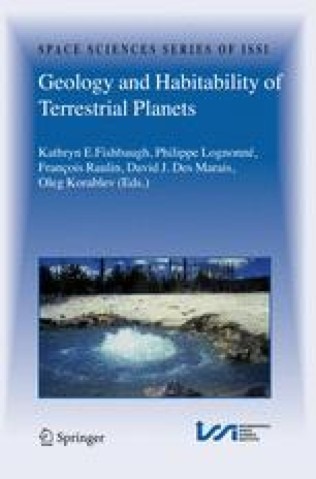
Geology and Habitability of Terrestrial Planets
This book has resulted from a workshop at the International Space Science Institute (ISSI) in Bern, Switzerland (5-9 September 2005) that brought together planetary geologists, geophysicists, atmospheric scientists, and biologists to discuss the multi-faceted problem of how the habitability of a planet co-evolves with the geology of the surface and interior, the atmosphere, and the magnetosphere.

Future Satellite Gravimetry and Earth Dynamics
Currently, a first generation of dedicated satellite missions for the precise mapping of the Earth’s gravity field is in orbit (CHAMP, GRACE, and soon GOCE). The gravity data from these satellite missions provide us with very new information on the dynamics of planet Earth. In particular, on the mass distribution in the Earth’s interior, the entire water cycle (ocean circulation, ice mass balance, continental water masses, and atmosphere), and on changes in the mass distribution. The results are fascinating, but still rough with respect to spatial and temporal resolution. Technical progress in satellite-to-satellite tracking and in gravity gradiometry will allow more detailed results in the future. In this special issue, Earth scientists develop visions of future applications based on follow-on high-precision satellite gravimetry missions.

Fundamentals of Space Medicine
Topics discussed in this book include: adaptation of sensory-motor, cardio-vascular, bone, and muscle systems to the microgravity of spaceflight; psychological and sociological issues of living in a confined, isolated, and stressful environment; operational space medicine, such as crew selection, training and in-flight health monitoring, countermeasures and support; results of space biology experiments on individual cells, plants, and animal models; and the impact of long-duration missions such as the human mission to Mars. The author also provides a detailed description of how to fly a space experiment, based on his own experience with research projects conducted onboard Salyut-7, Mir, Spacelab, and the Space Shuttle. Now is the time to look at the future of human spaceflight and what comes next. The future human exploration of Mars captures the imagination of both the public and the scientific community. Many physiological, psychological, operational, and scientific issues need to be solved before the first crew can explore the enigmatic Red Planet. This book also identifies the showstoppers that can be foreseen and what we need to learn to fully understand the implications and risks of such a mission.

Fundamental astronomy
Fundamental Astronomy gives a well-balanced and comprehensive introduction to the topics of classical and modern astronomy. While emphasizing both the astronomical concepts and the underlying physical principles, the text provides a sound basis for more profound studies in the astronomical sciences.
From Suns to Life: : A Chronological Approach to the History of Life on Earth
This review emerged from several interdisciplinary meetings and schools gathering a group of astronomers, geologists, biologists, and chemists, attempting to share their specialized knowledge around a common question: how did life emerge on Earth? Their ultimate goal was to provide some kind of answer as a prerequisite to an even more demanding question: is life universal? The main chapters of this review present the formation and evolution of the solar system (3); the building of a habitable planet (4); prebiotic chemistry, biochemistry, and the emergence of life (5); the environmental context of the early Earth (6); and the ancient fossil record and early evolution (7). The concluding chapter (9) provides the highlights of the review and presents the different points of view about the universality of life. Two pedagogical chapters are included; one on chronometers (2), another in the form of a "frieze" (8) which summarizes in graphical form the present state of knowledge about the chronology of the emergence of life on Earth, before the Cambrian explosion.

From Fossils to Astrobiology : Records of Life on Earth and Search for Extraterrestrial Biosignatures
From Fossils to Astrobiology reviews developments in paleontology and geobiology that relate to the rapidly-developing field of Astrobiology, the study of life in the Universe. Many traditional areas of scientific study, including astronomy, chemistry and planetary science, contribute to Astrobiology, but the study of the record of life on planet Earth is critical in guiding investigations in the rest of the cosmos. In this varied book, expert scientists from 15 countries present peer-reviewed, stimulating reviews of paleontological and astrobiological studies. The overviews of established and emerging techniques for studying modern and ancient microorganisms on Earth and beyond, will be valuable guides to evaluating biosignatures which could be found in the extraterrestrial surface or subsurface within the Solar System and beyond.
