



الصفحة 2
الصفحة 2

Foundations of software science and computation structures ; 25th International conference, FOSSACS 2022, Held as Part of the European joint conferences on theory and practice of software, ETAPS 2022, Munich, Germany, April 2–7, 2022, proceedings
This book constitutes the proceedings of the 25th International Conference on Foundations of Software Science and Computational Structures, FOSSACS 2022, which was held during April 4-6, 2022, in Munich, Germany, as part of the European Joint Conferences on Theory and Practice of Software, ETAPS 2022. They deal with research on theories and methods to support the analysis, integration, synthesis, transformation, and verification of programs and software systems.
Foundations of software science and computation structures ; 24th International conference, FOSSACS 2021, Held as Part of the European joint conferences on theory and practice of software, ETAPS 2021, Luxembourg City, Luxembourg, March 27 – April 1, 2021, proceedings
This book constitutes the proceedings of the 24th International Conference on Foundations of Software Science and Computational Structures, FOSSACS 2021, which was held during March 27 until April 1, 2021, as part of the European Joint Conferences on Theory and Practice of Software, ETAPS 2021. The conference was planned to take place in Luxembourg and changed to an online format due to the COVID-19 pandemic.

Foundations of software science and computation structures ; 23rd International conference, FOSSACS 2020, Held as part of the European joint conferences on theory and practice of software, ETAPS 2020, Dublin, Ireland, April 25–30, 2020, proceedings
This book constitutes the proceedings of the 23rd International Conference on Foundations of Software Science and Computational Structures, FOSSACS 2020, which took place in Dublin, Ireland, in April 2020, and was held as Part of the European Joint Conferences on Theory and Practice of Software, ETAPS 2020.

Foundations of software science and computation structures ; 22nd International conference, FOSSACS 2019, Held as part of the European joint conferences on theory and practice of software, ETAPS 2019, Prague, Czech Republic, April 6–11, 2019, proceedings
This book constitutes the proceedings of the 22nd International Conference on Foundations of Software Science and Computational Structures, FOSSACS 2019, which took place in Prague, Czech Republic, in April 2019, held as part of the European Joint Conference on Theory and Practice of Software, ETAPS 2019. The 29 papers presented in this volume were carefully reviewed and selected from 85 submissions. They deal with foundational research with a clear significance for software science.
Foundations of software science and computation structures ; 11th International conference, FOSSACS 2008, Held as part of the joint European conferences on theory and practice of software, ETAPS 2008, Budapest, Hungary, March 29 - April 6, 2008. proceedings
The fve main conferences received 571 submissions, 147 of which were accepted, giving an overall acceptance rate of less than 26%, with each conference below 27%.Congratulations there foretoall the authorswhomadeittothe fnalprogramme! I hope that most of the other authors will still have found a way of participating in this exciting event, and that you will all continue submitting to ETAPS and contributing to make of it the best conference in the area. The events that comprise ETAPS address various aspects of the system velopment process, including specifcation, design, implementation, analysis and improvement

Formal Methods and Software Engineering ; 10th International Conference on Formal Engineering Methods, ICFEM 2008, Kitakyushu-City, Japan, October 27-31, 2008. Proceedings
This book constitutes the refereed proceedings of the 10th International Conference on Formal Engineering Methods, ICFEM 2008, held in Kitakyushu-City, Japan, October 2008.The 20 revised full papers together with 3 invited talks presented were carefully reviewed and selected from 62 submissions. The papers address all current issues in formal methods and their applications in software engineering. They are organized in topical sections on specification and verification; testing; verification; model checking and analysis; tools; application of formal methods; semantics.
Formal Concept Analysis ; 6th International Conference, ICFCA 2008, Montreal, Canada, February 25-28, 2008. Proceedings
Formal Concept Analysis (FCA) is a mathematical theory of concepts and c- ceptual hierarchyleadingto methods for conceptually analyzing data and kno- edge. The theory itselfstronglyreliesonorder and lattice theory,whichhasbeen studied by mathematicians over decades. FCA proved itself highly relevant in several applications from the beginning , and, over the last years, the range of application shaskept growing. The mainreasonfor this comesfromthe fact that our modern society has turned into an “information” society. After years and years of using computers, companies realized they had stored gigantic amounts of data.

Fading Foundations : Probability and the Regress Problem
This book addresses the age-old problem of infinite regresses in epistemology. How can we ever come to know something if knowing requires having good reasons, and reasons can only be good if they are backed by good reasons in turn? The problem has puzzled philosophers ever since antiquity, giving rise to what is often called Agrippa's Trilemma. The current volume approaches the old problem in a provocative and thoroughly contemporary way. Taking seriously the idea that good reasons are typically probabilistic in character, it develops and defends a new solution that challenges venerable philosophical intuitions and explains why they were mistakenly held. Key to the new solution is the phenomenon of fading foundations, according to which distant reasons are less important than those that are nearby.

Ernst Zermelo : An approach to his life and work
This biography attempts to shed light on all facets of Zermelo's life and achievements. Personal and scientific aspects are kept separate as far as coherence allows, in order to enable the reader to follow the one or the other of these threads. The description of his personality owes much to conversations with his late wife Gertrud. The presentation of his work explores motivations, aims, acceptance, and influence. Selected proofs and information gleaned from unpublished notes and letters add to the analysis.

Discrete Mathematics Using a Computer
Discrete Mathematics Using a Computer offers a new, "hands-on" approach to teaching Discrete Mathematics. Using software that is freely available on Mac, PC and Unix platforms, the functional language Haskell allows students to experiment with mathematical notations and concepts -- a practical approach that provides students with instant feedback and allows lecturers to monitor progress easily.

Developments in Language Theory ; 12th International Conference, DLT 2008, Kyoto, Japan, September 16-19, 2008. Proceedings
This book constitutes the refereed proceedings of the 12th International Conference on Developments in Language Theory, DLT 2008, held in Kyoto, Japan, September 2008.

Deontic Logic in Computer Science ; 9th International Conference, DEON 2008, Luxembourg, Luxembourg, July 15-18, 2008. Proceedings
This volume presents the refereed proceedings of the 9th International Conference on Deontic Logic in Computer Science, DEON 2008, held in Luxembourg in July 2008.

Deduction, Computation, Experiment : Exploring the Effectiveness of Proof
What is a proof for? What is the characteristic use of a proof as a computation, as opposed to its use as an experiment? What is the relationship between mathematical procedures and natural processes? The essays collected in this volume address such questions from different points of view and will interest students and scholars in several branches of scientific knowledge. Some essays deal with the logical skeleton of deduction, others examine the interplay between natural systems and models of computation, yet others use significant results from the natural sciences to illustrate the character of procedures in applied mathematics. Focusing on relevant conceptual and logical issues underlying the overall quest for proving, the volume seeks to cast light on what the effectiveness of proof rests on.

Decision Procedures : An Algorithmic Point of View
Concentrates on decision procedures for first-order theories that are commonly used in automated verification and reasoning, theorem-proving, compiler optimization and operations research.

Constraint handling rules : Current research topics
The Constraint Handling Rules (CHR) language is a declarative concurrent committed-choice constraint logic programming language consisting of guarded rules that transform multisets of relations called constraints until no more change occurs. The aim of this volume was to attract high-quality research papers on these recent advances in Constraint Handling Rules.
Concurrency, Graphs and Models : Essays Dedicated to Ugo Montanari on the Occasion of His 65th Birthday
The volume consists of seven sections, six of which are dedicated to the main research areas to which Ugo Montanari has contributed: Graph Transformation; Constraint and Logic Programming; Software Engineering; Concurrency; Models of Computation; and Software Verification.

Conceptual Structures : Knowledge Visualization and Reasoning; 16th International Conference on Conceptual Structures, ICCS 2008 Toulouse, France, July 7-11, 2008 Proceedings
This book constitutes the refereed proceedings of the 16th International Conference on Conceptual Structures, ICCS 2008, held in Toulouse, France, in July 2008.
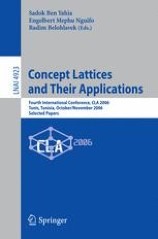
Concept Lattices and Their Applications ; Fourth International Conference, CLA 2006 Tunis, Tunisia, October 30-November 1, 2006 Selected Papers
This book constitutes the refereed proceedings of the Fourth International Conference on Concept Lattices and their Applications, CLA 2006, held in Tunis, Tunisia, October 30-November 1, 2006.

Computer science logic ; Vol. 4207 ; 20th International Workshop, CSL 2006, 15th Annual Conference of the EACSL, Szeged, Hungary, September 25-29, 2006, Proceedings
Coverage includes automated deduction and interactive theorem proving, constructive mathematics and type theory, equational logic and term rewriting, automata and formal logics, modal and temporal logic, model checking, finite model theory, and more.

Computer Science Logic ; Vol. 3634
This book constitutes the refereed proceedings of the 19th International Workshop on Computer Science Logic, CSL 2005, held as the 14th Annual Conference of the EACSL in Oxford, UK in August 2005. The 33 revised full papers presented together with 4 invited contributions were carefully reviewed and selected from 108 papers submitted. All current aspects of logic in computer science are addressed ranging from mathematical logic and logical foundations to methodological issues and applications of logics in various computing contexts. The volume is organized in topical sections on semantics and logics, type theory and lambda calculus, linear logic and ludics, constraints, finite models, decidability and complexity, verification and model checking, constructive reasoning and computational mathematics, and implicit computational complexity and rewriting.
