



الصفحة 2
الصفحة 2

Fractal Geometry, Complex Dimensions and Zeta Functions : Geometry and Spectra of Fractal Strings
Number theory, spectral geometry, and fractal geometry are interlinked in this in-depth study of the vibrations of fractal strings, that is, one-dimensional drums with fractal boundary. Key Features The Riemann hypothesis is given a natural geometric reformulation in the context of vibrating fractal strings Complex dimensions of a fractal string, defined as the poles of an associated zeta function, are studied in detail, then used to understand the oscillations intrinsic to the corresponding fractal geometries and frequency spectra Explicit formulas are extended to apply to the geometric, spectral, and dynamical zeta functions associated with a fractal Examples of such explicit formulas include a Prime Orbit Theorem with error term for self-similar flows, and a geometric tube formula The method of Diophantine approximation is used to study self-similar strings and flows Analytical and geometric methods are used to obtain new results about the vertical distribution of zeros of number-theoretic and other zeta functions Throughout new results are examined. The final chapter gives a new definition of fractality as the presence of nonreal complex dimensions with positive real parts, and discusses several open problems and extensions.
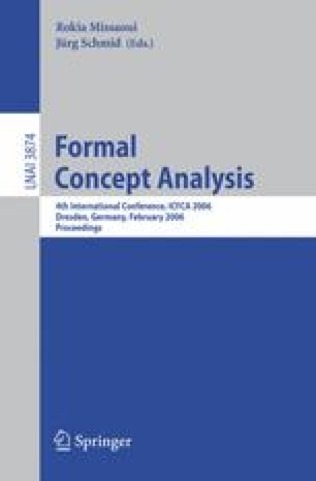
Formal concept analysis ; Vol. 3874 ; 4th International Conference, ICFCA 2006, Dresden, Germany, Feburary 13-17, 2006, Proceedings
This book constitutes the refereed proceedings of the 4th International Conference on Formal Concept Analysis, held in February 2006. The 17 revised full papers presented together with four invited papers were carefully reviewed and selected for inclusion in the book. The papers show advances in applied lattice and order theory and in particular scientific advances related to formal concept analysis and its practical applications: data and knowledge processing including data visualization, information retrieval, machine learning, data analysis and knowledge management.

Formal concept analysis ; Vol. 3403 ; 3rd International Conference, ICFCA 2005, Lens, France, February 14-18, 2005, Proceedings
This book constitutes a comprehensive and systematic presentation of the state of the art of formal concept analysis and its applications. The first part of the book is devoted to foundational and methodological topics. The contributions in the second part demonstrate how formal concept analysis is successfully used outside of mathematics, in linguistics, text retrieval, association rule mining, data analysis, and economics. The third part presents applications in software engineering.
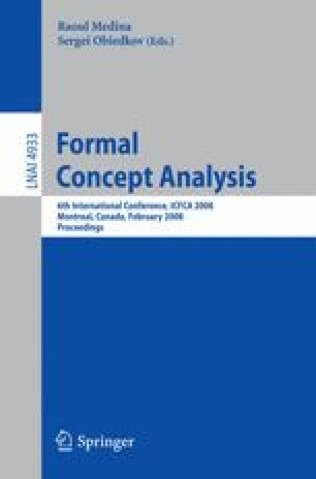
Formal Concept Analysis ; 6th International Conference, ICFCA 2008, Montreal, Canada, February 25-28, 2008. Proceedings
Formal Concept Analysis (FCA) is a mathematical theory of concepts and c- ceptual hierarchyleadingto methods for conceptually analyzing data and kno- edge. The theory itselfstronglyreliesonorder and lattice theory,whichhasbeen studied by mathematicians over decades. FCA proved itself highly relevant in several applications from the beginning , and, over the last years, the range of application shaskept growing. The mainreasonfor this comesfromthe fact that our modern society has turned into an “information” society. After years and years of using computers, companies realized they had stored gigantic amounts of data.

Formal Concept Analysis ; 5th International Conference, ICFCA 2007, Clermont-Ferrand, France, February 12-16, 2007, Proceedings
This book constitutes the refereed proceedings of the 5th International Conference on Formal Concept Analysis, ICFCA 2007. The papers comprise state of the art research from foundational to applied lattice theory and related fields, all of which involve methods and techniques of formal concept analysis such as data visualization, information retrieval, machine learning, data analysis and knowledge management.

Flowing Matter
This book presents an introduction to selected research topics in the broad field of flowing matter, including the dynamics of fluids with a complex internal structure -from nematic fluids to soft glasses- as well as active matter and turbulent phenomena. Flowing matter is a subject at the crossroads between physics, mathematics, chemistry, engineering, biology and earth sciences, and relies on a multidisciplinary approach to describe the emergence of the macroscopic behaviours in a system from the coordinated dynamics of its microscopic constituents. Depending on the microscopic interactions, an assembly of molecules or of mesoscopic particles can flow like a simple Newtonian fluid, deform elastically like a solid or behave in a complex manner. When the internal constituents are active, as for biological entities, one generally observes complex large-scale collective motions. Phenomenology is further complicated by the invariable tendency of fluids to display chaos at the large scales or when stirred strongly enough. This volume presents several research topics that address these phenomena encompassing the traditional micro-, meso-, and macro-scales descriptions, and contributes to our understanding of the fundamentals of flowing matter.

Error-Correcting Linear Codes : Classification by Isometry and Applications
This text offers a thorough introduction to the mathematical concepts behind the theory of error-correcting linear codes. Care is taken to introduce the necessary algebraic concepts, for instance the theory of finite fields, the polynomial rings over such fields and the ubiquitous concept of group actions that allows the classification of codes by isometry. The book provides in-depth coverage of important topics like cyclic codes and the coding theory used in compact disc players. The final four chapters cover advanced and algorithmic topics like the classification of linear codes by isometry, the enumeration of isometry classes, random generation of codes, the use of lattice basis reduction to compute minimum distances, the explicit construction of codes with given parameters, as well as the systematic evaluation of representatives of all isometry classes of codes.

Ensembles ordonnés finis : concepts, résultats et usages = Finite ordered sets : concepts, results and uses
The concepts of order, classification, storage are presented in many activities and human situations. The mathematical formalization of these notions first allowed the great development of the theory of lattices, then that of more general ordered structures, in particular those relating to discrete mathematics.

Emergent Nonlinear Phenomena in Bose-Einstein Condensates : Theory and Experiment
This book, written by experts in the fields of atomic physics and nonlinear science, consists of reviews of the current state of the art at the interface of these fields, as is exemplified by the modern theme of Bose-Einstein condensates. Topics covered include bright, dark, gap and multidimensional solitons; vortices; vortex lattices; optical lattices; multicomponent condensates; manipulation of condensates; mathematical methods/rigorous results; and aspects beyond the mean field approach. A distinguishing feature of the contents is the detailed incorporation of both the experimental and theoretical viewpoints through subsections of the relevant chapters.

Dynamics of Coupled Map Lattices and of Related Spatially Extended Systems
This book is about the dynamics of coupled map lattices (CML) and of related spatially extended systems. It will be useful to post-graduate students and researchers seeking an overview of the state-of-the-art and of open problems in this area of nonlinear dynamics. The special feature of this book is that it describes the (mathematical) theory of CML and some related systems and their phenomenology, with some examples of CML modeling of concrete systems (from physics and biology). More precisely, the book deals with statistical properties of (weakly) coupled chaotic maps, geometric aspects of (chaotic) CML, monotonic spatially extended systems, and dynamical models of specific biological systems.

Discrete Geometry, Combinatorics and Graph Theory ; 7th China-Japan Conference, CJCDGCGT 2005, Tianjin, China, November 18-20, 2005, and Xi'an, China, November 22-24, 2005, Revised Selected Papers
Theis book includes discrete algorithmic geometry, combinatorics and graph theory

Discrete and computational geometry; Japanese Conference, JCDCG 2004, Tokyo, Japan, October 8-11, 2004
This book constitutes the thoroughly refereed post-proceedings of the Japanese Conference on Discrete Computational Geometry, JCDCG 2004, held in Tokyo, Japan in October 2004, to honor Janos Pach on his fiftieth year. The 20 revised full papers presented were carefully selected during two rounds of reviewing and improvement from over 60 talks at the conference. All current issues in discrete algorithmic geometry are addressed.

Dilute III-V Nitride Semiconductors and Material Systems : Physics and Technology
A major current challenge for semiconductor devices is to develop materials for the next generation of optical communication systems and solar power conversion applications. Recently, extensive research has revealed that an introduction of only a few percentages of nitrogen into III-V semiconductor lattice leads to a dramatic reduction of the band gap. This discovery has opened the possibility of using these material systems for applications ranging from lasers to solar cells. Physics and Technology of Dilute III-V Nitride Semiconductors & Novel Dilute Nitride Material Systems reviews the current status of research and development in dilute III-V nitrides, with 24 chapters from prominent research groups covering recent progress in growth techniques, experimental characterization of band structure, defects carrier transport, transport properties, dynamic behavior of N atoms, device applications, modeling of device design, novel optoelectronic integrated circuits, and novel nitrogen containing III-V materials.

Cryptology and Network Security ; 19th International Conference, CANS 2020, Vienna, Austria, December 14–16, 2020, Proceedings
This book constitutes the refereed proceedings of the 19th International Conference on Cryptology and Network Security, CANS 2020, held in Vienna, Austria, in December 2020.* The 30 full papers were carefully reviewed and selected from 118 submissions. The papers focus on topics such as cybersecurity; credentials; elliptic curves; payment systems; privacy-enhancing tools; lightweight cryptography; and codes and lattices.

Cryptography and cryptanalysis in Java : Creating and programming advanced algorithms with Java SE 17 LTS and Jakarta EE 10
Includes challenging cryptographic solutions that are implemented in Java 17 and Jakarta EE 10. It provides a robust introduction to Java 17's new features and updates, a roadmap for Jakarta EE 10 security mechanisms, a unique presentation of the "hot points" (advantages and disadvantages) from the Java Cryptography Architecture (JCA), and more. You Will Learn : Develop programming skills for writing cryptography algorithms in Java / Dive into security schemes and modules using Java / Explore “good” vs “bad” cryptography based on processing execution times and reliability / Play with pseudo-random generators, hash functions, etc. / Leverage lattice-based cryptography methods, the NTRU framework library, and more

Convex and Discrete Geometry
Gives an overview of major results, methods and ideas of convex and discrete geometry and its applications. Besides being a graduate-level introduction to the field, it is a practical source of information and orientation for convex geometers.

Constructive Negations and Paraconsistency
This book presents the author’s recent investigations of the two main concepts of negation developed in the constructive logic: the negation as reduction to absurdity (L.E.J. Brouwer) and the strong negation (D. Nelson) are studied in the setting of paraconsistent logic. The paraconsistent logics are those, which admit inconsistent but non-trivial theories, i.e., the logics which allow making inferences in non-trivial fashion from an inconsistent set of hypotheses. The study is based on algebraic methods, demonstrates the remarkable regularity and the similarity of structures of both lattices of logics, and gives essential information on the paraconsistent nature of logics Lj and N4.The methods developed in this book can be applied for investigation of other classes of paraconsistent logics.
Concept Lattices and Their Applications ; Fourth International Conference, CLA 2006 Tunis, Tunisia, October 30-November 1, 2006 Selected Papers
This book constitutes the refereed proceedings of the Fourth International Conference on Concept Lattices and their Applications, CLA 2006, held in Tunis, Tunisia, October 30-November 1, 2006.

Computing the Continuous Discretely : Integer-Point Enumeration in Polyhedra
This textbook illuminates the field of discrete mathematics with examples, theory, and applications of the discrete volume of a polytope. The authors have weaved a unifying thread through basic yet deep ideas in discrete geometry, combinatorics, and number theory.

Computer Simulations of Liquid Crystals and Polymers ; Proceedings of the NATO Advanced Research Workshop on Computational Methods for Polymers and Liquid Crystalline Polymers, Erice, Italy. 16-22 July 2003
Liquid crystals, polymers and polymer liquid crystals are soft condensed matter systems of major technological and scientific interest. An understanding of the macroscopic properties of these complex systems and of their many and interesting peculiarities at the molecular level can nowadays only be attained using computer simulations and statistical mechanical theories. Both in the Liquid Crystal and Polymer fields a considerable amount of simulation work has been done in the last few years with various classes of models at different special resolutions, ranging from atomistic to molecular and coarse-grained lattice models. Each of the two fields has developed its own set of tools and specialized procedures and the book aims to provide a state of the art review of the computer simulation studies of polymers and liquid crystals. This is of great importance in view of a potential cross-fertilization between these connected areas which is particularly apparent for a number of experimental systems like, e.g. polymer liquid crystals and anisotropic gels where the different fields necessarily merge. An effort has been made to assess the possibilities of a coherent description of the themes that have developed independently, and to compare and extend the theoretical and computational techniques put forward in the different areas.
