



الصفحة 2
الصفحة 2

Fundamentals of clinical research : Bridging medicine, statistics and operations
The scope of clinical research is to evaluate the effect of a treatment on the evolution of a disease in the human species.The treatment can be pharmacological, surgical, psychological/behavioral or organizational/logistic. The disease, intended as an impairment of a state of well-being or a condition capable of provoking such impairment over time, can be universally accepted as such (e.g. a cancer or a bone fracture) or perceived as such only by limited groups of individuals in a given cultural context (e.g. hair loss or weight gain). The course of the disease that ones wishes to change can be the one with no intervention or, more frequently, the one observed with the available treatment. The evaluation of the effect of a treatment on the course of a disease is a lengthy process, which progresses in increasingly complex stages.

Formulas, ingredients and production of cosmetics technology of skin- and hair-care products in Japan
Provides the comprehensive knowledge and instruction necessary for researchers to design and create cosmetics products. The book’s chapters cover a comprehensive list of topics, which include, among others, the basics of cosmetics, such as the raw materials of cosmetics and their application; practical techniques and technologies for designing and manufacturing cosmetics, as well as theoretical knowledge; emulsification; sensory evaluations of cosmetic ingredients; and how to create products such as soap-based cleansers, shampoos, conditioners, creams, and others. The potential for innovation is great in Japan’s cosmetics industry. This book expresses the hope that the high level of dedicated research continues and proliferates, especially among those who are innovators at heart.

Evaluation of the use of medicine plants in cancer treatment
Turmeric (Curcuma longa) and ginger (Zingiber officinale) have been widely studied for their potential anticancer effects, primarily due to the bioactive compounds curcumin and gingerol. Both compounds exhibit significant therapeutic properties, including anti-inflammatory, antioxidant, pro-apoptotic, and anti-angiogenic activities, which target key pathways implicated in cancer progression, such as NF-κB, STAT-3, and mTOR. Through these mechanisms, curcumin and gingerol inhibit tumor growth, reduce metastasis, and enhance the efficacy of conventional cancer treatments.

Esthetic & restorative dentistry : Material selection & technique
Provides the most up-to-date information on enhanced developments, materials, and techniques that have emerged since the publication of the second edition, offering the reader a completely updated, revised, and newly illustrated overview of modern esthetic and restorative dentistry complete with tutorial videos. New topics include web-based communication with the laboratory, indirect composite chairside CAD/CAM restorations, a comparison of digital and conventional techniques, the resin composite injection technique, as well as updated information on composites and ceramic systems, including esthetic zirconia. New cases illustrate the maintenance of esthetic restorative materials, esthetic contouring, immediate dentin sealing, and novel surgical techniques such as lip repositioning, connective tissue grafting, and ridge preservation with collagen membranes.

Essential Topology
Taking a direct route, Essential Topology brings the most important aspects of modern topology within reach of a second-year undergraduate student. Based on courses given at the University of Wales Swansea, it begins with a discussion of continuity and, by way of many examples, leads to the celebrated ""Hairy Ball theorem"" and on to homotopy and homology: the cornerstones of contemporary algebraic topology. While containing all the key results of basic topology, Essential Topology never allows itself to get mired in details. Instead, the focus throughout is on providing interesting examples that clarify the ideas and motivate the student, reflecting the fact that these are often the key examples behind current research.

Education and Society in Hong Kong and Macao : Comparative Perspectives on Continuity and Change
The overarching theme of the book, on continuity and change is particularly pertinent following the transition of the two societies of the postcolonial era.This thoroughly-revised and expanded second edition builds on the widely-acclaimed first edition. The work has been recognised as a significant contribution to the broad field of comparative education as well as to study of the specific societies which are its main focus.Mark Bray is Chair Professor of Comparative Education at the University of Hong Kong.

Eco-design of buildings and infrastructure : developments in the period 2016–2020
Reviews the second five-year sequence of the Chair, first presenting methodological advances in eco-design: life cycle assessment and quantification of uncertainties; local environmental impacts of transport and biodiversity. The interdisciplinary partnership, also associating the human sciences, shows its interest in taking into account the human factor in the modelling of urban systems. This modelling is based on several numerical simulation tools, presented in the third part.

Drug residues in animal products
The use of veterinary drugs in food-producing animals has the potential to generate residues in animal derived products (meat, milk, eggs and honey) and poses a health hazard to the consumer. There are many factors influencing the occurrence of residues in animal products such as drug's properties and their pharmacokinetic characteristics, physicochemical or biological processes of animals and their products. The most likely reason for drug residues might be due to improper drug usage and failure to keep the withdrawal period...

DNA Binders and Related Subjects
advances in technology and the application of new methods to outstanding problems have played a major part in the development of ideas about drug-nucleic acid recognition. The field has undergone an explosive diversification as wider and wider problems became accessible to study using the new ideas and techniques. This volume reflects that diversification by offering accounts of selected areas that illustrate recent advances in the study of ligand–nucleic acid binding over disparate areas of the subject. There are chapters dealing specifically with the invention and application of new methodology, and a particularly thoughtful essay on the interpretation of X-ray diffraction data which may not be as straightforward as is often imagined. Other chapters illustrate the diversity and complexity of drug-DNA binding from several perspectives, referring to particular groups of related compounds or the potential attractions of the less-preferred DNA major groove as a target for nucleotide sequence recognition by ligands.
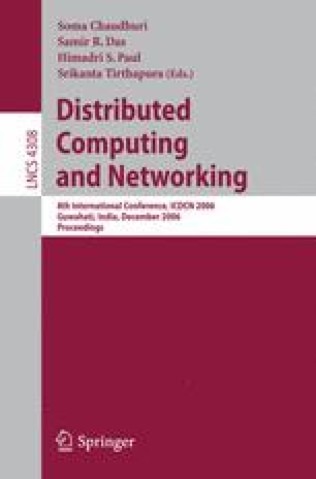
Distributed computing and networking ; 8th International conference, ICDCN 2006, Guwahati, India, December 27-30, 2006, Proceedings
VI realm between distributed computing and networking, namely, Modeling Biological Networks, Network Security, Algorithmic Issues in Wireless Sensor Networks, and Optical Networking. This was made possible by the efforts of the Tutorial Chairs, Sr- har Iyer and Pinaki Mitra. The Organizing Committee worked hard to ensure that the participants enjoyed a comfortable stay and the technical meetings proceeded as smoothly as possible.

Distributed computing -- IWDC 2004 ; 6th International Workshop, Kolkata, India, December 27-30, 2004, Proceedings
Last, but not least, thanks to all the participants and authors. We hope that they enjoyed the workshop as much as the wonderful and culturally vibrant city of Kolkata! Bhabani P. Sinha Indian Statistical Institute, Kolkata, India December 2004 Sajal K. Das University of Texas, Arlington, USA December 2004 Program Chairs’ Message On behalf of the Technical Program Committee of the 6th International Wo- shop on Distributed Computing, IWDC 2004, it was our great pleasure to w- come the attendees to Kolkata, India. Over the last few years, IWDC has emerged as an internationally renowned forum for interaction among researchers from academia and industries around the world.

Dependable computing - EDCC 2005 ; 5th European dependable computing Conference, Budapest, Hungary, April 20-22, 2005, Proceedings
It is always a special honor to chair the European Dependable Computing C- ference (EDCC). EDCC has become one of the well-established conferences in the ?eld of dependability in the European research area. Budapest was selected as the host of this conference due to its traditions in organizing international scienti?c events and its traditional role of serving as a meeting point between East and West. EDCC-5 was the ?fth in the series of these high-quality scienti?c conf- ences. In addition to the overall signi?cance of such a pan-European event, this year’s conference was a special one due to historic reasons. The roots of EDCC date back to the moment when the Iron Curtain fell. Originally, two groups of scientists from di?erent European countries in Western and Eastern Europe – who were active in research and education related to dependability created a – joint forum in order to merge their communities as early as in 1989. This trend has continued up to today. This year’s conference was the ?rst one where the overwhelming majority of the research groups belong to the family of European nations united in the European Union. During the past 16 years we observed that the same roots in all the professional, cultural and scienti?c senses led to a seamless integration of these research communities previously separated ar- ?cially for a long time. EDCC has become one of the main European platforms to exchange new - searchideasinthe?eldofdependability.

Cosmetic procedures in skin of color
Provides complete, clear descriptions for aesthetic dermatological concerns in patients with skin of color, including dedicated chapters on populations of African, East Asian, South Asian, Middle Eastern, and Hispanic/Latino ancestry Covers management of key dermatologic conditions in skin of color including melasma, post-inflammatory hyperpigmentation, hair loss, and keloids

Cosmetic dermatology : products and procedures
Provides a highly-illustrated, clinical guide to the full range of cosmetic skin treatments. Bringing together experts from research, industry, surgery and practice, it is structured in four distinct parts for easy navigation by the busy clinician:Basic Concepts - giving an overview of the physiology pertinent to cosmetic dermatology and the delivery systems by which treatments can take effect;Hygiene Products - evaluating cleansing and moisturising products;Adornment - looking at aesthetic techniques such as cosmetics, nail protheses and hair treatment;Antiaging - ie, injectables, resurfacing and skin contouring techniques, and the rapidly growing area of Cosmeceuticals.

Cosmeceuticals as Game Changers in the Cosmetic Industry
Objectives of this work is to compare conventional cosmetics to biotechnology derived cosmeceuticals in terms of skin anti-aging, skin color modulation and hair growth, and to find out which is of greater overall performance. Research revealed superiority of cosmeceuticals to classical cosmetics as it was found that many classical cosmetic agents used for aesthetical purposes posed a certain level of either ineffectiveness, for the reason that the effect did not treat the cause of the problem and was merely temporary and external, or harmfulness because of proposed potential health risks and adverse effects. Whereas cosmeceuticals presented promising novel mechanisms and compounds for a deeper, more thorough remedy.

Computer Vision - ECCV 2002 ; 7th European Conference on Computer Vision, Copenhagen, Denmark, May 28-31, 2002. Proceedings. Part IV
The privilege of organizing it was shared by three universities: The IT University of Copenhagen, the University of Copenhagen, and Lund University, with the conference venue in Copenhagen. This year’s conference attracted more papers than ever before, with around 600 submissions. Still, together with the conference board, we decided to keep the tradition of holding ECCV as a single track conference. Each paper was anonymously refereed by three different reviewers. For the ?nal selection, for the ?rst time for ECCV, a system with area chairs was used.
Computer Vision - ECCV 2002 ; 7th European Conference on Computer Vision, Copenhagen, Denmark, May 28-31, 2002. Proceedings. Part II
The privilege of organizing it was shared by three universities: The IT University of Copenhagen, the University of Copenhagen, and Lund University, with the conference venue in Copenhagen. This year’s conference attracted more papers than ever before, with around 600 submissions. Still, together with the conference board, we decided to keep the tradition of holding ECCV as a single track conference. Each paper was anonymously refereed by three different reviewers. For the ?nal selection, for the ?rst time for ECCV, a system with area chairs was used.

Computer Vision - ECCV 2002 ; 7th European Conference on Computer Vision, Copenhagen, Denmark, May 28-31, 2002, Proceedings, Part III
The privilege of organizing it was shared by three universities: The IT University of Copenhagen, the University of Copenhagen, and Lund University, with the conference venue in Copenhagen. This year’s conference attracted more papers than ever before, with around 600 submissions. Still, together with the conference board, we decided to keep the tradition of holding ECCV as a single track conference. Each paper was anonymously refereed by three different reviewers. For the ?nal selection, for the ?rst time for ECCV, a system with area chairs was used.
Computer Vision - ECCV 2002 ; 7th European Conference on Computer Vision, Copenhagen, Denmark, May 28-31, 2002, Proceedings, Part I
The privilege of organizing it was shared by three universities: The IT University of Copenhagen, the University of Copenhagen, and Lund University, with the conference venue in Copenhagen. This year’s conference attracted more papers than ever before, with around 600 submissions. Still, together with the conference board, we decided to keep the tradition of holding ECCV as a single track conference. Each paper was anonymously refereed by three different reviewers. For the ?nal selection, for the ?rst time for ECCV, a system with area chairs was used.

Computer Vision - ACCV 2006 ; Vol. 3852 ; 7th Asian Conference on Computer Vision, Hyderabad, India, January 13-16, 2006, Proceedings, Part II
ACCV has been making its rounds through the Asian landscape and came to India this year. Interest in computer vision is increasing and ACCV 2006 attracted about 500 submission. The evaluation team consisted of 27 experts serving as Area Chairs and about 270 reviewers in all. The whole process was conducted electronically in a double-blind manner,a ?rstfor ACCV.
