



الصفحة 2
الصفحة 2
Geographic Information Science ; 4th International Conference, GIScience 2006, Münster, Germany, September 20-23, 2006, Proceedings
The GIScience conference series (www. giscience. org) was created as a forum for all researchers who are interested in advancing research in the fundam- tal aspects of geographic information science.The conferences focus on emerging topics and basic research ?ndings across all s- tors of geographic information science. After three highly successful conferences in the United States, this year’s GIScience conference was held in Europe for the ?rst time. The GIScience conferences have been a meeting point for researchers coming from various disciplines, including cognitive science, computer science, engine- ing, geography,information science, mathematics, philosophy, psychology,social science, and statistics. The advancement of geographic information science - quiressuchinterdisciplinarybreadth,andthisisalsowhatmakestheconferences so exciting. In order to account for the di?erent needs of the involved scienti?c disciplines with regard to publishing their research results.

Geographic Hypermedia : Concepts and Systems
This book introduces a new paradigm, Geographic Hypermedia, which emerges from the convergence of Geographic Information Science and - permedia technology. Both GI Science and hypermedia have been rapidly evolving fields. The initial idea of Geographic Hypermedia was born in 2004 when the editors had been invited to organize a workshop in conju- tion with the ‘Hypertext’ conference organized annually by the Special - terest Group of the Association for Computing Machinery. The purpose of the workshop was to examine how hypermedia concepts and tools may be applied in geographical domains. The workshop was eventually held in conjunction with the Maps and the Internet Commission of the International Cartographic Association at the annual meeting of the Association of American Geographers in Denver, Colorado, in April 2005. The Denver workshop was a successful event, bringing together mul- disciplinary researchers and professionals in the area of Geographic - permedia.

Geodynamics of the Lithosphere : An Introduction
This second edition of the important introductory text for earth scientists has been thoroughly revised and extended. It contains chapters on heat flow, sedimentary basin modeling, the mechanics of continental deformation, PT path modeling, geomorphology, mass transfer and more.

Geodetic Deformation Monitoring : From Geophysical to Engineering Roles ; IAG Symposium Jaén, Spain, March 7-19,2005
Geodesy is the science dealing with the determination of the position of points in space, the shape and gravity field of the Earth and with their time variations. A consequence is that geodesists feel as a permanent subject of research, the detection, analysis and interpretation of spatial deformation as well as gravity field variation. This book collects 36 selected papers from the International Symposium on Geodetic Deformation Monitoring held in Jaén (Spain) from 17th to 19th March 2005. The main topics covered in the symposium were: mathematical and statistical models for crustal deformation analysis, deformation monitoring from GPS and InSAR data: analysis and geophysical interpretation, geodetic monitoring of movements in civil engineering, integration of spatial and terrestrial techniques in deformation studies, geodynamical applications of gravimetric observations and present-day geodetic instrumentation for deformation monitoring. This volume is a good overview of theoretical matters, models and results.

Frontiers of Geographic Information Technology
Although designed primarily for desktop mapping and analysis, Geographic Information Systems have, for some years, been ‘coupled’ to other ‘allied’ technologies. This coupling or integration has occurred for some time due to the limitations in commercially available systems. It has occurred in several areas including visualisation (virtual reality), simulation (pedestrian, urban modelling), data storage and management (distributed or Internet GIS) and decision support. The chapters of the book, written by an international group of experts examine several of these discrete areas, focussing on the use of GIS and the technology it has been allied to.

Flood Risk Management : Hazards, Vulnerability and Mitigation Measures
Floods are of increasing public concern world-wide due to increasing damages and unacceptably high numbers of injuries. Previous approaches of flood protection led to limited success especially during recent extreme events. Therefore, an integrated flood risk management is required which takes into consideration both the hydrometeorogical and the societal processes. Moreover, real effects of risk mitigation measures have to be critically assessed. The book draws a comprehensive picture of all these aspects and their interrelations. It furthermore provides a lot of detail on earth observation, flood hazard modelling, climate change, flood forecasting, modelling vulnerability, mitigation measures and the various dimensions of management strategies. In addition to local and regional results of science, engineering and social science investigations on modelling and management, transboundary co-operation of large river catchments are of interest.

Earthquake Monitoring and Seismic Hazard Mitigation in Balkan Countries
this book including deployment of modern seismograph stations and arrays and these developments are detailed in the book. Station and network operations require near real time record analysis and topics dealt with here are 2-D signal detector, epicenter location and earthquake monitoring. Balkan is seismically the most active part of Europe due to multiple plate interactions in the Aegean Sea. The tectonic evolution and on-going geodynamic deformations are described in 2 articles. Earthquake hazard analysis and topographic site effects are discussed and likewise large earthquake hazards in the Aegean and the Marmara seas relate to practical applications of such procedures. Foremost; the book gives a good account of past, present and likely future seismological developments in Balkan countries and various kinds of network operations on local to global scales.

Earthquake Early Warning System
The book provides information on the major EEW systems in operation and on the state of the art of the different blocks forming an EW system: the rapid detection and estimation of the earthquake’s focal parameters, the signal transmission, the engineering interface and the information reliability/false alarm problem.

Earth science satellite remote sensing ; Vol.2 : Data, computational processing, and tools
Earth science satellite remote sensing has been rapidly expanding during the last decade. Volume 2 of this two volume monograph provides information on the Earth science remote sensing data information and data format such as HDF-EOS, and tools. It evaluates the current data processing approaches and introduces data searching and ordering from different public domains. Further it explores the remote sensing and GIS migration products and WebGIS applications. The core of this book arose from the workshop for Earth Science Satellite Remote Sensing held at George Mason University (GMU) in October 2002. Both volumes are designed to give scientists and graduate students with limited remote sensing background a thorough introduction to current and future NASA, NOAA and other Earth science remote sensing.
Earth observation science and applications for risk reduction and enhanced resilience in Hindu Kush Himalaya Region : A decade of experience from SERVIR
This book is a consolidation of lessons learnt and experiences gathered from our efforts to utilise Earth observation (EO) science and applications to address environmental challenges in the Hindu Kush Himalayan region.

Digital Terrain Modelling : Development and Applications in a Policy Support Environment
This book presents a set of papers on Digital Terrain Modelling for Policy Support which aims to be informative and stimulating for both developers and users of digital terrain models. It should also be useful for professi- als who are interested in the wider aspects of the applications of terrain models in support for policies and decision making. There is an increasing demand for regional and continental scale data for use in environmental modelling and spatial analysis to support envir- mental policy development and implementation. Important environmental processes act at regional and continental scales, for example climatic change inducing floods and soil erosion, and management of these pr- esses for the sustainable development of society requires policies to be - plied at the corresponding scales. One of the most important factors inf- encing these environmental processes which act on the earth’s surface is the surface topography, hence the need for extensive, harmonised digital terrain models.

Digital Soil Mapping with Limited Data
This book focuses on digital soil mapping methodologies and applications for areas where data are limited, and has the following sections (i) introductory papers, (ii) dealing with limited spatial data infrastructures, (iii) methodology development, and (iv) examples of digital soil mapping in various parts of the globe (including USA, Brazil, UK, France, Czech Republic, Honduras, Kenya, Australia). The final chapter summarises priorities for digital soil mapping.
Digital Photogrammetry : A Practical Course
The main part of the book contains several tutorials. In increasing complexity, accompanied by texts explaining further theory, the reader can proceed step by step through the particular working parts. Most of the standard work in Digital Photogrammetry is shown and trained for example scanning, image orientation, mono and stereo plotting, aerial triangulation measurement (manual and automatic), block adjustment, automatic creation of surface models via image matching, creation of ortho images and mosaics, and others. Not only standard situations are dealt with but also more complex ones, such as unknown camera data, extreme relief or areas with very low contrast. Examples of both aerial and close-range photogrammetry present the power of these type of measurement techniques.

Developments in spatial data handling ; 11th International Symposium on Spatial Data Handling
The International Symposium on Spatial Data Handling is the premier research forum for Geographic Information Science. The papers published in this volume are carefully refereed by an international programme committee composed of experts in various areas of GIS who are especially renowned for their scientific innovation.
Map-based Mobile Services : Theories, Methods and Implementations
Divided into three parts - theory, method and implementation, this book starts with a summary of the state-of-the-art in mobile technologies. It also introduces a conceptual framework of mobile cartography with the emphasis on mobile usage context. It is accompanied by a CD-ROM which contains the PDF-Files in colour.
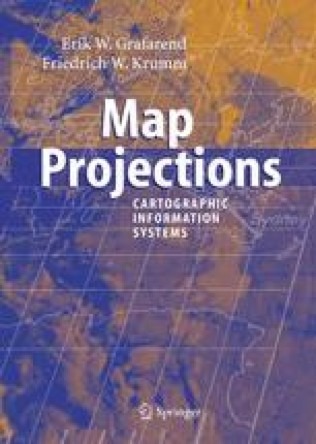
Map Projections : Cartographic Information Systems
In the context of Geographical Information Systems (GIS) the book offers a timely review of map projections (sphere, ellipsoid, rotational surfaces) and geodetic datum transformations. For the needs of photogrammetry, computer vision, and remote sensing space projective mappings are reviewed.
Location Based Services and TeleCartography
Provides for the first time a general overview of research activities related to location and map-based services. These activities have emerged over the last years, especially around issues of positioning, spatial modelling, cartographic communication as well as in the fields of ubiquitious cartography, geo-pervasive services, user-centered modelling and geo-wiki activities. Topics cover an enormous range with heterogenous relationships to the main book issues. Whilst contemporary cartography aims at looking at new and efficient ways for communicating spatial information the development and availability of technologies like mobile networking, mobile devices or short-range sensors lead to interesting new possibilities for achieving this aim.
Landscape Analysis and Visualisation : Spatial Models for Natural Resource Management and Planning
This book presents a collection and synthesis of many of these perspectives — perhaps it could only be produced in a land urb- ised in the tiniest of pockets, and yet so daunting with respect to the way non-populated landscapes dwarf its cities. Many travel to Australia to its cities and never see the landscapes — but it is these that give the country its power and imagery. It is the landscapes that so impress on us the need to consider how our intervention, through activities ranging from resource exploitation and settled agriculture to climate change, poses one of the greatest crises facing the modern world. In this sense, Australia and its landscape provide a mirror through which we can glimpse the extent to which our intervention in the world threatens its very existence.

Buried Waste in the Seabed – Acoustic Imaging and Bio-Toxicity : Results from the European SITAR Project
Buried waste on the seabed is a major source of pollution. But, very often, waste sites are not known until a serious problem occurs, or are not adequately mapped. Recent examples around Europe include WWI and WWII ammunition dump sites (e.g. Beufort Dyke in the UK), dumped nuclear submarines in the Arctic Seas, clandestine or hidden toxic-waste in the Baltic Sea and the North Sea.. Even if properly documented, waste sites evolve with time (dumped material can move with currents and tides, especially on a scale of decades; toxic-material barrels can corrode and leak). This book shows the results of a concerted EU-funded effort to tackle this problem and find innovative ways to identify and map toxic waste sites ona the seabed, whether they have been covered with sediments or not. These results are applicable to any region on the seabed in the entire world.
Biogeochemical cycles in globalization and sustainable development
This valuable study of environmental subsystems functioning under various climatic and anthropogenic conditions provides a unique insight into the social context of global changes in biogeochemical cycles and demonstrates current understanding of globalization and sustainable development.
