



الصفحة 2
الصفحة 2

Informatics Education - The Bridge between Using and Understanding Computers ; International Conference on Informatics in Secondary Schools - Evolution and Perspectives, ISSEP 2006, Vilnius, Lithuania, November 7-11, 2006, Proceedings
Although the school system is subject to specific national regulations, didactical issues warrant discussion on an international level. This applies specifically to informatics didactics. In contrast to most other scientific disciplines, informatics undergoes substantial technical and scientific changes and shifts of paradigms even at the basic level taught in secondary school. Moreover, informatics education is under more stringent observation from parents, potential employers, and policy makers than other disciplines. It is considered to be a modern discipline. Hence, being well-educated in informatics seemingly ensures good job perspectives. Further, policy makers pay attention to informatics education, hoping that a young population well-educated in this modern technology will contribute to the future wealth of the nation.

Informatics education - supporting computational thinking ; 3rd International Conference on informatics in secondary schools : Evolution and perspectives, ISSEP 2008 Torun Poland, July 1-4, 2008 Proceedings
Informatics Education – Supporting Computational Thinking contains papers presented at the Third International Conference on Informatics in Secondary Schools – Evolution and Perspective, ISSEP 2008, held in July 2008 in Torun, Poland. As with the proceedings of the two previous ISSEP conferences (2005 in Klag- furt, Austria, and 2006 in Vilnius, Lithuania), the papers presented in this volume address issues of informatics education transcending national boundaries and, the- fore, transcending differences in the various national legislation and organization of the educational system. Observing these issues, one might notice a trend. The p- ceedings of the First ISSEP were termed From Computer Literacy to Informatics F- damentals [1]. There, broad room was given to general education in ICT.

Hybrid Learning and Education ; 1st International Conference, ICHL 2008 Hong Kong, China, August 13-15, 2008 Proceedings
This book constitutes the refereed proceedings of the First International Conference on Hybrid Learning, ICHL 2008, held in Hong Kong, China, in August 2008.The 38 revised full papers presented together with 3 keynote lectures were carefully reviewed and selected from 142 submissions. The papers are organized in topical sections on hybrid education, model and pedagogies for hybrid learning, trends, pervasive learning, mobile and ubiquitous learning, hybrid learning experiences, hybrid learning systems, technologies, as well as contextual attitude and cultural effects.

Human-computer interaction – INTERACT 2007 ; 11th IFIP TC 13 International Conference, Rio de Janeiro, Brazil, September 10-14, 2007, Proceedings, Part II
This book is part of a two-volume work that constitutes the refereed proceedings of the 11th IFIP TC13 International Conference on Human-Computer Interaction, INTERACT 2007, held in Rio de Janeiro, Brazil in September 2007. It covers tangible user interfaces and interaction; as well as software engineering and HCI.

Human interface and the management of information : Interacting in information environments ; Symposium on Human Interface 2007, Held as Part of HCI International 2007, Beijing, China, July 22-27, 2007, Proceedings, Part II
The 12th International Conference on Human-Computer Interaction, HCI Inter- tional 2007, was held in Beijing, P.R. This volume, edited by Michael J. Smith and Gavriel Salvendy, contains papers in the thematic area of Human Interface and the Management of Information, addressing the following major topics: • Communication and Collaboration • Knowledge, Learning and Education • Mobile Interaction • Interacting with the World Wide Web and Electronic Services • Business Management and Industrial Applications • Environment, Transportation and Safety.

Handbook on Quality and Standardisation in E-Learning
The handbook provides a cross-national perspective on these issues and draws a clear picture of the situation in quality development and standardisation. It covers topics of a rather foundational nature in quality and standardisation research as well as descriptions of quality approaches, instruments, standards, experiences and best practices. The Handbook is directed to learners, professionals, researchers and policy makers – people creating the next generation of learning.

Handbook on Information Technologies for Education and Training
The handbook's goal is to enable the reader to gain a deep understanding of past, current and future research and applications in the field of educational technology. The reader will gain an in-depth understanding of complex theories, strategies, concepts, and methods relating to the design, development, implementation, and evaluation of educational technologies. Because it combines both the present experience in the field and the vision of its emerging directions, the handbook will be a comprehensive guide for researchers and practitioners working with educational technologies. All the chapters of the second edition are newly written, the handbook therefore presents the latest developments in the field.

Handbook of Teacher Education : Globalization, Standards and Professionalism in Times of Change
This book provides an international review of the current state of teacher education, with chapters from an international group of teacher educators. It focuses on major issues that are confronting teacher educators now and in the next decade. These include the impact of globalization on the profession of teaching, and how teacher education must deal with changing accountability requirements from governments and establish a set of minimum standards acceptable to enable a person to teach.

Guide to Efficient Software Design : An MVC Approach to Concepts, Structures, and Models
This classroom-tested textbook presents an active-learning approach to the foundational concepts of software design. These concepts are then applied to a case study, and reinforced through practice exercises, with the option to follow either a structured design or object-oriented design paradigm. The text applies an incremental and iterative software development approach, emphasizing the use of design characteristics and modeling techniques as a way to represent higher levels of design abstraction, and promoting the model-view-controller (MVC) architecture.
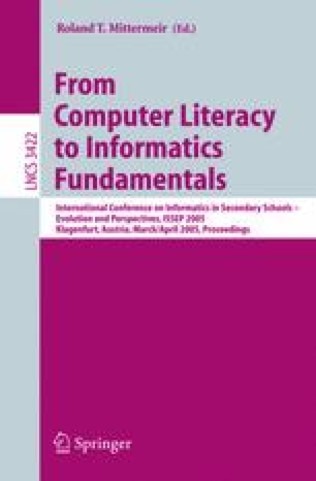
From computer literacy to informatics fundamentals ; International conference on informatics in secondary schools : Evolution and perspectives, ISSEP 2005, Klagenfurt, Austria, March 30-April 1, 2005, Proceedings
Duetothepenetrationofinformationtechnologyintosocietyatlargeandinto schools in particular, the relationship between informatics and education leading togeneralcomputerliteracyortotheuseofIT-basedapproachesinconventional subjects, e-learning in school, is an evident focus of many contributions. According to the broad scope of the conference its proceedings are split into two volumes. This volume, From Computer Literacy to Informatics Fundam- tals, covers papers reporting on national strategies of informatics instruction and their evolution in accordance with the penetration of information proce- ing equipment in our daily life. In one way or another, these strategies strive to accommodate the needs of basic skills in information and communication te- nology (ICT) with educational principles that can be conveyed by informatics instruction in a traditional sense. Hence, the papers on national strategies are complementedintwoways: ?rstly, bycontributionsthatstrivetoidentifyfun- mental issues, informatics can contribute to the general education process of the youth; and, secondly, by papers presenting approaches on how to link or even to combine instruction about such informatics fundamentals with the need to introduce pupils to the productive use of ICT.

E-Training Practices for Professional Organizations
E-Training Practices for Professional Organizations is an essential reference for anyone interested in the integration of e-business, e-work and e-learning processes. The book collects, for the first time, the proceedings from the 2003 IFIP eTrain Conference held in Pori, Finland. The text serves as a multi-disciplinary resource for information on the research, development and applications of all topics related to e-Learning. The first half of the book discusses theories, paradigms and their applications in academia and industry. The last half of the book examines learning environments, design issues and collaboration among the corporate, governmental and academic sectors. With academic and professional contributors, E-Training Practices for Professional Organizations reflects the multi-faceted and exciting nature of e-training studies. This volume presents the balanced view of past developments and current research necessary to truly reach the potential of this burgeoning field.

E-Service Intelligence : Methodologies, Technologies and Applications
Business organizations and governments are nowadays developing and providing internet based electronic services (e-services) featuring various intelligent functions. E-Service Intelligence integrates intelligent techniques into e-service systems for realizing intelligent internet information searching, presentation, provision, recommendation, online system design, implementation, and assessment to internet users. This book offers a thorough introduction and systematic overview of the new field and covers the state-of-the-art of the research and development in E-Service Intelligence ranging from e-services and/or intelligent techniques to web information presentation, search, and mining, to personalization, privacy, and trust in e-services, to e-service evaluation, optimization and knowledge discovery, and to intelligent e-service system developments.

Enterprise Knowledge Infrastructures
Success of an organization is increasingly dependent on its capability to create an environment to improve the productivity of knowledge work. This book focuses on the concepts, models and technologies that are used to design and implement such an environment. It develops the vision of a modular, yet highly integrated enterprise knowledge infrastructure and presents an ideal architecture replete with current technologies and systems. The most important streams of technological development that are covered in the book are computer-supported cooperative work, document and content management, e-learning, enterprise portals, information life cycle management, knowledge management, mobile computing, and the Semantic Web. It includes learning goals, exercises and case examples that help the reader to easily understand and practice the concepts.

Enterprise Information Systems VI
This book contains the best papers of the Sixth International Conference on Enterprise Information Systems (ICEIS 2004), held in Porto (Portugal) and organized by INSTICC (Institute for Systems and Technologies of Information, Communication and Control) in collaboration with PORTUCALENSE UNIVERSITY, who hosted the event. Following the route started in 1999, ICEIS has become a major point of contact between research scientists, engineers and practitioners on the area of business applications of information systems. This conference has received an increased interest every year, from especially from the international academic community, and it is now one of the world largest conferences in its area. This year, five simultaneous tracks were held, covering different aspects related to enterprise computing, including: “Databases and Information Systems Integration”,

Enduring Bonds : The Significance of Interpersonal Relationships in Young Children’s Lives
This, the first volume in a series of edited books designed to synthesize research, theory, and practice, will focus on key interpersonal relationships affecting the young child. A distinguished group of authors will examine a wide array of relationships that affect the child today and influence the adult tomorrow—important bonds such as those between caregivers and infants; among siblings; between literate adults and the language-learning child; between the homeless and those providing support services, between principals and young students; and between recently immigrated preschoolers, teachers, and families, to name a few.

Empowering Teaching for Digital Equity and Agency ; IFIP TC 3 Open Conference on Computers in Education, OCCE 2020, Mumbai, India, January 6–8, 2020, Proceedings
This book constitutes the refereed post-conference proceedings of the IFIP TC 3 Open Conference on Computers in Education, OCCE 2020, held in Mumbai, India, in January 2020. The 11 full papers and 4 short papers included in this volume were carefully reviewed and selected from 57 submissions. The papers discuss key emerging topics and evolving practices in the area of educational computing research. They are organized in the following topical sections: computing education; learners’ and teachers’ perspectives; teacher professional development; the industry perspective; and further aspects.

Emerging Technologies and Information Systems for the Knowledge Society ; 1st World Summit on the Knowledge Society, WSKS 2008, Athens, Greece, September 24-26, 2008. Proceedings
This book, in conjunction with the volume CCIS 19, constitutes the refereed proceedings of theFirst World Summit, WSKS 2008, held in Athens, Greece, in September 2008.
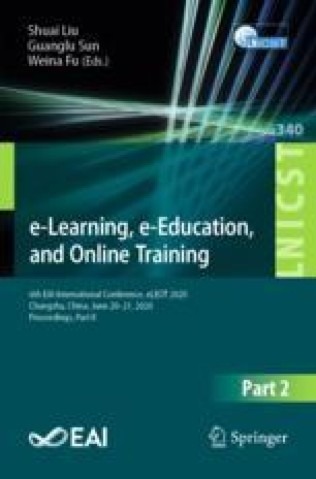
e-Learning, e-Education, and Online Training ; 6th EAI International Conference, eLEOT 2020, Changsha, China, June 20-21, 2020, Proceedings, Part II
Constitutes the proceedings of the 6th International Conference on e-Learning, e-Education, and Online Training, eLEOT 2020, held in Changsha, China, in June 2020. The conference was held virtually due to the COVID-19 pandemic. The 68 full papers presented were carefully reviewed and selected from 141 submissions. They focus on most recent and innovative trends and new technologies in for educational modernization, such as artificial intelligence and big data. The theme of eLEOT 2020 was “Education with New Generation Information Technology”.
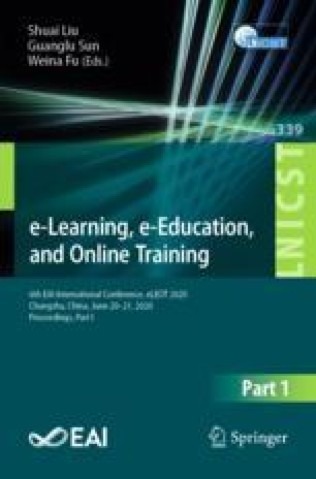
e-Learning, e-Education, and Online Training ; 6th EAI International Conference, eLEOT 2020, Changsha, China, June 20-21, 2020, Proceedings, Part I
Constitutes the proceedings of the 6th International Conference on e-Learning, e-Education, and Online Training, eLEOT 2020, held in Changsha, China, in June 2020. The conference was held virtually due to the COVID-19 pandemic. The 68 full papers presented were carefully reviewed and selected from 141 submissions. They focus on most recent and innovative trends and new technologies in for educational modernization, such as artificial intelligence and big data. The theme of eLEOT 2020 was “Education with New Generation Information Technology”.

E-Learning Methodologies : Fundamentals, technologies and applications
Covers state of the art topics including user modeling for e-learning systems and cloud, IOT, and mobile-based frameworks. It also considers security challenges and ethical conduct using Blockchain technology. E-learning has become an important part of our educational life with the development of e-learning systems and platforms and the need for online and remote learning. ICT and computational intelligence techniques are being used to design more intelligent and adaptive systems. However, the art of designing good real-time e-learning systems is difficult as different aspects of learning need to be considered including challenges such as learning rates, involvement, knowledge, qualifications, as well as networking and security issues. The earlier concepts of standalone integrated virtual e-learning systems have been greatly enhanced with emerging technologies such as cloud computing, mobile computing, big data, Internet of Things (IoT), AI and machine learning, and AR/VT technologies.
