



الصفحة 2
الصفحة 2

Criminalising Harmful Conduct : The Harm Principle, its Limits and Continental Counterparts
This book explores the issue of legitimate criminalization in a modern, liberal society. Coverage provides a comparative study between two major criminal legal systems and its theories: the Anglo-American, on one side, and the Continental criminal legal system of Germanic legal circle, on the other.

Criminal law: The basics
Considers key questions such as: How should we decide what is criminal and what isn't? What is the difference between murder and manslaughter? Could you ever be guilty of stealing your own property? What defences are available to those accused of crime? Featuring a range of case studies, from the infamous to the bizarre, the new edition has been thoroughly updated to include new material on loss of control, accessorial liability, dishonesty, causation, liability, manslaughter and sexual offences.

Criminal law for criminologists : Principles and theory in criminal justice
Introduces the key policies and principles that drive criminal law in England and then explains the law itself in terms of relevant statute and case law. Starting with an outline of the basic principles and theories of criminal law and criminal justice

Criminal law : Cases and materials
Provides the reader with both critical race and critical feminist theory perspectives on criminal law while following a traditional format. All of the usual subject areas are covered, but the book is unique in highlighting the cultural context of substantive criminal law. The book seamlessly integrates issues of race, gender.

Criminal law : A desk reference
This book will get you up to speed.Criminal Law: A Desk Reference covers the basic to the complex in alphabetical order. Whether it’s “alibi” or “writ of habeas corpus,” the book makes it easy to find and understand what you’re looking for.

Criminal law
Guides you as you sharpen your critical thinking and legal analysis skills. As you progress through the book, you'll learn about the general principles of criminal liability and its defenses, as well as the elements of crimes against persons, property, society, and the state. You'll also see these principles at work in the cases and crimes that illustrate them.

Criminal law
Provides a sound base level of knowledge of the substantive law. It then adds to this knowledge to ensure that students are able to apply the substantive law using a variety of skills in different contexts. Then, the text shows students how to engage with the subject and critically evaluate and consider the implications of the law in any given scenario.

Criminal law
Updated to include new developments such as the interaction of the legal rights in the Charter with the reasonable limits provision in section 1 of the Charter in R v KR, disagreements between the Ontario Court of Appeal and the Manitoba Court of Appeal about whether the exclusion of murder from the offence of duress can be justified, new developments in the offence of infanticide, and the relation of the due diligence defence to statutory standards.

Crime and culpability : a theory of criminal law
This book presents a comprehensive overview of what the criminal law would look like if organised around the principle that those who deserve punishment should receive punishment commensurate with, but no greater than, that which they deserve.

Core concepts in criminal law and criminal justice ; Vol. 3
Explores the principles and concepts that underpin the different domestic systems and rules. It will focus on the Germanic and several principal Anglo-American jurisdictions, which are employed as examples of the wider common law-civil law divide.

Core concepts in criminal law and criminal justice ; 2nd ed.
Explores the foundational principles and concepts that underpin the different domestic systems. It will focus on the Germanic and several principal Anglo-American jurisdictions, which are employed as examples of the wider divide between common law and civil law

Combatting Illicit Trade on the EU Border : A Comparative Perspective
This book provides the first-ever comparative study on criminal policy concerning the illicit trade of tobacco, conducted among four comparatively new EU Member States (Lithuania, Poland, Slovakia and Romania) and two “old” EU countries (Germany and Italy).

Collaborating against child abuse : Exploring the Nordic Barnahus model
This edited collection explores the background and implementation of the Nordic Barnahus (or 'Children's House') model – recognised as one of the most important reforms related to children who are the victims of crime in the Nordic region. This book discusses both its potential to affect change and the challenges facing it. The model was introduced as a response to a growing recognition of the need for more integrated and child-centred services for children exposed to violence and sexual abuse. In the Barnahus structure, different professions work together to ensure that victimized children receive help and treatment and that their legal rights are met. This original study is organised into four broad themes: child-friendliness, support and treatment; the forensic child investigative interview; children’s rights perspectives; and interagency collaboration and professional autonomy.

Coercive human rights: positive duties to mobilise the criminal law under the ECHR
Traditionally, human rights have protected those facing the sharp edge of the criminal justice system. But over time human rights law has become increasingly infused with duties to mobilise criminal law towards protection and redress for violation of rights. These developments give rise to a whole host of questions concerning the precise parameters of coercive human rights, the rationale(s) that underpin them, and their effects and implications for victims, perpetrators, domestic legal systems, and for the theory and practice of human rights and criminal justice. This collection addresses these questions with a focus on the rich jurisprudence of the European Court of Human Rights (ECtHR).
Legal maxims in islamic criminal law : Theory and applications
Delves into the theoretical and practical studies of al-Qawaid al-Fiqhiyyah in Islamic legal theory. It elucidates the importance of this concept in the application of Islamic law and demonstrates how the concept relates to the objectives of Islamic law generally.
Law and Justice in a globalized world
Consists of a selection of papers presented at the Asia-Pacific Research Conference on Social Sciences and Humanities. It contains essays on current legal issues in law and justice, and their role and transformation in a globalizing world. Topics covered include human rights, criminal law, law of the sea, good governance, democracy, foreign investment, and regional integration. The conference focused on Asia and the Pacific, two regions where law has taken an important position in creating and shaping the regional integrations, new legal institutions, and norms.
Justice in extreme cases: criminal law theory meets international criminal law
Shows how to use moral theory to challenge and improve ICL, and how extreme cases can challenge and improve criminal law theory. It will appeal to scholars and jurists in ICL, as well as scholars of criminal law theory or legal philosophy.
Complete criminal law : Text, cases, and materials
Provides a student-centred, straightforward approach to the criminal law LLB/CPE syllabus. The author's lucid commentary clearly explains the general principles, whilst the structured learning features enable students to interact and engage with the integrated case extracts and academic materials.
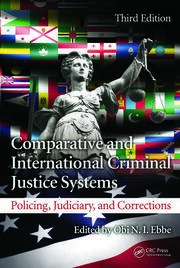
Comparative and international criminal justice systems : policing, judiciary, and corrections
The Nature of Comparative and International Criminal JusticeThe Purpose of Comparative and International Criminal Justice Systems; Crime and Criminal Law: Global PerspectiveCrime: International and Comparative;Overview of Model Criminal Justice Systems

Child soldiers and the defence of duress under International criminal law
Investigates the use of duress as a defence in international criminal law, specifically in cases of child soldiers. The prosecution of children for international crimes often only focuses on whether children can and should be prosecuted under international law. However, it is rarely considered what would happen to these children at the trial stage. This work offers a nuanced approach towards international prosecution and considers how children could be implicated and defended in international courts.
