



الصفحة 2
الصفحة 2

Computer algebra in scientific computing ; Vol. 3718 ; 8th International workshop, CASC 2005, Kalamata, Greece, September 12-16, 2005, Proceedings
This volume contains the proceedings of the CASC 2005 continued a tradition — started in 1998 — of international con-ferences on the latest advances in the application of computer algebra systems(CASs) and methods to the solution of various problems in scientific computing.The methods of scientific computing play an important role in research andengineering applications in the natural and the engineering sciences. The signif-icance and impact of computer algebra methods and computer algebra systemsfor scientific computing has increased considerably in recent times. Nowadays,such general-purpose computer algebra systems as Maple, Magma, Mathematica,MuPAD, Singular, CoCoA and others enable their users to solve the followingthree important tasks within a uniform framework:(a) symbolic manipulation;(b) numerical computation;(c) visualization. The result of this job is reflected in this volume, which contains revised versionsof the accepted papers. The collection of papers included in the proceedingscovers various topics of computer algebra methods, algorithms, and softwareapplied to scientific computing:

Computer algebra in scientific computing ; 23rd International Workshop, CASC 2021, Sochi, Russia, September 13–17, 2021, Proceedings
This book constitutes the proceedings of the 23rd International Workshop on Computer Algebra in Scientific Computing, CASC 2021, held in Sochi, Russia, in September 2021. The 24 full papers presented together with 1 invited talk were carefully reviewed and selected from 40 submissions. The papers cover theoretical computer algebra and its applications in scientific computing.

Computer algebra in scientific computing ; 22nd International Workshop, CASC 2020, Linz, Austria, September 14–18, 2020, Proceedings
This book constitutes the refereed proceedings of the 22nd International Workshop on Computer Algebra in Scientific Computing, CASC 2020, held in Linz, Austria, in September 2020. The conference was held virtually due to the COVID-19 pandemic. The 34 full papers presented together with 2 invited talks were carefully reviewed and selected from 41 submissions. They deal with cutting-edge research in all major disciplines of computer algebra. The papers cover topics such as polynomial algebra, symbolic and symbolic-numerical computation, applications of symbolic computation for investigating and solving ordinary differential equations, applications of CAS in the investigation and solution of celestial mechanics problems, and in mechanics, physics, and robotics.

Computer Algebra in Scientific Computing ; 10th International Workshop, CASC 2007, Bonn, Germany, September 16-20, 2007, Proceedings
The book covers not only various expanding applications of computer algebra to scientific computing but also the computer algebra systems themselves and the CA algorithms. Topics addressed are studies in polynomial and matrix algebra, quantifier elimination, and Gröbner bases, as well as stability investigation of both differential equations and difference methods for them. Several papers are devoted to the application of computer algebra methods and algorithms to the derivation of new mathematical models in biology and in mathematical physics.
Computer algebra and geometric algebra with applications ; 6th International Workshop, IWMM 2004, Shanghai, China, May 19-21, 2004 and International Workshop, GIAE 2004, Xian, China, May 24-28, 2004.Revised Selected Papers
MathematicsMechanization consistsoftheory,softwareandapplicationofc- puterized mathematical activities such as computing, reasoning and discovering. ItsuniquefeaturecanbesuccinctlydescribedasAAA(Algebraization,Algori- mization, Application). The name “Mathematics Mechanization” has its origin in the work of Hao Wang (1960s), one of the pioneers in using computers to do research in mathematics, particularly in automated theorem proving. Since the 1970s, this research direction has been actively pursued and extensively dev- oped by Prof. Wen-tsun Wu and his followers. It di?ers from the closely related disciplines like Computer Mathematics, Symbolic Computation and Automated Reasoning in that its goal is to make algorithmic studies and applications of mathematics the major trend of mathematics development in the information age.

Computational Science – ICCS 2007; 7th International Conference, Beijing China, May 27-30, 2007, Proceedings, Part I
This book contiants sections on efficient data management, parallel monte carlo algorithms, simulation of multiphysics multiscale systems, dynamic data driven application systems, computer graphics and geometric modeling, computer algebra systems, computational chemistry, computational approaches and techniques in bioinformatics, computational finance and business intelligence, geocomputation, high-level parallel programming, networks theory and applications, collective intelligence for semantic and knowledge grid, collaborative and cooperative environments, tools for program development and analysis in CS, intelligent agents in computing systems, CS in software engineering, computational linguistics in HCI, internet computing in science and engineering, workflow systems in e-science, graph theoretic algorithms and applications in cs, teaching CS, high performance data mining, mining text, semi-structured, Web, or multimedia data,
Computational Science – ICCS 2007 ; 7th International Conference, Beijing China, May 27-30, 2007, Proceedings, Part IV
This book covers computational science and related areas, from multiscale physics to wireless networks, and from graph theory to tools for program development.
Computational Science – ICCS 2007 ; 7th International Conference, Beijing China, May 27-30, 2007, Proceedings, Part III
This book covers computational science and related areas, from multiscale physics to wireless networks, and from graph theory to tools for program development.

Computational Science – ICCS 2007 ; 7th International Conference, Beijing China, May 27-30, 2007, Proceedings, Part II
This book covers computational science and related areas, from multiscale physics to wireless networks, and from graph theory to tools for program development.

Computational Science - ICCS 2006 ; Vol. 3994 ; 6th International Conference, Reading, UK, May 28-31, 2006, Proceedings, Part IV
The four-volume set LNCS 3991-3994 constitutes the refereed proceedings of the 6th International Conference on Computational Science, ICCS 2006, held in Reading, UK, in May 2006. The papers span the whole range of computational science.

Computational Science - ICCS 2006 ; Vol. 3993 ; 6th International Conference, Reading, UK, May 28-31, 2006, Proceedings, Part III
The four-volume set LNCS 3991-3994 constitutes the refereed proceedings of the 6th International Conference on Computational Science, ICCS 2006, held in Reading, UK, in May 2006. The papers span the whole range of computational science.

Computational Science -- ICCS 2005 ; Vol. 3516 ; 5th International Conference, Atlanta, GA, USA, May 22-25, 2005, Proceedings, Part III
This book constitutes the refereed proceedings of the Fifth International Conference on Computational Science (ICCS 2005) held in Atlanta, Georgia, USA, 2005, Computational science is rapidly maturing as a mainstream discipline. It is central to an ever-expanding variety of ?elds in which computational methods and tools enable new discoveries with greater accuracy and speed. The primary objectives of this conference were to discuss problems and solutions in allareas,toidentifynewissues,toshapefuturedirectionsofresearch,andtohelp users apply various advanced computational techniques. The event highlighted recent developments in algorithms, computational kernels, next generation c- puting systems, tools, advanced numerical methods, data-driven systems, and emerging application ?elds, such as complex systems, ?nance, bioinformatics, computational aspects of wireless and mobile networks, graphics, and hybrid computation.

Computational Science -- ICCS 2005 ; Vol. 3515 ; 5th International Conference, Atlanta, GA, USA, May 22-25, 2005, Proceedings, Part I
This book constitutes the refereed proceedings of the Fifth International Conference on Computational Science (ICCS 2005) held in Atlanta, Georgia, USA, 2005, Computational science is rapidly maturing as a mainstream discipline. It is central to an ever-expanding variety of ?elds in which computational methods and tools enable new discoveries with greater accuracy and speed. The primary objectives of this conference were to discuss problems and solutions in allareas,toidentifynewissues,toshapefuturedirectionsofresearch,andtohelp users apply various advanced computational techniques. The event highlighted recent developments in algorithms, computational kernels, next generation c- puting systems, tools, advanced numerical methods, data-driven systems, and emerging application ?elds, such as complex systems, ?nance, bioinformatics, computational aspects of wireless and mobile networks, graphics, and hybrid computation.

Computational science -- ICCS 2005 ; Vol. 3514 ; 5th International Conference, Atlanta, GA, USA, May 22-25, 2005, Proceedings, Part I
This book constitutes the refereed proceedings of the Fifth International Conference on Computational Science (ICCS 2005) held in Atlanta, Georgia, USA, 2005, Computational science is rapidly maturing as a mainstream discipline. It is central to an ever-expanding variety of ?elds in which computational methods and tools enable new discoveries with greater accuracy and speed. The primary objectives of this conference were to discuss problems and solutions in allareas,toidentifynewissues,toshapefuturedirectionsofresearch,andtohelp users apply various advanced computational techniques. The event highlighted recent developments in algorithms, computational kernels, next generation c- puting systems, tools, advanced numerical methods, data-driven systems, and emerging application ?elds, such as complex systems, ?nance, bioinformatics, computational aspects of wireless and mobile networks, graphics, and hybrid computation.

Computational Probability : Algorithms and Applications in the Mathematical Sciences
Computational probability encompasses data structures and algorithms that have emerged over the past decade that allow researchers and students to focus on a new class of stochastic problems. COMPUTATIONAL PROBABILITY is the first book that examines and presents these computational methods in a systematic manner. The techniques described here address problems that require exact probability calculations, many of which have been considered intractable in the past. The first chapter introduces computational probability analysis, followed by a chapter on the Maple computer algebra system. The third chapter begins the description of APPL, the probability modeling language created by the authors. The book ends with three applications-based chapters that emphasize applications in survival analysis and stochastic simulation.

Computational Commutative : Algebra 2
The main part of this book is a breathtaking passeggiata through the computational domains of graded rings and modules and their Hilbert functions. Besides Gröbner bases, we encounter Hilbert bases, border bases, SAGBI bases, and even SuperG bases. The tutorials traverse areas ranging from algebraic geometry and combinatorics to photogrammetry, magic squares, coding theory, statistics, and automatic theorem proving. Whereas in the first volume gardening and chess playing were not treated, in this volume they are. This is a book for learning, teaching, reading, and most of all, enjoying the topic at hand. The theories it describes can be applied to anything from children's toys to oil production. If you buy it, probably one spot on your desk will be lost forever!
Maple and Mathematica : A Problem Solving Approach for Mathematics
the history of mathematics there are many situations in which cal- lations were performed incorrectly for important practical applications. the history of computing the number began in Egypt and Babylon about 2000 years BC, since then many mathematicians have calculated (e. g. , Archimedes, Ptolemy, Vi` ete, etc. ). In modern mathematics there exist computers that can perform various mathematical operations for which humans are incapable. Therefore the computers can be used to verify the results obtained by humans, to discovery new results, to - prove the result sthatahumancanobtain without anytechnology
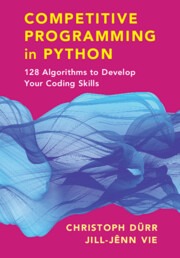
Competitive Programming in Python : 128 Algorithms to Develop your Coding Skills
Learn all the algorithmic techniques and programming skills you need from two experienced coaches, problem setters, and jurors for coding competitions. The authors highlight the versatility of each algorithm by considering a variety of problems and show how to implement algorithms in simple and efficient code. What to expect: * Master 128 algorithms in Python. * Discover the right way to tackle a problem and quickly implement a solution of low complexity.
Calculus of one variable
Aimed at first-year undergraduates in mathematics and the physical sciences, the only prerequisites are basic algebra, coordinate geometry and the beginnings of differentiation as covered in school. The transition from school to university mathematics is addressed by means of a systematic development of important classes of techniques, and through careful discussion of the basic definitions and some of the theorems of calculus, with proofs where appropriate, but stopping short of the rigour involved in Real Analysis.The influence of technology on the learning and teaching of mathematics is recognised through the use of the computer algebra and graphical package MAPLE to illustrate many of the ideas.
Arithmetic of finite fields ; 2nd International Workshop, WAIFI 2008 Siena, Italy, July 6-9, 2008 Proceedings
This book constitutes the refereed proceedings of the Second International Workshop on the Arithmetic of Finite Fields, WAIFI 2008, held in Siena, Italy, in July 2008.
