



الصفحة 2
الصفحة 2

Intercultural Language Use and Language Learning
This volume attempts to address an issue that deserves further attention on the part of language acquisition researchers: that of intercultural learners in instructed language contexts. Given the fact that most speech communities where such learning takes place are at least bilingual, and the idea that English is studied for the purposes of communication among people from different cultures, the book focuses on English learners as intercultural speakers. In so doing, the volume brings together three main research areas: those of the study of English as a lingua franca, the development of communicative competence and the use and acquisition of a language beyond a second one in instructed contexts.
Intelligence and security informatics ; Vol. 3495 : IEEE International Conference on Intelligence and Security Informatics, ISI 2005, Atlanta, GA, USA, May 19-20, 2005, Proceedings
Intelligence and security informatics (ISI) can be broadly defined as the study of the development and use of advanced information technologies and systems for national and international security-related applications, through an integrated technological, organizational, and policy-based approach. In the past few years, ISI research has experienced tremendous growth and attracted substantial interest from academic researchers in related fields as well as practitioners from both government agencies and industry. The first two meetings (ISI 2003 and ISI 2004) in the ISI symposium and conference series were held in Tucson, Arizona, in 2003 and 2004, respectively. They provided a stimulating intellectual forum for discussion among previously disparate communities: academic researchers in information technologies, computer science, public policy, and social studies; local, state, and federal law enforcement and intelligence experts; and information technology industry consultants and practitioners.

Integrated Management and Biocontrol of Vegetable and Grain Crops Nematodes
The second volume of the IMPD series describes aspects related to most important phytoparasitic nematodes, considering the integration of biological control methods with other management practices and technologies, including the use of predatory nematodes and microbial rhizosphere antagonists. Chapters cover topics like the mode of action and interactions of nematophagous fungi, the efficacy of controll and management of plant parasitic nematode communities through a soil conservation approach, and exploitation of nematodes-bacteria antagonistic relationships.

Integrated formal methods ; 3rd International Conference, IFM 2002, Turku, Finland, May 15-18, 2002. Proceedings.
IFM 2002 explored the relations between formal methods and graphical notations, especially the industrial standard language for software design, the Unified Modeling Language (UML). The themes of IFM 2002 reflect what we believe is a growing trend in the Formal Methods and Software Engineering research communities. Over the last threedecades,computer scientists have developed a range of formalisms focusing on particular aspects of behavior or analysis, such as sequential program structures, concurrent program structures, data and information structures, temporal reasoning, deductive proof, and model checking. Much effort is now being devoted to integrating these methods in order to combine their advantages and ensure they scale up to industrial needs. Graphical notations are now widely used in software engineering and there is growing recognition of the importance of providing these with the for mal underpinnings and form alanalysis capabilities found in formal methods.

Innovative Internet Community Systems ; Vol. 3908 ; 5th International Workshop, IICS 2005, Paris, France, June 20-22, 2005. Revised Papers
Traditionally, there are topics discussed in three main aspects. All of them must be considered in a united manner in order to investigate and understand the emergence and evolution of communities in the Internet: knowledge about networking, content and text processing as well as theory. The goal of the I2CS workshop is to bring researchers from both industry and academic fields together to discuss current progress and future developments in these areas and to eliminate the gap between theory and application. At this point, we want to express immense gratitude to all the authors of the submitted papers and to the members of the international Program Committee for their contribution to the success of the event and a program of high quality. In a peer-to-peer review process, 17 papers were selected out of 27 submissions.
Innovative Internet Community Systems ; Vol. 3473 ; 4th International Workshop, IICS 2004, Guadalajara, Mexico, June 21-23, 2004. Revised Papers
This book constitutes the thoroughly refereed postproceedings of the 4th International Workshop on Innovative Internet Community Systems, IICS 2004, held in Guadalajara, Mexico, in June 2004. The 25 revised full papers presented together with 2 invited papers have been carefully reviewed. They focus mainly on system-oriented problems, text processing, and theoretical foundations of distributed and Internet systems. They also deal with speed and quality-of-service problems of Internet protocols, aspects of cooperation and collaboration in Internet systems, as well as agent and text-processing-based methods. In addition, 9 papers stem from two mini-workshops, one on computational epidemiology and the other on optimization of urban traffic systems.
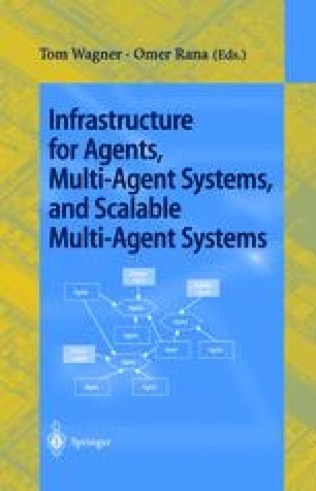
Infrastructure for Agents, Multi-Agent Systems, and Scalable Multi-Agent Systems ; International Workshop on Infrastructure for Scalable Multi-Agent Systems, Barcelona, Spain, June 3-7, 2000 Revised Papers
Building research grade multi-agent systems usually involves a broad variety of software infrastructure ingredients like planning, scheduling, coordination, communication, transport, simulation, and module integration technologies and as such constitutes a great challenge to the individual researcher active in the area. The book presents a collection of papers on approaches that will help make deployed and large scale multi-agent systems a reality. The first part focuses on available infrastructure and requirements for constructing research-grade agents and multi-agent systems. The second part deals with support in infrastructure and software development methods for multi-agent systems that can directly support coordination and management of large multi-agent communities; performance analysis and scalability techniques are needed to promote deployment of multi-agent systems to professionals in software engineering and information technology.

Indigenous Cultures and Sustainable Development in Latin America
This book outlines development theory and practice over time as well as critically interrogates the “cultural turn” in development policy in Latin American indigenous communities, specifically, in Guatemala, Honduras, Ecuador, and Bolivia.

Imaging for Detection and Identification
The dynamic interaction between world-renowned scientists from the usually disparate communities of pure mathematicians and applied sci- tists which occurred at our seven previous ASI’s continued at this meeting. The fusion of basic ideas in mathematics, radar, sonar, biology, and ch- istry with ongoing improvements in hardware and computation offers the promise of much more sophisticated and accurate detection and identi?cation capabilities than currently exist. Coupled with the dramatic rise in the need for surveillance in innumerable aspects of our daily lives, brought about by hostile acts deemed unimaginable only a few short years ago, the time is ripe for image processing scientists in these usually diverse ?elds to join together in a concerted effort to combat the new brands of terrorism. This ASI was one important initial step.

Human nutrition : University of Hawai‘i at Mānoa food science and human nutrition Program
A nutrition resource that reflects the diverse dietary patterns of people in Hawai‘i and the greater Pacific. Using the ‘ōlelo no‘eau, or Hawaiian proverb, stated above, we believe that the prin-ciples of nutrition should be taught through the context of our communities and environ-ments.

Human microbiome : Clinical implications and therapeutic interventions
The human microbiome refers to the complete microorganisms inhabiting the human body sites including skin, ear, nose, oral cavity, the genital, gastrointestinal and respiratory tracts, and body fluids such as breast milk, saliva, and urine. It is a significant and essential organ recognized for the body and has an established involvement in the host wellbeing, in terms of nutritional requirements and immunomodulation. Talks about how alteration and imbalance in the same can have clinical implications associated with a multitude of gastrointestinal, lifestyle-associated, and neurodegenerative disorders. How the proliferation of specific groups of bacteria and their metabolic activities, as a result of intestinal dysbiosis leads to the 'leaky gut' condition thereby influences brain activity via the bidirectional gut-brain axis. It also coves the importance of microbial seeding and how it can be influenced by the mode of delivery, nutrition, and medication. This book also provides various therapeutic interventions such as the establishment of stool banks and Faecal microbiota transplantation (FMT) that have recently proved promising in the treatment of ASD, Inflammatory Bowel Disease, and Ulcerative Colitis. This book provides a deeper understanding of the development of the human gut microbiome and the factors driving its dysbiosis. This book is a valuable read for health professionals, medical students, nutritionists, and scientific research communities who are eager to update themselves with recent trends in microbiome research. It will also aid gastroenterologists and nutritionists to make well-informed choices regarding therapeutic regimes.

Human Ecology : Biocultural Adaptations in Human Communities
Beginning with resource use and food procurement behaviour, the text examines major subsistence modes, the circumstances and dynamics of large-scale subsistence change, the effect of social differentiation on resource use and the effects of subsistence behaviour on population development and regulation.

Histories of experience in the world of lived religion
This book offers a theoretical introduction to the history of experience on three conceptual levels: everyday experience, experience as process, and experience as structure. Chapters apply 'experience' to empirical case studies, exploring how people have made and shared their religion through experience in history. This book understands experience as a simultaneously socially constructed and intimately personal process that connects individuals to communities and past to future, thereby forming structures that create and direct societies. It represents the crossroads of a new field of the history of experience, and an established tradition of the history of lived religion.

Higher education : Handbook of theory and research ; Vol. 23
Published annually since 1985, the Handbook series provides a compendium of thorough and integrative literature reviews on a diverse array of topics of interest to the higher education scholarly and policy communities. Each chapter provides a comprehensive review of research findings on a selected topic, critiques the research literature in terms of its conceptual and methodological rigor, and sets forth an agenda for future research intended to advance knowledge on the chosen topic. The Handbook focuses on twelve general areas that encompass the salient dimensions of scholarly and policy inquiries undertaken in the international higher education community.

Higher education : Handbook of theory and research ; Vol. 22
Published annually since 1985, the Handbook series provides a compendium of thorough and integrative literature reviews on a diverse array of topics of interest to the higher education scholarly and policy communities. Each chapter provides a comprehensive review of research findings on a selected topic, critiques the research literature in terms of its conceptual and methodological rigor, and sets forth an agenda for future research intended to advance knowledge on the chosen topic. The Handbook focuses on twelve general areas that encompass the salient dimensions of scholarly and policy inquiries undertaken in the international higher education community. The series is fortunate to have attracted annual contributions from distinguished scholars throughout the world.

Higher education : Handbook of theory and research ; Vol. 21
Published annually since 1985, the Handbook series provides a compendium of thorough and integrative literature reviews on a diverse array of topics of interest to the higher education scholarly and policy communities. Each chapter provides a comprehensive review of research findings on a selected topic, critiques the research literature in terms of its conceptual and methodological rigor, and sets forth an agenda for future research intended to advance knowledge on the chosen topic. The Handbook focuses on twelve general areas that encompass the salient dimensions of scholarly and policy inquiries undertaken in the international higher education community. The series is fortunate to have attracted annual contributions from distinguished scholars throughout the world.

Higher education : Handbook of theory and research ; Vol. 20
Published annually since 1985, the Handbook series provides a compendium of thorough and integrative literature reviews on a diverse array of topics of interest to the higher education scholarly and policy communities. Each chapter provides a comprehensive review of research findings on a selected topic, critiques the research literature in terms of its conceptual and methodological rigor, and sets forth an agenda for future research intended to advance knowledge on the chosen topic. The Handbook focuses on twelve general areas that encompass the salient dimensions of scholarly and policy inquiries undertaken in the international higher education community. The series is fortunate to have attracted annual contributions from distinguished scholars throughout the world.
Heritage building conservation : Sustainable and digital modelling
Covers: The technology used to digitally document heritage buildings, including LIDAR, photogrammetry, Heritage Building Information Modelling (HBIM), and Virtual Reality (VR) technologies Introducing a Maintainability Index of Heritage Buildings (MIHB) to support the decision-making and prioritization process for the maintenance of heritage buildings The adaptive reuse of heritage buildings Modelling embodied and operational energy performance Using Chatbot and Blockchain technology to support the management and preservation of heritage buildings Ultimately, this book presents a useful tool for use in heritage management and highlights how the reusability of heritage buildings is critical to the creation and survival of sustainable communities.

Hardware and software : Verification and testing ; 1st International Haifa Verification Conference, Haifa, Israel, November 13-16, 2005, Revised Selected Papers
The First Haifa Verification Conference was held at the IBM Haifa Research Lab and at the Haifa University in Israel from November 13 to16, 2005. The conference incorporated three different workshops that took place separately in previous years. The IBM Verification Workshop is now its sixth year, the IBM Software Testing Workshop is now in its fourth year, and the PADTAD Workshop on testing and debugging multi-threaded and parallel software was held for the third time. The Verification Conference was a three-day, single-track conference followed by a one-day tutorial on the testing and review of multi-threaded code. The conference presented a unique combination of fields that brought together the hardware and software testing communities. Merging the different communities under a single roof gave the conference a distinctive flavor and provided the participants with added benefits. While the applications in these separate fields are different, the techniques used are often very similar. By offering lectures in these disparate but related disciplines, the conference engendered an environment of collaboration and discovery.

Happiness is the Wrong Metric : A Liberal Communitarian Response to Populism
This timely book addresses the conflict between globalism and nationalism. It provides a liberal communitarian response to the rise of populism occurring in many democracies. The book highlights the role of communities next to that of the state and the market. It spells out the policy implications of liberal communitarianism for privacy, freedom of the press, and much else. In a ersuasive argument that speaks to politics today from Europe to the United States to Australia, the author offers a compelling vision of hope. Above all, the book offers a framework for dealing with moral challenges people face as they seek happiness but also to live up to their responsibilities to others and the common good.
