



الصفحة 2
الصفحة 2

Dynamic Spectrum Management : From Cognitive Radio to Blockchain and Artificial Intelligence
This book, authored by a world-leading researcher in this field, describes fundamentals of dynamic spectrum management, provides a systematic overview on the enabling technologies covering cognitive radio, blockchain, and artificial intelligence, and offers valuable guidance for designing advanced wireless communications systems.

Dynamic characterisation of analogue-to-digital converters
Dynamic Characterisation of Analogue-to-Digital Converters presents a state of the art overview of the methods and procedures employed for characterising ADCs’ dynamic performance behaviour using sinusoidal stimuli. The three classical methods – histogram, sine wave fitting, and spectral analysis – are thoroughly described, and new approaches are proposed to circumvent some of their limitations

Distributed Embedded Control Systems : Improving Dependability with Coherent Design
Distributed Embedded Control Systems handles the domains encountered when designing a distributed embedded computer control system as an integrated whole. First to be discussed are some basic issues about real-time systems and their properties, specifically safety. Then, system and hardware architectures are dealt.

Distributed Consensus in Multi-vehicle Cooperative Control : Theory and Applications
Distributed Consensus in Multi-vehicle Cooperative Control develops distributed consensus strategies designed to ensure that the information states of all vehicles in a network converge to a common value. This approach strengthens the team, minimizing power consumption and the deleterious effects of range and other restrictions.
Distributed computing in sensor systems ; 4th IEEE International Conference, DCOSS 2008 Santorini Island, Greece, June 11-14, 2008 Proceedings
The book constitutes the refereed proceedings of the 4th International Conference on Distributed Computing in Sensor Systems, DCOSS 2008, held on Santorini Island, Greece, in June 2008.
Dissemination of Information in Optical Networks : From Technology to Algorithms In Cooperation with Ralf Klasing
This book gives a broad overview of techniques used in the design of WDM networks for efficient dissemination of information in computer networks.

Digital video and audio broadcasting technology : A practical engineering guide
"Digital Video and Audio Broadcasting Technology – A Practical Engineering Guide" deals with all the most important digital television, sound radio and multimedia standards such as MPEG, DVB, DVD, DAB, ATSC, T-DMB, DMB-T, DRM and ISDB-T. The book provides an in-depth look at these subjects in terms of practical experience.

Digital synthesizers and transmitters for software radio
By programming the digital synthesizers and transmitters, adaptive channel bandwidths, modulation formats, frequency hopping and data rates are easily achieved. Techniques such as digital predistortion for power amplifier linearization, digital compensation methods for analog I/Q modulator nonlinearities and digital power control and ramping are presented in this book

Digital Signal Processing : An Experimental Approach
Digital Signal Processing is a mathematically rigorous but accessible treatment of digital signal processing that intertwines basic theoretical techniques with hands-on laboratory instruction. Divided into three parts, the book covers various aspects of the digital signal processing (DSP) "problem".

Design of Ultra Wideband Antenna Matching Networks : Via Simplified Real Frequency Technique
Design of Ultra Wideband Antenna Matching Networks: via Simplified Real Frequency Technique (SRFT) is the first of its kind and expected to fill a very important gap in the field of wireless communication.

Converged communications : Evolution from telephony to 5G mobile internet
The central theme of the book is to build deeper understanding about incremental technological progress by introducing both state of the art and their predecessor technologies. The book explores four main areas, including fixed telephone systems, data communication systems, mobile cellular systems, and IP multimedia systems. It clearly explains architectures, protocols, and functional procedures, and discusses a variety of topics ranging from physical layer processes to system level interactions. Converged Communications offers: In-depth treatments of fixed telephone and transmission systems, including operation of telephone exchanges and signaling systems Comprehensive explorations of data communication systems, including transmission of data over telephone lines and data network technologies, such as Ethernet and TCP/IP Incisive discussions of mobile cellular systems, including GSM, 3G, LTE, VoLTE and 5G Insightful analysis of incremental system evolution to justify various design choices made The book is supported with extensive online appendices, which covers communication system concepts, an overview of standardization, various technologies used in the past, state-of-the art technologies such as WLAN, cable modems, and FTTx, complementing the other systems described in the book which have evolved from the fixed telephone network.

Control and Scheduling Codesign : Flexible Resource Management in Real-Time Control Systems
Recent evolutionary advances in information and communication technologies give rise to a new environment for Real Time Control Systems. This book is a monograph that covers our recent and original results in this direction.

Contributions to Simulation Speed-Up : Rare Event Simulation and Short-Term Dynamic Simulation for Mobile Network Planning
Eugen Lamers explains the principle of simulation speed-up in general, demonstrates the technique RESTART for the simulation of rare events, and addresses its efficiency on distributed systems.
Managing the Complexity of Critical Infrastructures : A Modelling and Simulation Approach
This book summarizes work being pursued in the context of the CIPRNet (Critical Infrastructure Preparedness and Resilience Research Network) research project, co-funded by the European Union under the Seventh Framework Programme (FP7). The project is intended to provide concrete and on-going support to the Critical Infrastructure Protection (CIP) research communities, enhancing their preparedness for CI-related emergencies, while also providing expertise and technologies for other stakeholders to promote their understanding and mitigation of the consequences of CI disruptions, leading to enhanced resilience.
Machine Learning for Cyber Physical Systems : Selected papers from the International Conference ML4CPS 2020
Presents new approaches to Machine Learning for Cyber Physical Systems, experiences and visions. It contains selected papers from the fifth international Conference ML4CPS – Machine Learning for Cyber Physical Systems, which was held in Berlin, March 12-13, 2020.

Machine Learning for Cyber Physical Systems : Selected papers from the International Conference ML4CPS 2018
Presents new approaches to Machine Learning for Cyber Physical Systems, experiences and visions. Cyber Physical Systems are characterized by their ability to adapt and to learn: They analyze their environment and, based on observations, they learn patterns, correlations and predictive models. Typical applications are condition monitoring, predictive maintenance, image processing and diagnosis. Machine Learning is the key technology for these developments.

Communicating, Networking : Interacting : The International Year of Global Understanding - IYGU
illustrates the benefits to be gained from digitally networked communication for health, education and transitioning economies in developing nations (Sierra Leone and Papua New Guinea) and developed nations. Growing powers of e-citizenship can help build sustainable futures. This small volume provides a collection of examples and ideas from which the authors hope will help build a wider resource. Understanding how to link everyday lives with global networks in the digital world in ways that add benefit for the world’s people, and the health of the planet, is an ongoing project. IYGU recognises the integral roles of networking and communication systems, as well as interactions between people, near and far, as fundamental for building better futures. The global penetration of digital devices means everyday life, present and future, is inextricably linked with information technologies

Challenges for next generation network operations and service management : 11th Asia-Pacific network operations and management symposium, APNOMS 2008, Beijing, China, October 22-24, 2008. Proceedings
This book constitutes the refereed proceedings of the 11th Asia-Pacific Network Operations and Management Symposium, APNOMS 2008, held in Beijing, China, in October 2008.
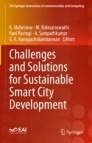
Challenges and Solutions for Sustainable Smart City Development
Discusses advances in smart and sustainable development of smart environments. The authors discuss the challenges faced in developing sustainable smart applications and provide potential solutions. The solutions are aimed at improving reliability and security with the goal of affordability, safety, and durability. Topics include health care applications, sustainable smart transportation systems, intelligent sustainable wearable electronics, and sustainable smart building and alert systems. Authors are from both industry and academia and present research from around the world. Addresses problems and solutions for sustainable development of smart cities; Includes applications such as healthcare, transportation, wearables, security, and more ; Relevant for scientist and researchers working on real time smart city development.

Broadband satellite communication systems and the challenges of mobility ; IFIP TC6 Workshops on broadband satellite communication systems and challenges of mobility, world computer congress ; August 22-27, 2004, Toulouse, France
This book constitutes the refereed proceedings of IFIP TC6 Workshops on Broadband Satellite Communication Systems and Challenges of Mobility, World Computer Congress, 2004, Toulouse, France includTopics Communications Engineering, Networks Computer Communication Networks / Software Engineering/Programming and Operating Systems / Computer Systems Organization and Communication Networks / Information Systems and Communication Service / Multimedia Information Systems
