



الصفحة 2
الصفحة 2
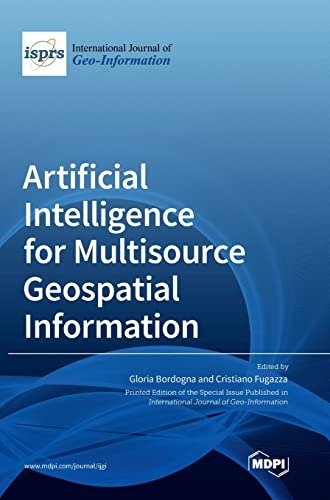
Artificial intelligence for multisource geospatial information
Collects 10 original research contributions published in the Special Issue entitled “Artificial Intelligence for Multisource Geospatial Information” of the ISPRS International Journal of Geo-Information. The focus is on different methods of Geospatial Artificial Intelligence (GeoAI) based on deep learning using different network architectures, clustering, soft computing, and semantic approaches. They are proposed to deal with a variety of Geospatial Big Data (GBD), such as georeferenced texts and photos in social networks, remote sensing images, cartographic maps, multidimensional geo databases, metadata in spatial data infrastructures, and for different tasks, such as for multisource georeferenced text integration and geodata flexible querying, for social sensing by applying sentiment analysis, clustering and geo analysis, for segmentation of roads, clouds and snow, and for detection of small targets and people on the streets.

Applied Multivariate Statistical Analysis
This book presents the tools and concepts of multivariate data analysis in a way that is understandable for non-mathematicians and practitioners who face statistical data analysis.

An R and S-Plus® Companion to Multivariate Analysis
Most data sets collected by researchers are multivariate, and in the majority of cases the variables need to be examined simultaneously to get the most informative results. This requires the use of one or other of the many methods of multivariate analysis, and the use of a suitable software package such as S-PLUS or R. In this book the core multivariate methodology is covered along with some basic theory for each method described. The necessary R and S-PLUS code is given for each analysis in the book, with any differences between the two highlighted.

Advances in radar systems for target detection and tracking
Radar systems can provide the all-weather and all-time detection and tracking of targets of interest, and they have been extensively applied by the remote sensing community, in applications such as geological exploration, disaster forecasting, traffic monitoring, urban planning, environmental sciences, hydrology, littoral zones, oceans, etc. This reprint contains the several advance research studies on radar systems for target detection and tracking. It includes multipath ghost suppression, maneuvering target tracking, target detection, and other topics.

Advanced artificial intelligence models and its applications
The field of artificial intelligence (AI) has undergone enormous expansion since its inception in the mid-20th century, as demonstrated by its application across an array of engineering and scientific challenges. Particularly in the last decade, AI has witnessed a significant breakthrough with the advent of deep learning, which has facilitated the employment of various AI models across a multitude of domains. This reprint features ten papers accepted for publication in the Special Issue titled "Advanced Artificial Intelligence Models and Their Applications," published in the MDPI Mathematics journal. These papers explore numerous facets of advanced artificial intelligence models and their applications, covering areas such as cybersecurity, image classification, logistics optimization, automatic music generation, human capital investment, writer recognition, remote sensing image indexing, target tracking, and more.

A Theory of Shape Identification
Recent years have seen dramatic progress in shape recognition algorithms applied to ever-growing image databases. They have been applied to image stitching, stereo vision, image mosaics, solid object recognition and video or web image retrieval. More fundamentally, the ability of humans and animals to detect and recognize shapes is one of the enigmas of perception. The book describes a complete method that starts from a query image and an image database and yields a list of the images in the database containing shapes present in the query image. A false alarm number is associated to each detection. Many experiments will show that familiar simple shapes or images can reliably be identified with false alarm numbers ranging from 10-5 to less than 10-300.

A concise guide to market research : The process, data, and methods using IBM SPSS Statistics, 3rd
Offers an easily accessible and comprehensive guide to the entire market research process, from asking market research questions to collecting and analyzing data by means of quantitative methods. It is intended for all readers who wish to know more about the market research process, data management, and the most commonly used methods in market research. The book helps readers perform analyses, interpret the results, and make sound statistical decisions using IBM SPSS Statistics. Hypothesis tests, ANOVA, regression analysis, principal component analysis, factor analysis, and cluster analysis, as well as essential descriptive statistics, are covered in detail.
