



الصفحة 2
الصفحة 2

Engineering for Sustainable Development : Theory and Practice
Offers a wide range of civil, mechanical, electrical, and chemical engineering industry applications. Readers will also benefit from: A thorough introduction to contemporary sustainability challenges in the engineering discipline Comprehensive discussions of sustainability assessment tools, including triple bottom line assessment (TBL) and the environmental life cycle assessment (LCA) In-depth examinations of sustainable engineering strategies, including cleaner production and eco-efficiency methods and environmental management systems Detailed review of green engineering principles and industrial symbiosis in engineering application. A link between product stewardship and the design for the environment

Electroanalytical shemistry : Principles, best practices, and case studies
Written for undergraduate majors in chemistry and chemical engineering, this book teaches the basic principles of electroanalytical chemistry and illustrates best practices through the use of case studies of organic reactions and catalysis using voltammetric methods and of the measurement of clinical and environmental analytes by potentiometric techniques. It provides insight beyond the field of analysis as students address problems arising in many areas of science and technology. The book also emphasizes electrochemical phenomena and conceptual models to help readers understand the influence of experimental conditions and the interpretation of results for common potentiometric and voltammetric methods.

Dynamics of Fibre Formation and Processing : Modelling and Application in Fibre and Textile Industry
The book deals with the modelling of steady state and non-steady state basic processes of fibre formation and fibre processing. Focal points are melt spinning processes (polymers and glass, drawing, spunbonded nonwoven), spun yarn spinning processes (drafting, carding) and the description of the dynamics in different process steps during the fibre processing (fibre transport, fibre heating and cooling, false twist texturing). A special chapter deals with dynamics of tensile force (measuring and evaluation possibilities) and its importance for the process stability. All presented examples are based on industrial practice and give the reader a direct imagination of the discussed problems. The results are explained in a userfriendly way and give the practitioner the possibility to optimize his or her own processing.

Dynamic Modeling, Predictive Control and Performance Monitoring : A Data-driven Subspace Approach
A typical design procedure for model predictive control or control performance monitoring consists of: identification of a parametric or nonparametric model, derivation of the output predictor from the model and design of the control law or calculation of performance indices according to the predictor.

Distillation : Principles and practice
Distillation Principles and Practice Second Edition covers all the main aspects of distillation including the thermodynamics of vapor/liquid equilibrium, the principles of distillation, the synthesis of distillation processes, the design of the equipment, and the control of process operation.

Control and Observer Design for Nonlinear Finite and Infinite Dimensional Systems
This volume presents a well balanced combination of state-of-the-art theoretical results in the field of nonlinear controller and observer design, combined with industrial applications stemming from mechatronics, electrical, (bio–) chemical engineering, and fluid dynamics. The unique combination of results of finite as well as infinite–dimensional systems makes this book a remarkable contribution addressing postgraduates, researchers, and engineers both at universities and in industry. The contributions to this book were presented at the Symposium on Nonlinear Control and Observer Design: From Theory to Applications (SYNCOD), held September 15–16, 2005, at the University of Stuttgart, Germany.

Collaborative and Distributed Chemical Engineering : From Understanding to Substantial Design Process Support; Results of the IMPROVE Project
The focus of IMRPOVE is on understanding, formalizing, evaluating, and, consequently, improving design processes in chemical engineering. In particular, IMPROVE focuses on conceptual design and basic engineering, where the fundamental decisions concerning the design or redesign of a chemical plant are undertaken.

Materials Handbook : A Concise Desktop Reference
The unique and practical Materials Handbook (second edition) provides quick and easy access to data on the physical and chemical properties of all classes of materials. The second edition has been much expanded to include whole new families of materials while many of the existing families are broadened and refined with new material and up-to-date information. Particular emphasis is placed on the properties of common industrial materials in each class.

Marine Biotechnology II
This volume of Advances in Biochemical Engineering/Biotechnology illustrates several topics in line with the following broad objectives: thinking of marine biotechnology as the controlled production and use of marine organisms and molecules for useful purposes, firstly by exploring aspects of marine biodiversity and exploitation of biomass, then considering the identification, production and processing of marine products.

Marine Biotechnology I
Oceans, which occupy up to two thirds of the surface of our planet, were not really approached from scientific point of view until the second half of the 19th century and even the 20th with regard to microbial and unicellular life. Today, the importance of marine biodiversity has been fully recognized. It is, indeed, one of the aspects which, over the two past decades, have made a major contribution to our knowledge and vision of the living planetThis volume of Advances in Biochemical Engineering/Biotechnology illustrates several topics in line with the following broad objectives: thinking ofmarine biotechnology as the controlled production and use of marine organisms and molecules for useful purposes, firstly by exploring aspects of marine biodiversity and exploitation of biomass, then considering the identification, production and processing of marine products.
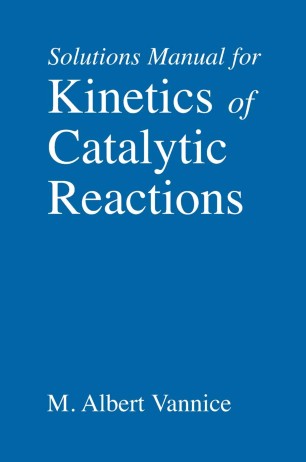
Kinetics of Catalytic Reactions--Solutions Manual
This textbook contains all the information needed for graduate students or industrial researchers to design kinetic experiments involving heterogeneous catalysts, to characterize these catalysts, to acquire valid rate data, to verify the absence of mass (and heat) transfer limitations, to propose reaction models, to derive rate expressions based on these models and, finally, to assess the consistency of these rate equations.The most recent technique to calculate heats of adsorption and activation barriers on metal surfaces, the BOC-MP approach, is discussed in detail. Methods to measure metal surface areas and crystallite sizes using x-ray diffraction, transmission electron microscopy and various chemisorption techniques are discussed. Different experimental techniques to determine the influence of mass transfer limitations, especially within the pores of a catalyst, are reviewed in detail, with a particular emphasis on liquid-phase reactions.

Kinetics of Catalytic Reactions
This textbook contains all the information needed for graduate students or industrial researchers to design kinetic experiments involving heterogeneous catalysts, to characterize these catalysts, to acquire valid rate data, to verify the absence of mass (and heat) transfer limitations, to propose reaction models, to derive rate expressions based on these models and, finally, to assess the consistency of these rate equations.Many illustrations of these and other topics are provided along with numerous problems and a Solutions Manual for instructors. This book will be applicable to any graduate course in chemical engineering, chemistry or materials science that involves kinetics of catalytic reactions, including those catalyzed by enzymes.

Chemical Reactor Modeling : Multiphase Reactive Flows
Chemical Reactor Modeling closes the gap between Chemical Reaction Engineering and Fluid Mechanics. It presents the fundamentals of the single-fluid and multi-fluid models for the analysis of single- and multiphase reactive flows in chemical reactors with a chemical reactor engineering rather than mathematical bias.
Chemical product formulation design and optimization : methods, rechniques, and case studies
A team of renowned technologists and engineers delivers a practice guide to chemical product design. Offering real-world case studies for disinfectant formulation, the optimization of defined media, and the formulation of biocomposites, the book contains introduction to the current product design process. A practical approach to the essentials of product design, related statistical techniques and optimization, patents, green chemistry and gives real life case studies.

Chemical process engineering ; Vol.1 : Design, analysis, simulation, integration, and problem solving with microsoft Excel-UniSim software for chemical engineers computation, physical Property, fluid flow, equipment and instrument sizing
The book provides a detailed description and hands-on experience on process design in chemical engineering, and it is an integrated text that focuses on practical design with new tools, such as Excel spreadsheets and UniSim simulation software.

Characterization II
Molecular Sieves - Science and Technology covers, in a comprehensive manner, the science and technology of zeolites and all related microporous and mesoporous materials. Authored by renowned experts, the contributions to this handbook-like series are grouped together topically in such a way that each volume deals with a specific sub-field. Volume 5 complements Volume 4 (Characterization I) in that it is devoted to the characterization of molecular sieves by a variety of non-spectroscopic techniques (Characterization II). Thus, Volume 5 comprises Chemical Analysis, Thermal Analysis, Pore-Size Characterization by Molecular Probes, Characterization by 129Xe NMR, Coke Characterization, Synthesis and Characterization of Isomorphously Substituted Molecular Sieves.
Cell Culture Engineering
Many patients suffering with life-threatening diseases or chronic dysfunctions, which were medically untreatable not long ago, can attest to the wonder these drugs have achieved. Although the first generation of p- tein therapeutics was produced in recombinant Escherichia coli, most recent products use mammalian cells as production hosts. Not long after the first p- duction of recombinant proteins in E. coli, it was realized that the complex tasks of most post-translational modifications on proteins could only be efficiently carried out in mammalian cells.

Cathodic Arcs : From Fractal Spots to Energetic Condensation
Cathodic Arcs: From Fractal Spots to Energetic Condensation is the first book in over a decade dedicated to the physics and technology of cathodic arcs. It includes a detailed account of arc history, a textbook-like introduction to cathode phenomena, and some basic physics of expanding plasmas; it deals with the infamous macroparticle issue and describes a host of practical plasma filter solutions. In contrast to previous books on cathodic arcs, the focus is on the relation of arc plasmas and their properties to surface modification and thin film deposition. The book contains sections on basic plasma physics and thin film materials science. It also deals with practical issues of coatings such as stress control and the often-underrated issue of the coating’s color. By stressing the fractal nature of cathode spots, the theme of fluctuations can be found throughout the book: fluctuations affect all plasma properties and thereby have consequences for plasma-based surface modifications and film growth.

Biotechnology for the Future
One area that has attracted much attention is the use of cell factories for the production of a wide range of chemicals. This area illustrates very well the definition of biochemical engineering , and it has therefore been chosen as the focus of this volume. The use of cell factories for production of chemicals dates back to the production of penicillin, ethanol, acetone–butanol, glycerol and further to enzymes and other antibiotics. All these products were traditionally produced by cell factories that naturally produce these compounds. With the introduction of genetic engineering it has,This volume therefore contains chapters on concepts of metabolic engineering on detailed modeling of cellular systems

Biosensing for the 21st Century
Covers trends in modern biotechnology All aspects of this interdisciplinary technology, where knowledge, methods and expertise are required from chemistry, biochemistry, microbiology, genetics, chemical engineering and computer science, are treated
