



الصفحة 2
الصفحة 2

Introducing architectural tectonics
Focuses on the tectonic analysis of twenty contemporary works of architecture located in eleven countries including Germany, Italy, United States, Chile, Japan, Bangladesh, Spain, and Australia and designed by such notable architects as Tadao Ando, Herzog & de Meuron, Kengo Kuma, Olson Kundig, and Peter Zumthor. Although similarities do exist between the projects, their distinctly different characteristics – location and climate, context, size, program, construction methods – and range of interpretations of tectonic expression provide the most significant lessons of the book, helping you to understand tectonic theory. Written in clear, accessible language, these investigations examine the poetic creation of architecture, showing you lessons and concepts that you can integrate into your own work, whether studying in a university classroom or practicing in a professional office.

Interiors Construction Manual : Integrated Planning, Finishings and Fitting-Out, Technical Services
Supports planners in their daily work as a practical planning aid and reference work with the relevant standards, guidelines, reference details, and constructional solutions, all illustrated by built example projects. It brings together the crucial facts on all aspects of interior construction and presents the key fundamentals of building physics, fire protection, interior construction systems, and openings. In addition, it offers concrete tips on integrated planning approaches, energy and sustainability issues, materials used in interior construction, hazardous substances, and dealing with building services and light planning.

Interior Design Illustrated
Introduces complex design concepts in a visually stunning format; from defining the space and using the elements of design, to planning building systems and incorporating sustainable materials, this volume embodies the idea that beauty and function are not separate entities, but two parts of a whole. This new fourth edition has been updated to reflect the latest building codes and design practices, with discussion of new materials related to acoustics, lighting, and sustainable furnishings. Renewed attention to sustainability includes new information on energy conservation, design for longevity and adaptive reuse of existing buildings, as well as an updated discussion on LED lighting, workplace design, use of color, and computer modeling software to provide a well-rounded view of how interior design firms are working today. This classic text brings the elements and principles of design to life, giving students the practical skills they need to transition from idea to concept. Understand the latest building codes and how to integrate them into your design Explore new advances in materials, lighting, and wireless technology Design from a perspective of sustainability, longevity, and energy efficiency Delve into BIM, including software for modeling lighting, acoustics, and more

Insulating Modernism : Isolated and Non-Isolated Thermodynamics in Architecture
What is the best way to achieve sustainable energy savings in buildings? This book describes the history, theory and facts of the mainstream insulation technology and the emerging alternative design approaches.

Innovative Tools and methods using BIM for an efficient renovation in buildings
This book describes a BIM-based toolkit that has been developed according to the latest research activities on building information modelling and semantic interoperability to optimize the building process. It highlights the impacts of using such new tools to fast renovation activities starting from the decision-making and design stages to the construction site management with the possibility to monitor occupants' and owners’ feedback during the realization process. In this process, a framework has been developed and implemented to allow stakeholders involved in a renovation project to efficiently compile, maintain, and add data about (i) building elements, (ii) building services systems, (iii) tenants, operators, and owners of the building, and (iv) current and predicted performance of the building from the various data sources available. The framework applies and specializes the existing practices in the Semantic Web, Linked Data, and ontology domain to the management of renovation projects. It has been designed to be open so that any system which implements the required functions and uses the specified conventions will be able to achieve semantic interoperability with other framework-compliant systems in the renovation domain. Finally, this book represents the validation process of the toolkit that has been held in three demo sites: a social housing building in Italy and two private residential buildings in Poland and Finland. The outcome shows that the toolkit facilitates the renovation process with relevant reductions of time, costs, and energy consumption and that the inhabitants can take advantage of the increase in building performances, quality, and comfort.

Innovations in impact and blast protections : Foam-filled energy absorbers and steel-concrete-steel sandwich structures
Develops several novel foam-filled structures and steel-concrete-steel (SCS) sandwich structures, which provides more alternatives for ensuring the safety of buildings and infrastructures under extreme loading, like impact and blast.

Industrial steel building
The project is a design for a metal facility, which is a biscuit factory within the city of Damascus. The building consists of two floors, the first floor is offices and the second floor is for storage. The study was conducted according to the European code and the Syrian Arab code.

If ... then : Architectural speculations
he creates houses and other buildings that are snugly energy-ef?cient and sit lightly on the land. Introduction 10 Camera-Ready Green Design 11 Standards and Practices Introduction 12 A Very Short History Camera-Ready Green Design 13 A Movement’s Priorities Introduction 14 Camera-Ready Green Design 15 The Damage Done Introduction 16 Camera-Ready Green Design 17 city Cities have been around for more than six thousand years, drawing successive waves of new residents with their blend of commerce, culture, energy, and opportunity. The first city to surpass a population of one million was Baghdad, thirteen centuries ago. London topped ?ve million in 1825; New York exceeded ten million a hundred years later

Ibn Battuta Restaurant Complex
يقوم المشروع على فكرة الاستفادة من العناصر الثقافية المتنوعة في اعداد الطعام و تقديمه و اسلوب و اجواء تناوله و اعتامادها كعناصر تصميم رئيسية (ألوان - خامات - تماثيل - لوحات - أقواس.....) وأخذ العميل في جولة حول العالم في مكان واحد. لذلك فان هذا المشروع يهدف لدعم السياحة التي بدورها تدعم الاقتصاد و كذلك الى التعريف بالثقالفة الشرقية والدمشقية.

How structures work : Design and behaviour from bridges to buildings ; 2nd ed.
How the building behaves when subjected to various forces – the weight of the materials used to build it, the weight of the occupants or the traffic it carries, the force of the wind etc – is fundamental to its stability. The alliance between architecture and structural engineering is therefore critical to the successful design and completion of the buildings and infrastructure that surrounds us. Yet structure is often cloaked in mathematics which many architects and surveyors find difficult to understand.

Hotel building in Damascus city
Show a hotel building in Damascus. The project is a facility consisting of one basement use as a storage rooms and shelter, and ground story and twelve story.

Historic construction and conservation : Materials, Systems and Damage
Takes a modern approach to the meaning of a heritage structure and its conservation. The historical evolution of conservation is briefly addressed, considering prominent individuals and cases; along with the history of construction, focusing on materials and related structural elements, with insight on the sizing rules adopted by masons. This explains structural decisions made during the construction process and allows comparison of scientific theories from the 18th century to modern understanding of limit analysis. Damage and collapse mechanisms for masonry construction, as the most widespread structural form for historical buildings, is described. Excess permanent loading and settlement is differentiated from environmental and anthropogenic actions such as earthquake or incorrect intervention.
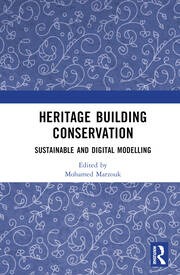
Heritage building conservation : Sustainable and digital modelling
Covers: The technology used to digitally document heritage buildings, including LIDAR, photogrammetry, Heritage Building Information Modelling (HBIM), and Virtual Reality (VR) technologies Introducing a Maintainability Index of Heritage Buildings (MIHB) to support the decision-making and prioritization process for the maintenance of heritage buildings The adaptive reuse of heritage buildings Modelling embodied and operational energy performance Using Chatbot and Blockchain technology to support the management and preservation of heritage buildings Ultimately, this book presents a useful tool for use in heritage management and highlights how the reusability of heritage buildings is critical to the creation and survival of sustainable communities.

Heating, cooling, lighting : Sustainable design methods for architects
Helps architects minimize mechanical systems and energy usage over the life of the building by siting, building design, and landscaping to maximize natural heating, cooling, and lighting. This new fourth edition includes new information on integrated design strategies and designing for the Tropics. Resources include helpful case studies, checklists, diagrams, and a companion website featuring additional cases, an image bank, and instructor materials. Designing buildings that require less energy to heat, cool, and light means allowing the natural energy of the sun and wind to reduce the burden on the mechanical and electrical systems. Basic design decisions regarding size, orientation, and form have a great impact on the sustainability, cost, and comfort of a building. Heating, Cooling, and Lighting provides detailed guidance for each phase of a design project.

Heat and cold storage with PCM : An up to date introduction into basics and applications
Latent heat storage with phase change materials (PCM) has the potential to improve significantly the efficiency of heat and cold storages and to reduce their size considerably. The book is an introduction into the field for researchers and students. It summarizes and explains the basics, general concepts, and applications with examples in a single text. For a better understanding, many derivations, graphs and tables are included. All aspects from materials analysis and modification, storage design, storage integration, and different application examples are covered. Special focus is on applications in buildings.

Healthcare design basics
Delivers an up-to-date text covering the critical aspects of healthcare design, preparing students for a specialty rapidly growing in importance and size. includes: Step by step studio guidance outlining the basic design elements required for a wide range of ambulatory healthcare facilities and rooms Comprehensive explorations of the demands of new and improved healthcare facilities that meet the needs of an aging population Practical discussions of the space planning challenges involved in designing rooms and facilities for use during public health crises, including pandemics Dozens of full-color images that illustrate and highlight important concepts, examples, and design solutions

Guidelines for thermography in architecture and civil engineering : theory, application area, practical implementation
These guidelines convey in condensed form the authors' many years of experience in detecting thermal engineering defects and structural damage such as thermal bridges, air leaks or moisture penetration damage with a non-destructive and easily applicable method of measurement and investigation. As well as providing an introduction to the physical fundamentals of thermography, the book offers an up-to-date overview of the technology, structure, standards and selection criteria of common thermographic systems.

Green new deal landscapes : Architectural design
Explores the principles behind the Green New Deal and how they apply to the architectural and landscape professions. Whatever form the Green New Deal will take and is taking, it will be materialised through infrastructure, buildings, landscapes and various other constructed forms. The contributors to this AD examine the theoretical frameworks and design practices within which the protocols of the Green New Deal could be integrated. Initially, such a goal requires a survey of the available design tools and methodologies necessary to achieve a transition to a decarbonised economy in an equitable manner. The articles feature design practices who are transforming their existing modes of operation to work in environments were fossil fuels are kept well below ground, and to explore renewable forms of local, regional and planetary urbanisation.

Graeme Mann & Patricia Capua Mann
The Lausanne architects Mann & Capua Mann have been active since 1991. Their structures are compelling thanks to the variety of their views, the diversity of their light effects, and the expressive simplicity of their spatial effects.

Future healthcare design
Describes how architects can design better healthcare buildings for a rapidly changing context and climate. Innovation in the design of healthcare estates is essential to the sustainability of our health services. Design thinking in this field is being influenced by a range of factors, such as economic constraints, an ageing demographic, complex health conditions (co-morbidities), and climate change.
