



الصفحة 2
الصفحة 2
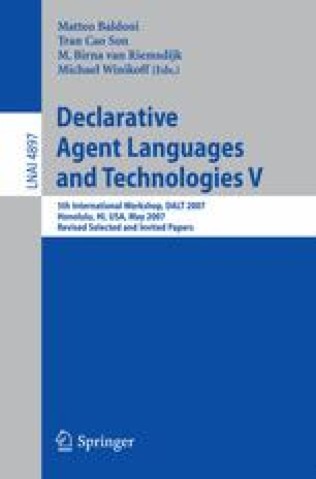
Declarative agent languages and technologiesV ; 5th International Workshop, DALT 2007, Honolulu, HI, USA, May 14, 2007, Revised Selected and Invited Papers
This book constitutes the thoroughly refereed post-workshop proceedings of the 5th International Workshop on Declarative Agent Languages and Technologies, DALT 2007, held in Honolulu, USA, in 2007.

Declarative agent languages and technologies IV ; 4th International Workshop, DALT 2006, Hakodate, Japan, May 8, 2006, Selected, Revised and Invited Papers
Constitutes the thoroughly refereed post-proceedings of the 4th International Workshop on Declarative Agent Languages and Technologies, DALT 2006, held in Japan in May 2006. This was an associated event of AAMAS 2006, the main international conference on autonomous agents and multi-agent systems. The 12 revised full papers presented together with one invited talk and three invited papers were carefully selected for inclusion in the book.

Declarative agent languages and technologies III ; 3rd International Workshop, DALT 2005, Utrecht, The Netherlands, July 25, 2005, Selected and Revised Papers
The workshop on Declarative Agent Languages and Technologies is a we- established venue for researchers interested in sharing their experiences in the areas of declarative and formal aspects of agents and multi-agent systems, and in engineering and technology. Today it is still a challenge to develop techno- gies that can satisfy the requirements of complex agent systems. The design and development of multi-agent systems still calls for models and technologies that ensure predictability, enable feature discovery, allow for the veri?cation of properties, and guarantee ?exibility. Declarative approaches are potentially a valuable means for satisfying the needs of multi-agent system developers and for specifying multi-agent systems.

Declarative agent languages and technologies II ; 2nd international workshop, DALT 2004, New York, NY, USA, July 19, 2004, revised selected papers
Nearly 40 research groups worldwide were motivated to contribute to this event by submitting their most recent research achievements, covering a wide variety of the topics listed in the call for papers. More than 30 top researchers agreed to join the Program Committee, which then collectively faced the hard task of selecting the one-day event program. The fact that research in multi-agent systems is no longer only a novel and promising research horizon at dawn is, in our opinion, the main reason behind DALT’s (still short) success story. On the one hand, agent theories and app- cations are mature enough to model complex domains and scenarios, and to successfully address a wide range of multifaceted problems, thus creating the urge to make the best use of this expressive and versatile paradigm, and also pro?t from all the important results achieved so far. On the other hand, bui- ing multi-agent systems still calls for models and technologies that could ensure system predictability, accommodate ?exibility, heterogeneity and openness, and enable system veri?cation.

Coordination, organizations, institutions, and norms in agent system III ; COIN 2007 International Workshops COIN@AAMAS 2007, Honolulu, HI, USA, May 14, 2007 COIN@MALLOW 2007, Durham, UK, September 3-4, 2007 Revised Selected Papers
This book constitutes the refereed post-workshop proceedings of the International Workshop on Coordination, Organization, Institutions and Norms in Agent Systems, COIN 2007.

Cooperative Control : A Post-Workshop Vol., 2003 Block Island Workshop on Cooperative Control
This carefully edited book presents how natural groupings such as fish schools, bird flocks, deer herds etc. coordinate themselves and move so flawlessly, often without an apparent leader or any form of centralized control. It shows how the underlying principles of cooperative control may be used for groups of mobile autonomous agents to help enable a large group of autonomous robotic vehicles in the air, on land or sea or underwater, to collectively accomplish useful tasks such as distributed, adaptive scientific data gathering, search and rescue, or reconnaissance.

Computational Logic in Multi-Agent Systems ; 7th International Workshop, CLIMA VII, Hakodate, Japan, May 8-9, 2006, Revised Selected and Invited Papers
This book constitutes the thoroughly refereed post-proceedings of the 7th International Workshop on Computational Logic for Multi-Agent Systems. It was an associated event of AAMAS 2006, the main international conference on autonomous agents and multi-agent systems.

Learning and Adaption in Multi-Agent Systems ; 1st International Workshop, LAMAS 2005, Utrecht, The Netherlands, July 25, 2005, Revised Selected Papers
Contains selected and revised papers of the International Workshop on Lea- ing and Adaptation in Multi-Agent Systems (LAMAS 2005), held at the AAMAS 2005 Conference in Utrecht, The Netherlands, July 26. An important aspect in multi-agent systems (MASs) is that the environment evolves over time, not only due to external environmental changes but also due to agent int- actions. For this reason it is important that an agent can learn, based on experience, and adapt its knowledge to make rational decisions and act in this changing environment autonomously. Machine learning techniques for single-agent frameworks are well established. Agents operate in uncertain environments and must be able to learn and act - tonomously. This task is, however, more complex when the agent interacts with other agents that have potentially different capabilities and goals. The single-agent case is structurally different from the multi-agent case due to the added dimension of dynamic interactions between the adaptive agents. Multi-agent learning, i.e., the ability of the agents to learn how to cooperate and compete, becomes crucial in many domains. Autonomous agents and multi-agent systems (AAMAS) is an emerging multi-disciplinary area encompassing computer science, software engineering, biology, as well as cognitive and social sciences. A t- oretical framework, in which rationality of learning and interacting agents can be - derstood, is still under development in MASs, although there have been promising ?
Autonomous Robots and Agents
This book deals with the theoretical and methodological aspects of incorporating intelligence in Autonomous Robots and Agents. Challenges faced in the real world to accomplish complex tasks, which require collaborative efforts, and methods to overcome them, are detailed. Several informative articles deal with navigation, localization and mapping of mobile robots, a problem that engineers and researchers are grappling with all the time.This edited volume is targeted to present the latest state-of-the-art methodologies in Robotics. It is a compilation of the extended versions of the very best papers selected from the many that were presented at the 3rd International Conference on Autonomous Robots and Agents (ICARA 2006) which was held at Palmerston North, New Zealand from 11-14 December, 2006. Scientists and engineers who work with mobile robots will find this book very useful and stimulating.
Autonomous intelligent systems : Multi-agents and data mining ; 2nd International workshop, AIS-ADM 2007, St. Petersburg, Russia, June 3-5, 2007, Proceedings
MAS offiers powerful metaphors for information system conceptualization, a range of new techniques, and technologies specifically focused on the design and implementation of lar- scale open distributed intelligent systems. KDD also provides intelligent inf- mation technology with powerful ideas, algorithms, and software means to help cope with the main problem of artificial intelligence, formulated in the we- known question “Where does the knowledge come from?”, thus actually making modern applications intelligent and adaptive. The evident recent trend in both science and industry is to integrate and take advantage of both technologies. The existing experience with combined application of multi-agent technology to design architectures of distributed (- erarchical and peer-to-peer) data mining and KDD systems, as well as the u- lization of data mining and KDD achievements to provide enhanced intelligence of MAS, confirms the fact that both technologies are capable of mutual enri- ment and their integrateduse may result in intelligent information systems with new emergent properties.
Autonomous intelligent systems : Agents and data mining ; International workshop, AIS-ADM 2005
This book constitutes the refereed proceedings of the International Workshop on Autonomous Intelligent Systems: Agents and Data Mining, AIS-ADM 2005, held in St. Petersburg, Russia in June 2005. The 17 revised full papers presented together with 5 invited papers and the abstract of an invited talk were carefully reviewed and selected from 29 submissions. The papers are organized in topical sections on agent-based data mining issues, ontologies and Web mining, and applications and case studies.
Argumentation in multi-agent systems ; Vol. 4049 ; 2nd International Workshop, ArgMAS 2005, Utrecht, Netherlands, July 26, 2005, revised selected and invited papers
This book constitutes the thoroughly refereed post-proceedings of the Second International Workshop on Argumentation in Multi-Agent Systems held in Utrecht, Netherlands in July 2005 as an associated event of AAMAS 2005, the main international conference on autonomous agents and multi-agent systems. The 10 revised full papers presented together with an invited paper were carefully reviewed and selected from 17 submissions. The papers are organized in topical sections on foundations, negotiation, protocols, deliberation and coalition formation, and consensus formation.
Argumentation in multi-agent systems ; 4th International Workshop, ArgMAS 2007, Honolulu, HI, USA, May 15, 2007, revised selected and invited papers
This volume presents the latest developments in the growing area of research at the interface of argumentation theory and multiagent systems. Argumentation provides tools for designing, implementing and analyzing sophisticated forms of interaction among rational agents.
Anticipatory Behavior in Adaptive Learning Systems : From Brains to Individual and Social Behavior
Anticipatory behavior in adaptive learning systems is steadily gaining the - terest of scientists, although many researchers still do not explicitly consider the actual anticipatory capabilities of their systems.The introductory chapter of this volume therefore does not only provide an overview of the contributions included in this volume but also proposes a taxonomy of how anticipatory mechanisms can improve adaptive behavior and learning in cognitive systems. During the workshop it became clear that ant- ipations are involved in various cognitive processes that range from individual anticipatory mechanisms to social anticipatory behavior.
Agents and peer-to-peer computing ; Vol. 4118 : 4th International workshop, AP2PC 2005, Utrecht, Netherlands, J uly 25, 2005, Revised and Invited Papers
Constitutes the thoroughly refereed post-proceedings of the 4th International Workshop on Agents and Peer-to-Peer Computing, AP2PC 2005, held in Utrecht, Netherlands, July 2005, in the context of the 4th International Joint Conference on Autonomous Agents and Multi-Agent Systems, AAMAS 2005. The 13 revised full papers cover trust and reputation, P2P infrastructure, semantic infrastructure, as well as community and mobile applications.

Agents and peer-to-peer computing ; Vol. 3601 ; 3rd international workshop, AP2PC 2004, New York, NY, USA, July 19, 2004, revised and invited papers
This volume presents the fully revised papers presented at the Third International Workshop on Agents and Peer-to-Peer Computing, AP2PC 2004, held in New York City on July 19, 2004 in the context of the Third International Joint Conference on Autonomous Agents and Multi-Agent Systems (AAMAS 2004). The volume is organized in topical sections on P2P networks and search performance, emergent communities and social behaviours, semantic integration, mobile P2P systems, adaptive systems, agent-based resource discovery, as well as trust and reputation.

Agents and peer-to-peer computing ; 5th International workshop, AP2PC 2006, Hakodate, Japan, May 9, 2006, Revised and Invited Papers
This book constitutes the thoroughly refereed post-workshop proceedings of the 5th International Workshop on Agents and Peer-to-Peer Computing, AP2PC 2006, held in Hakodate, Japan, in May 2006, in the context of the 5th International Joint Conference on Autonomous Agents and Multi-Agent Systems, AAMAS 2006.
Agent-mediated electronic commerce : automated negotiation and strategy design for electronic markets : AAMAS 2006 workshop, TADA/AMEC 2006, Hakodate, Japan, May 9, 2006 : selected and revised papers
The design and an alysis of trading agents and electronic trading systems in which they are deployed involve finding solutions to a diverse set of problems, invo- ing individual behaviors, interaction, and collective behavior in the context of trade. A wide variety of trading scenarios and systems, and agent approaches to these, have been studied in recent years. The AMEC series of wo- shops presents interdisciplinary researchon both theoretical and practical issues of agent-mediated electronic commerce ranging from the design of electronic marketplaces and e?cient protocols to behavioral aspects of agents operating in suchenvironments.

Agent Computing and Multi-Agent Systems ; 9th Pacific Rim International Workshop on Multi-Agents, PRIMA 2006, Guilin, China, August 7-8, 2006, Proceedings
PRIMA is a series of workshops on agent computing and multi-agent systems, integrating the activities in Asia and Pacific Rim countries. Agent computing and multi-agent systems are computational systems in which several autonomous or se- autonomous agents interact with each other or work together to perform some set of tasks or satisfy some set of goals. These systems may involve computational agents that are homogeneous or heterogeneous, they may involve activities on the part of agents having common or distinct goals, and they may involve participation on the part of humans and intelligent agents. The aim of PRIMA 2006 was to bring together Asian and Pacific Rim researchers and developers from academia and industry to report on the latest technical advances or domain applications and to discuss and explore scientific and practical problems as raised by the participants. PRIMA 2006 received 203 submitted papers.

Agent Communication II ; International Workshops on Agent Communication, AC 2005 and AC 2006, Utrecht, Netherlands, July 25, 2005, and Hakodate, Japan, May 9, 2006, Selected and Revised Papers
Although everyone recognizes communication as a central concept in mul- agents, many no longer see agent communication as a research topic. Unf- tunately there seems to be a tendency to regard communication as a kind of information exchange that can easily be covered using the standard FIPA ACL. However, the papers in this volume show that research in agent communication is far from ?nished. If we want to develop the full potential of multi-agent s- tems, agent communication should also develop to a level beyond parameter or value passing as is done in OO approaches! In this book we present the latest collection of papers around the topic of agentcommunication.Thecollectioncomprisesofthebestpapersfromtheagent communication workshops of 2005 and 2006, enriched with a few revised agent communication papers from the AAMAS conference.
