



الصفحة 2
الصفحة 2

Invariant Manifolds for Physical and Chemical Kinetics
By bringing together various ideas and methods for extracting the slow manifolds the authors show that it is possible to establish a more macroscopic description in nonequilibrium systems. The book treats slowness as stability. A unifying geometrical viewpoint of the thermodynamics of slow and fast motion enables the development of reduction techniques, both analytical and numerical. Examples considered in the book range from the Boltzmann kinetic equation and hydrodynamics to the Fokker-Planck equations of polymer dynamics and models of chemical kinetics describing oxidation reactions. Special chapters are devoted to model reduction in classical statistical dynamics, natural selection, and exact solutions for slow hydrodynamic manifolds. The book will be a major reference source for both theoretical and applied model reduction. Intended primarily as a postgraduate-level text in nonequilibrium kinetics and model reduction, it will also be valuable to PhD students and researchers in applied mathematics, physics and various fields of engineering.

Introduzione al Calcolo Scientifico : Esercizi e problemi risolti con MATLAB = Introduction to scientific computing : Exercises and problem solved with MATLAB
Introduces the fundamental concepts for the numerical modeling of partial differential problems. We consider the classic linear elliptic, parabolic and hyperbolic equations, but also other equations, such as those of diffusion and transport, of Navier-Stokes, and the conservation laws. Numerous physical examples underlying these equations are provided, their main mathematical properties are studied, then numerical resolution methods based on finite elements, finite differences, finite volumes and spectral methods are proposed and analyzed. In particular, the algorithmic and computer implementation aspects are discussed and some easy-to-use programs in C ++ language are provided. The text does not presuppose an advanced mathematical knowledge of partial differential equations: the strictly indispensable concepts in this regard are reported in the Appendix. THE VOLUME is therefore suitable for students of scientific degree courses (Engineering, Mathematics, Physics, Chemistry, Information Sciences) and recommended for researchers from the academic and extra-academic world who want to approach this interesting branch of applied mathematics.

Introduction to Partial Differential Equations: A Computational Approach
Mathematics is playing an ever more important role in the physical and biological sciences, provoking a blurring of boundaries between scientific disciplines and a resurgence of interest in the modern as well as the cl- sical techniques of applied mathematics. This renewal of interest, both in research and teaching, has led to the establishment of the series: Texts in Applied Mathematics (TAM). The development of new courses is a natural consequence of a high level of excitement on the research frontier as newer techniques, such as numerical and symbolic computer systems, dynamical systems, and chaos mix with and reinforce the traditional methods of applied mathematics. Thus, the purpose of this textbook series is to meet the current and future needs of these advances and encourage the teaching of new courses.

Introduction to applied mathematics for environmental science
Introduction to Mathematics for Environmental Science evolved from the author’s 30 years’ experience teaching mathematics to graduate and advanced undergraduate students in the environmental sciences. Its basic purpose is to teach various types of mathematical structures and how they can be applied in a broad range of environmental science subfields. Derivatives and integrals, ordinary and partial differential equations, and linear and non-linear algebraic equations are the basic kinds of structures (types of mathematical models) discussed.

Interfacial Convection in Multilayer Systems
This book contains a systematic investigation of the convection in systems with interfaces. For the first time, it classifies all of the known types of convective instabilities in such systems, and discusses the peculiarities of multilayer systems. The book provides an overview of the wide variety of steady and oscillatory patterns, waves, and other dynamic phenomena characteristic for multilayer fluid systems. Various physical effects, including heat and mass transfer, thermal and mechanical couplings on the interfaces, interfacial deformability, the influence of surfactants on different types of convective motions are investigated.

Interactions : Mathematics, Physics and Philosophy, 1860-1930
This is an outstanding collection of original essays. All of them concern the history and philosophy of mathematics and physics in the years from 1870 to 1930. More specifically, they are intellectual histories of the interactions between the three disciplines, philosophy, mathematics and physics, they too often overlook the wealth of philosophical perplexities that can arise in detailed examples and case studies, both contemporary and historical. This volume refocuses our attention by addressing a number of topics connected to applied mathematics, any one of which is worthy of every philosopher’s attention.

Intelligence and security informatics : Biosurveillance ; 2nd NSF Workshop, BioSurveillance 2007, New Brunswick, NJ, USA, May 22, 2007, Proceedings
The 2007 NSF BioSurveillance Workshop (BioSurveillance 2007) was built on the success of the first NSF BioSurveillance Workshop, hosted by the University of Arizona’s NSF BioPortal Center in March 2006.
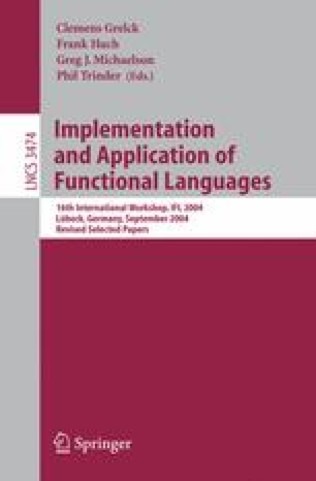
Implementation and application of functional languages ; Vol. 3474 ; 16th International Workshop, IFL 2004, Lübeck, Germany, September 8-10, 2004, Revised Selected Papers
The 16th International Workshop on Implementation and Application of Fu- tional Languages (IFL 2004) was held in Lub ¨ eck, Germany, September 8–10, 2004. It was jointly organized by the Institute of Computer Science and Applied Mathematics of the University of Kiel and the Institute of Software Technology and Programming Languages of the University of Lub ¨ eck. IFL 2004 was the sixteenth event in the annual series of IFL workshops. The aim of the workshop series is to bring together researchers actively engaged in the implementation and application of functional and function-based progr- ming languages. It provides an open forum for researchers who wish to present and discuss new ideas and concepts, work in progress, preliminary results, etc., related primarily, but not exclusively, to the implementation and application of functional languages. Topics of interest cover a wide range from theoretical - pects over language design and implementation towards applications and tool support.

Hyperbolic Problems : Theory, Numerics, Applications ; Proceedings of the Eleventh International Conference on Hyperbolic Problems held in Ecole Normale Supérieure, Lyon, July 17-21, 2006
This volume contains papers that were presented at HYP2006, the eleventh international Conference on Hyperbolic Problems: Theory, Numerics and Applications held at the Ecole Normale Supérieure de Lyon, France, July 17-21, 2006. This biennial series of conferences has become one of the most important international events in Applied Mathematics. As computers became more and more powerful, the interplay between theory, modelling, and numerical algorithms gained considerable impact, and the scope of HYP conferences expanded accordingly. The field is currently in interaction with a variety of scientific domains, including fluid dynamics, physics, electromagnetism, chemistry, biology, road and network traffic, and engineering. Many of these papers present new effective numerical methods and their application in various contexts.

Handbook on Scheduling : From Theory to Applications
This handbook covers not only in a unified approach the most important scheduling models and methods, it also put special emphasis to their relevance to practical situations. Many applications from industry and service operations management and case studies are described. Because the book offers some preliminaries concerning basic notions from discrete mathematics, it can also be used by beginners. As a consequence, the handbook is an indispensable source for a broad audience, ranging from researchers to practitioners, graduate and advanced undergraduate students in computer science/engineering, operations research, industrial and real-time engineering, management science, business administration, information systems, and applied mathematics curricula.

Handbook on Modelling for Discrete Optimization
This handbook couples the difficult, critical-thinking aspects of mathematical modeling with the hot area of discrete optimization. It will be done in an academic handbook treatment outlining the state-of-the-art for researchers across the domains of the Computer Science, Math Programming, Applied Mathematics, Engineering, and Operations Research. Included in the handbook's treatment are results from Graph Theory, Logic, Computer Science, and Combinatorics.

Handbook of biomedical image analysis ; Vol.2 : Segmentation models ; Part B
Handbook of Biomedical Image Analysis: Segmentation Models (Volume II) is dedicated to the segmentation of complex shapes from the field of imaging sciences using different mathematicaltechniques. This volume is aimed at researchers and educators in imaging sciences, radiological imaging, clinical and diagnostic imaging, physicists covering different medical imaging modalities, as well as researchers in biomedical engineering, applied mathematics, algorithmic development, computer vision, signal processing, computer graphics and multimedia in general, both in academia and industry.

Handbook of biomedical image analysis : Vol.3: Registration models
Handbook of Biomedical Image Analysis: Registration Models (Volume III) is dedicated to the algorithms for registration of medical images and volumes. This volume is aimed at researchers and educators in imaging sciences, radiological imaging, clinical and diagnostic imaging, biomedical engineering, physicists covering different medical imaging modalities and researchers in applied mathematics, algorithmic development, computer vision, signal processing, computer graphics and multimedia in general, both in academia and industry.

Handbook of biomedical image analysis : Vol.1 : Segmentation bodels ; Part A
Handbook of Biomedical Image Analysis: Segmentation Models (Volume I) is dedicated to the segmentation of complex shapes from the field of imaging sciences using different mathematical techniques. This volume is aimed at researchers and educators in imaging sciences, radiological imaging, clinical and diagnostic imaging, physicists covering different medical imaging modalities, as well as researchers in biomedical engineering, applied mathematics, algorithmic development, computer vision, signal processing, computer graphics and multimedia in general, both in academia and industry .

Graph theory, combinatorics and algorithms: interdisciplinary applications
focuses on discrete mathematics and combinatorial algorithms interacting with real world problems in computer science, operations research, applied mathematics and engineering. The book contains eleven chapters written by experts in their respective fields, and covers a wide spectrum of high-interest problems across these discipline domains.The chapters focus on "real world" applications, all of which will be of considerable interest across the areas of Operations Research, Computer Science, Applied Mathematics, and Engineering. These problems include Internet congestion control, high-speed communication networks, multi-object auctions, resource allocation, software testing, data structures, etc. In sum, this is a book focused on major, contemporary problems, written by the top research scholars in the field, using cutting-edge mathematical and computational techniques.

Graph theory and combinatorial optimization
Graph theory is very much tied to the geometric properties of optimization and combinatorial optimization. Moreover, graph theory's geometric properties are at the core of many research interests in operations research and applied mathematics. Its techniques have been used in solving many classical problems including maximum flow problems, independent set problems, and the traveling salesman problem. Graph Theory and Combinatorial Optimization explores the field's classical foundations and its developing theories, ideas and applications to new problems. The book examines the geometric properties of graph theory and its widening uses in combinatorial optimization theory and application.

Graph theory
Graph theory is a flourishing discipline containing a body of beautiful and powerful theorems of wide applicability. Its explosive growth in recent years is mainly due to its role as an essential structure underpinning modern applied mathematics – computer science, combinatorial optimization, and operations research in particular – but also to its increasing application in the more applied sciences. The versatility of graphs makes them indispensable tools in the design and analysis of communication networks, for instance. The primary aim of this book is to present a coherent introduction to the subject, suitable as a textbook for advanced undergraduate and beginning graduate students in mathematics and computer science. It provides a systematic treatment of the theory of graphs without sacrificing its intuitive and aesthetic appeal. Commonly used proof techniques are described and illustrated, and a wealth of exercises - of varying levels of difficulty - are provided to help the reader master the techniques and reinforce their grasp of the material.

Geometric Modelling, Numerical Simulation, and Optimization : Applied Mathematics at SINTEF
This book present scurrent activities of the Department of AppliedMathem- ics at SINTEF, the largest independent research organisation in Scandinavia. The book contains fteenpaperscontributedby employeesandfellowpartners from collaborating institutions. The research and development work within the department is focused on three main subject areas,andthestructureof the book refectsthisclustering: Part I Geometric Modelling Part II Numerical Simulation Part III Optimization Addressing Mathematics for Industry and Society, each contribution - scribesa problems ettingthatis of practical relevanceinone of thethreeareas and communicates the authors' own experiences in tackling these problems.

Functional imaging and modeling of the heart ; 3rd International workshop, FIMH 2005, Barcelona, Spain, June 2-4, 2005, Proceedings
The FIMH conference was the ?rst attempt to agglutinate researchers from several complementary but often i- lated ?elds: cardiac imaging, signal and image processing, applied mathematics and physics, biomedical engineering and computer science, cardiology, radi- ogy, biology, and physiology. In the ?rst two editions, the conference received an enthusiastic acceptance by experts of all these communities. FIMH was ori- nally started as a European event and has increasingly attracted more and more people from the US and Asia. This edition of FIMH received the largest number of submissions so far with a result of 47 papers being accepted as either oral presentations or posters. There were a number of submissions from non-EU institutions which con?rms the growing interest in this series of meetings. All papers were reviewed by up to four reviewers. The accepted contributions were organized into 8 oral sessions and 3 poster sessions complemented by a number of invited talks. This year we tried to allocate as many papers as possible as oral presentations to facilitate more active participation and to stimulate multidisciplinary discussions.

Fuchsian Reduction : Applications to Geometry, Cosmology, and Mathematical Physics
Fuchsian reduction is a method for representing solutions of nonlinear PDEs near singularities. The technique has multiple applications including soliton theory, Einstein's equations and cosmology, stellar models, laser collapse, conformal geometry and combustion. Developed in the 1990s for semilinear wave equations, Fuchsian reduction research has grown in response to those problems in pure and applied mathematics where numerical computations fail.
