



الصفحة 19
الصفحة 19

Green, pervasive, and cloud computing ; 15th International conference, GPC 2020, Xi'an, China, November 13–15, 2020, Proceedings
This book constitutes the refereed proceedings of the 15th International Conference on Green, Pervasive, and Cloud Computing, GPC 2020, held in Xi'an, China, in November 2020. The 30 full papers presented in this book together with 8 short papers were carefully reviewed and selected from 96 submissions. They cover the following topics: Device-free Sensing; Machine Learning; Recommendation Systems; Urban Computing; Human Computer Interaction; Internet of Things and Edge Computing; Positioning; Applications of Computer Vision; CrowdSensing; and Cloud and Related Technologies.

Graphic Design School : The principles and practice of graphic design ; 7th ed.
Develops design students' core competencies and provides practical advice and tips for how these fundamentals translate into new and evolving media. This Seventh Edition offers all new examples from web, app, social media, magazines, websites and books, presenting a comprehensive overview of the visual communications profession. This updated edition includes guidance and media examples using the latest in grahpic design software, and traditional printing techniques such as risograph and screen printing are revisited. Pedagogical tools throughout the text focus on the growth of interdisciplinary learning and collaborations between design specialists, as well as highlights on key players in the past and present of graphic design. Coveres : color, typographic rules and typefaces, coding requirements, information architecture, file organization, web design and layout, mobile device composition, app design, CMS, designing for social media, and SEO. Graphic Design School, 7th Edition includes full-color illustrations throughout, as well as case studies, designer biographies, and student assignments for testing skills and concepts.
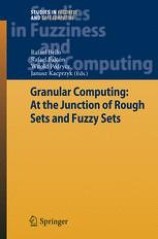
Granular computing : At the junction of rough sets and fuzzy sets
This volume is a compilation of the best papers presented at the First International Symposium on Fuzzy and Rough Sets (ISFUROS 2006) held in Santa Clara, Cuba. You will therefore find valuable contributions both in the theoretical field as in several application domains.
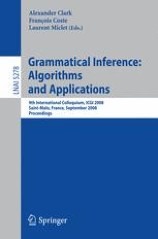
Grammatical Inference ; Algorithms and Applications : 9th International Colloquium, ICGI 2008 Saint-Malo, France, September 22-24, 2008 Proceedings
This book constitutes the refereed proceedings of the 9th International Colloquium on Grammatical Inference, ICGI 2008, held in Saint-Malo, France, in September 2008.The 21 revised full papers and 8 revised short papers presented were carefully reviewed and selected from 36 submissions. The topics of the papers presented vary from theoretical results of learning algorithms to innovative applications of grammatical inference, and from learning several interesting classes of formal grammars to applications to natural language processing.
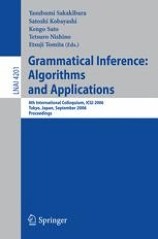
Grammatical Inference : Algorithms and Applications ; 8th International Colloquium, ICGI 2006, Tokyo, Japan, September 20-22, 2006, Proceedings
The topics discussed range from theoretical results of learning algorithms to innovative applications of grammatical inference and from learning several interesting classes of formal grammars to applications to natural language processing.

Grammar for Teachers : A Guide to American English for Native and Non-Native Speakers
The purpose of Grammar for Teachers is to encourage readers to develop a solid understanding of the use and function of grammatical structures in American English. It approaches grammar from a descriptive rather than a prescriptive approach; however, throughout Grammar for Teachers differences between formal and informal language, and spoken and written English are discussed. Grammar for Teachers avoids jargon or excessive use of technical terminology and reviews essential grammar structures clearly and concisely.

Graduate Attributes, Learning and Employability
In these complex and challenging times, students, teachers and employers are all interested in the development of generic abilities as these typically make the difference between good and indifferent employees, successful and unsuccessful learners. This book explains why generic capacities have become so important and argues that the process of acquiring them is both lifelong and developmental. By using case studies and theoretical analyses the authors collectively provide a comprehensive and contemporary coverage of the issues concerning generic abilities.

Global perspectives on recognising non-formal and Informal Learning : Why recognition matters
This book deals with the relevance of recognition and validation of non-formal and informal learning in education and training, the workplace and society. In an increasing number of countries, it is at the top of the policy and research agenda ranking among the possible ways to redress the glaring lack of relevant academic and vocational qualifications and to promote the development of competences and certification procedures which recognise different types of learning, including formal, non-formal and informal learning. The aim of the book is therefore to present and share experience, expertise and lessons in such a way that enables its effective and immediate use across the full spectrum of country contexts, whether in the developing or developed world. It examines the importance of meeting institutional and political requirements that give genuine value to the recognition of non-formal and informal learning; it shows why recognition is important and clarifies its usefulness and the role it serves in education, working life and voluntary work; it emphasises the importance of the coordination, interests, motivations, trust and acceptance by all stakeholders.

Global optimization ; Vol. 85 : Scientific and engineering case studies
Optimization models based on a nonlinear systems description often possess multiple local optima. The objective of global optimization (GO) is to find the best possible solution of multiextremal problems. Global Optimization: Selected Case Studies illustrates the applicability of GO modeling techniques and solution strategies to real-world problems.The contributed chapters cover a broad range of applications from agroecosystem management, assembly line design, bioinformatics, biophysics, black box systems optimization, cellular mobile network design, chemical process optimization, chemical product design, composite structure design, computational modeling of atomic and molecular structures, controller design for induction motors, electrical engineering design, feeding strategies in animal husbandry, the inverse position problem in kinematics, laser design, learning in neural nets, mechanical engineering design, numerical solution of equations, radiotherapy planning, robot design, and satellite data analysis. The solution strategies discussed encompass a range of practically viable methods, including both theoretically rigorous and heuristic approaches.

Geographies of Schooling
This book explores the complex relationship between schooling as a set of practices embedded in educational institutions and their specific spatial dimensions from different disciplinary perspectives.The book covers a broad range of topics, all examined from a spatial perspective: the governance of schooling, the transition processes of and within national school systems, the question of small schools in peripheral areas as well as the embeddedness of schooling in broader processes of social change. Transcending disciplinary boundaries, the book offers deep insights into current theoretical debates and empirical case studies within the broad research field encompassing the complex relationship between education and space.

Geographical Education in a Changing World : Past Experience, Current Trends and Future Challenges
The status of geography in school curricula varies across the globe. Geography, as a discrete subject, has, in some countries, established a strong position in both primary and secondary schools while in others it has a weaker position, often a component of integrated and cross-curricular arrangements. Globally, the trend is for geography's status to be challenged. A central theme of this book is the location of geography in school curricula with particular reference to centrality and marginality. A second theme relates to the subject status of geography. A third theme relates to the spirit and purpose of school geography and the traditions that underpin the subject and how these are changing. A fourth theme relates to the way geography is being seen by curriculum planners as contributing to the achievement of governmental aims for society in general. A fifth theme concerns the human and material resources infrastructure.

geoENV VI - Geostatistics for Environmental Applications : Proceedings of the Sixth European Conference on Geostatistics for Environmental Applications
This volume contains how geostatistics is applied within the environmental sciences. A few selected theoretical contributions are also included.

Genetic rogramming ; Vol. 3447 : 8th European conference, EuroGP 2005, Lausanne, Switzerland, March 30-April 1, 2005, Proceedings
In this volume we present the contributions for the 18th European Conference on Genetic Programming (EuroGP 2005). The conference took place from 30 March to 1 April in Lausanne, Switzerland. EuroGP is a well-established conf- ence and the only one exclusively devoted to genetic programming. All previous proceedings were published by Springer in the LNCS series. From the outset, EuroGP has been co-located with the EvoWorkshops focusing on applications of evolutionary computation. Since 2004, EvoCOP, the conference on evolutionary combinatorial optimization, has also been co-located with EuroGP, making this year’s combined events one of the largest dedicated to evolutionary computation in Europe. Genetic programming (GP) is evolutionary computation that solves complex problems or tasks by evolving and adapting a population of computer programs, using Darwinian evolution and Mendelian genetics as its sources of inspiration. Some of the 34 papers included in these proceedings address foundational and theoretical issues and there is also a wide variety of papers dealing with di?erent application areas, such as computer science, engineering, language processing, biology and computational design, demonstrating that GP is a powerful and practical problem-solving paradigm.

Genetic Programming Theory and Practice V
Genetic Programming Theory and Practice V was developed from the fifth workshop at the University of Michigan’s Center for the Study of Complex Systems to facilitate the exchange of ideas and information related to the rapidly advancing field of Genetic Programming (GP). Contributions from the foremost international researchers and practitioners in the GP arena examine the similarities and differences between theoretical and empirical results on real-world problems. The text explores the synergy between theory and practice, producing a comprehensive view of the state of the art in GP application.

Genetic Programming Theory and Practice IV
Genetic Programming Theory and Practice IV was developed from the fourth workshop at the University of Michigan’s Center for the Study of Complex Systems to facilitate the exchange of ideas and information related to the rapidly advancing field of Genetic Programming (GP). Contributions from the foremost international researchers and practitioners in the GP arena examine the similarities and differences between theoretical and empirical results on real-world problems.

Genetic Programming Theory and Practice III
Genetic Programming Theory and Practice III explores the emerging interaction between theory and practice in the cutting-edge, machine learning method of Genetic Programming (GP). This contributed volume was developed from the third workshop at the University of Michigan’s Center for the Study of Complex Systems to facilitate the exchange of ideas and information related to this rapidly advancing field. The text provides a cohesive view of the issues facing both practitioners and theoreticians and examines the synergy between GP theory and application.

Genetic Programming ; Vol. 3905 ; 9th European Conference, EuroGP 2006, Budapest, Hungary, April 10-12, 2006. Proceedings
This book constitutes the refereed proceedings of the 9th European Conference on Genetic Programming, EuroGP 2006, held in Budapest, Hungary, in April 2006, colocated with EvoCOP 2006. The 21 revised plenary papers and 11 revised poster papers were carefully reviewed and selected from 59 submissions. The papers address fundamental and theoretical issues, along with a wide variety of papers dealing with different application areas, such as computer science, engineering, machine learning, Kolmogorov complexity, biology and computational design.

Genetic Programming ; 10th European Conference, EuroGP 2007, Valencia, Spain, April 11-13, 2007, Proceedings
This book constitutes the refereed proceedings of the 10th European Conference on Genetic Programming, EuroGP 2007, held in Valencia, Spain in April 2007 colocated with EvoCOP 2007.

Genetic programming : Theory and practice II
This volume explores the emerging interaction between theory and practice in the cutting-edge, machine learning method of Genetic Programming (GP). The contributions developed from a second workshop at the University of Michigan's Center for the Study of Complex Systems where leading international genetic programming theorists from major universities and active practitioners from leading industries and businesses met to examine how GP theory informs practice and how GP practice impacts GP theory. Chapters include such topics as financial trading rules, industrial statistical model building, population sizing, the roles of structure in problem solving by computer, stock picking, automated design of industrial-strength analog circuits, topological synthesis of robust systems, algorithmic chemistry, supply chain reordering policies, post docking filtering, an evolved antenna for a NASA mission and incident detection on highways.

Generative adversarial text to image synthesis
Synthesizing high-quality images from text descriptions is a challenging problem in computer vision and has many practical applications. Samples generated by existing text-to-image approaches can roughly reflect the meaning of the given descriptions, but they fail to contain necessary details and vivid object parts. In order to make the project more specialized, it was approved that the project be dedicated to fashion image generation, we present an effective approach for generating new clothing through generative adversarial learning. Generative Adversarial Networks (GANs) successfully show the capability of synthesizing sharper images compared to other generative models.
