



الصفحة 19
الصفحة 19

Computer simulation studies in condensed-matter physics XVI ; Proceedings of the Seventeenth Workshop, Athens, GA, USA, February 16-20, 2004
This status report features the most recent developments in the field, spanning a wide range of topical areas in the computer simulation of condensed matter/materials physics. Both established and new topics are included, ranging from the statistical mechanics of classical magnetic spin models to electronic structure calculations, quantum simulations, and simulations of soft condensed matter. The book presents new physical results as well as novel methods of simulation and data analysis. Highlights of this volume include various aspects of non-equilibrium statistical mechanics, studies of properties of real materials using both classical model simulations and electronic structure calculations, and the use of computer simulations in teaching.

Computer science : Theory and applications ; 15th International computer science symposium in Russia, CSR 2020, Yekaterinburg, Russia, June 29 – July 3, 2020, Proceedings
This book constitutes the proceedings of the 15th International Computer Science Symposium in Russia, CSR 2020, held in Yekaterinburg, Russia, in June 2020. The 25 full papers and 6 invited papers were carefully reviewed and selected from 49 submissions. The papers cover a broad range of topics, such as: algorithms and data structures; computational complexity, including hardness of approximation and parameterized complexity; randomness in computing, approximation algorithms, fixed-parameter algorithms; combinatorial optimization, constraint satisfaction, operations research; computational geometry; string algorithms; formal languages and automata, including applications to computational linguistics; codes and cryptography; combinatorics in computer science; computational biology; applications of logic to computer science, proof complexity; database theory; distributed computing; fundamentals of machine learning, including learning theory, grammatical inference and neural computing; computational social choice; quantum computing and quantum cryptography; theoretical aspects of big data.
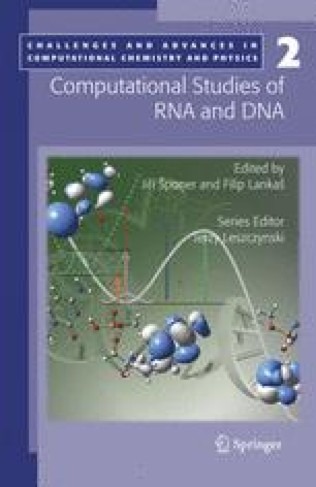
Computational studies of RNA and DNA
Computational Studies of RNA and DNA includes, in an integrated way, modern computational studies of nucleic acids, ranging from advanced electronic structure quantum chemical calculations through explicit solvent molecular dynamics (MD) simulations up to mesoscopic modelling, with the main focus given to the MD field. It gives an equal emphasis to the leading methods and applications while successes as well as pitfalls of the computational techniques are discussed.The systems and problems studied include: Accurate calculations of base pairing energies / Electronic properties of nucleic acids and electron transfer, through various types of nucleic acid / Calculating DNA elasticity

Computational Quantum Mechanics for Materials Engineers : The EMTO Method and Applications
Computational Quantum Mechanics for Materials Engineers describes new approaches to the modelling of disordered alloys that combine the most efficient quantum-level theories of random alloys with the most sophisticated numerical techniques to establish a theoretical insight into the electronic structure of complex materials such as stainless steels, Hume-Rothery alloys and silicates. The practical success of these approaches to applications in all of these areas are covered in detail. The new EMTO-CPA method is detailed, including its application in alloys to model structural stability and elastic properties of random alloys of arbitrary composition and the effect of alloying elements on elastic stiffnesses stacking fault energies and structural parameters. The EMTO-CPA method makes new approaches to computational alloy design feasible. Computational Quantum Mechanics for Materials Engineers shows how the technique will soon allow materials engineers to become "quantum blacksmiths

Computational Mind : A Complex Dynamics Perspective
Computational Mind: A Complex Dynamics Perspective is a graduate–level monographic textbook in the field of Computational Intelligence. It presents a modern dynamical theory of the computational mind, combining cognitive psychology, artificial and computational intelligence, and chaos theory with quantum consciousness and computation. The book introduces to human and computational mind, comparing and contrasting main themes of cognitive psychology, artificial and computational intelligence. It presents brain/mind dynamics from the chaos theory perspective, including sections on chaos in human EEG, basics of nonlinear dynamics and chaos, techniques of chaos control, synchronization in chaotic systems and complexity in humanoid robots. This book presents modern theory of quantum computational mind, including sections on Dirac–Feynman quantum dynamics, quantum consciousness, and quantum computation using Josephson junctions. The book is designed as a one–semester course for computer scientists, engineers, physicists and applied mathematicians, both in industry and academia. It includes a strong bibliography on the subject and detailed index.

Computational Many-Particle Physics
Complicated many-particle problems abound in nature and in research alike. Plasma physics, statistical physics and condensed matter physics, as primary examples, are all heavily dependent on efficient methods for solving such problems. Addressing graduate students and young researchers, this book presents an overview and introduction to state-of-the-art numerical methods for studying interacting classical and quantum many-particle systems. A broad range of techniques and algorithms are covered, and emphasis is placed on their implementation on modern high-performance computers.

Computational drug discovery : methods and application
Covers a wide range of cutting-edge computational technologies and computational chemistry methods that are transforming drug discovery. The book delves into recent advances, particularly focusing on artificial intelligence (AI) and its application for protein structure prediction, AI-enabled virtual screening, and generative modeling for compound design. Additionally, it covers key technological advancements in computing such as quantum and cloud computing that are driving innovations in drug discovery.

Computational Chemistry and Molecular Modeling : Principles and Applications
The gap between introductory level textbooks and highly specialized monographs is filled by this modern textbook. It provides in one comprehensive volume the in-depth theoretical background for molecular modeling and detailed descriptions of the applications in chemistry and related fields like drug design, molecular sciences, biomedical, polymer and materials engineering. Special chapters on basic mathematics and the use of respective software tools are included.

Collider Physics within the Standard Model : A Primer
In 2013 the late Prof. Altarelli wrote: The discovery of the Higgs boson and the non-observation of new particles or exotic phenomena have made a big step towards completing the experimental confirmation of the standard model of fundamental particle interactions. It is thus a good moment for me to collect, update and improve my graduate lecture notes on quantum chromodynamics and the theory of electroweak interactions, with main focus on collider physics. I hope that these lectures can provide an introduction to the subject for the interested reader, assumed to be already familiar with quantum field theory and some basic facts in elementary particle physics as taught in undergraduate courses.

Coherent Semiconductor Optics : From Basic Concepts to Nanostructure Applications
This book introduces the basic theoretical concepts required for the analysis of the optical response of semiconductor systems in the coherent regime. The entire presentation is based on a one-dimensional tight-binding model. Starting with discrete-level systems, increasing complexity is added gradually to the model by including band-structure and many-particle interaction.

Coherent Dynamics of Complex Quantum Systems
A large number of modern problems in physics, chemistry, and quantum electronics require a consideration of population dynamics in complex multilevel quantum systems. The purpose of this book is to provide a systematic treatment of these questions and to present a number of exactly solvable problems. It considers the different dynamical problems frequently encountered in different areas of physics from the same perspective, based mainly on the fundamental ideas of group theory and on the idea of ensemble average. Also treated are concepts of complete quantum control and correction of decoherence induced errors that are complementary to the idea of ensemble average. "Coherent Dynamics of Complex Quantum Systems" is aimed at senior-level undergraduate students in the areas of Atomic, Molecular, and Laser Physics, Physical Chemistry, Quantum Optics and Quantum Informatics. It should help them put particular problems in these fields into a broader scientific context and thereby take advantage of the well-elaborated technique of the adjacent fields.

Coding Theory and Applications ; 2nd International Castle Meeting, ICMCTA 2008, Castillo de la Mota, Medina del Campo, Spain, September 15-19, 2008. Proceedings
This book constitutes the refereed proceedings of the 2nd International Castle Meeting, ISMCTA 2008. The papers cover network coding, quantum codes, group codes, codes and combinatorial structures, agebraic-geometry codes, as well as codes and applications.

Coded Leadership : Developing Scalable Management in an AI-induced Quantum World
Introduces the necessary background to understand the challenges in today’s organizational leadership and how artificial intelligence enables learning to be viewed from a probabilistic framework. Introduction to Quantum Natural Language Processing. Overview of Leadership and AI. The Age of Quantum Superiority. Challenges to Today’s Leadership. AI-induced Strategic Implementation and Organizational Performance.

Clocks in the Sky : The Story of Pulsars
In this book, Geoff McNamara explores the history, subsequent discovery and contemporary research into pulsar astronomy. The story of pulsars is brought right up to date with the announcement in 2006 of a new breed of pulsar, Rotating Radio Transients (RRATs), which emit short bursts of radio signals separated by long pauses. These may outnumber conventional radio pulsars by a ratio of four to one. Geoff McNamara ends by pointing out that, despite the enormous success of pulsar research in the second half of the twentieth century, the real discoveries are yet to be made including, perhaps, the detection of the hypothetical pulsar black hole binary system by the proposed Square Kilometre Array - the largest single radio telescope in the world.

Mathematical foundations of computer science 2006 ; 31st International Symposium, MFCS 2006, Stará Lesná, Slovakia, August 28-September 1, 2006, Proceedings
This book constitutes the refereed proceedings of the 31st International Symposium on Mathematical Foundations of Computer Science, MFCS 2006, held in Stará Lesná, Slovakia in August/September 2006. The 62 revised full papers presented together with the full papers or abstracts of 7 invited talks were carefully reviewed and selected from 174 submissions. All current aspects in theoretical computer science and its mathematical foundations are addressed, ranging from algorithms and data structures, to complexity, automata, semantics, logic, formal specifications, models of computation, concurrency theory, computational geometry, parallel and distributed computing, networks, bioinformatics, quantum computing, cryptography, knowledge-based systems, and artificial intelligence.

Mathematical Foundations of Computer Science 2005 ; 30th International Symposium, MFCS 2005, Gdansk, Poland, August29-September 2. 2005, Proceedings
Constitutes the proceedings of the 30th International Symposium on Mathematical Foundations of Computer Science, MFCS 2005, held in Gdansk, Poland in August/September 2005. The 62 papers address various aspects in theoretical computer science, ranging from quantum computing, approximation, automata, circuits, scheduling, games, and more.
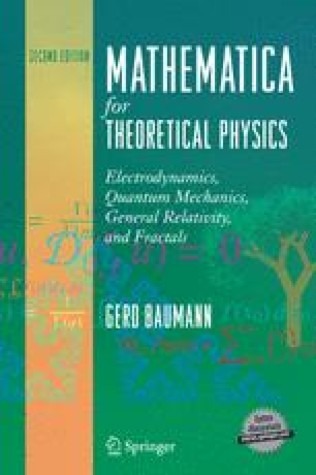
Mathematica for Theoretical Physics : Electrodynamics, Quantum Mechanics, General Relativity, and Fractals
Mathematica for Theoretical Physics: Electrodynamics, Quantum Mechanics, General Relativity, and Fractals This second edition of Baumann's Mathematica® in Theoretical Physics shows readers how to solve physical problems and deal with their underlying theoretical concepts while using Mathematica® to derive numeric and symbolic solutions. Each example and calculation can be evaluated by the reader, and the reader can change the example calculations and adopt the given code to related or similar problems. The second edition has been completely revised and expanded into two volumes: The first volume covers classical mechanics and nonlinear dynamics. Both topics are the basis of a regular mechanics course. The second volume covers electrodynamics, quantum mechanics, relativity, and fractals and fractional calculus. New examples have been added and the representation has been reworked to provide a more interactive problem-solving presentation. This book can be used as a textbook or as a reference work, by students and researchers alike. A brief glossary of terms and functions is contained in the appendices.
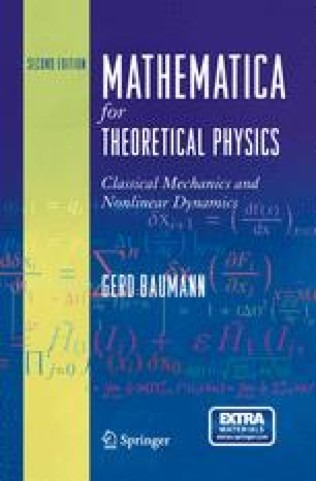
Mathematica for Theoretical Physics : Classical Mechanics and Nonlinear Dynamics
Mathematica for Theoretical Physics: Classical Mechanics and Nonlinear Dynamics This second edition of Baumann's Mathematica® in Theoretical Physics shows readers how to solve physical problems and deal with their underlying theoretical concepts while using Mathematica® to derive numeric and symbolic solutions. Each example and calculation can be evaluated by the reader, and the reader can change the example calculations and adopt the given code to related or similar problems. The second edition has been completely revised and expanded into two volumes: The first volume covers classical mechanics and nonlinear dynamics. Both topics are the basis of a regular mechanics course. The second volume covers electrodynamics, quantum mechanics, relativity, and fractals and fractional calculus. New examples have been added and the representation has been reworked to provide a more interactive problem-solving presentation. This book can be used as a textbook or as a reference work, by students and researchers alike. A brief glossary of terms and functions is contained in the appendices.
Many Body Structure of Strongly Interacting Systems ; Refereed and Selected Contributions from the Symposium "20 Years of Physics at the Mainz Microtron MAMI"
This carefully edited proceedings volume provides an extensive review and analysis of the work carried out over the past 20 years at the Mainz Microtron (MAMI). This research centered around the application of Quantum Chromodynamics in the strictly nonperturbative regime at hadronic scales of about 1 fm. Due to the many degrees of freedom in hadrons at this scale the leitmotiv of this research is "Many body structure of strongly interacting systems". Further, an outlook on the research with the forthcoming upgrade of MAMI is given. This volume is an authoritative source of reference for everyone interested in the field of the electro-weak probing of the structure of hadrons.
Manipulating Quantum Coherence in Solid State Systems
Presents a fundamental introduction to three solid-state approaches to achieving quantum computation: semiconductor spin-based, semiconductor charge-based, and superconducting approaches.
