



الصفحة 19
الصفحة 19
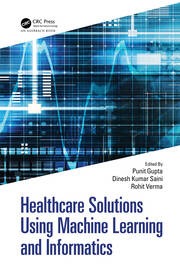
Healthcare solutions using machine learning and informatics
Covers novel and innovative solutions for the healthcare that apply machine learning and biomedical informatics technology. The healthcare sector is one of the most critical in society. This book presents a series of artificial intelligence, machine learning, intelligent IoT-based solutions for medical image analysis, medical big data processing, disease predictions. Machine learning and artificial intelligence use cases in healthcare presented in the book give researchers, practitioners, and students a wide range of practical examples of cross-domain convergence. The wide variety of topics covered include: Artificial Intelligence in healthcare Machine learning solutions for such disease as diabetes, arthritis, cardiovascular disease, and COVID-19 Big data analytics solutions for healthcare data processing Reliable biomedical applications using AI models Intelligent IoT in healthcare. The book explains fundamental concepts as well as the advanced use cases illustrating how to apply emerging technologies such as machine learning, AI models, data informatics into practice to tackle challenges in the field of healthcare with real-world scenarios. Chapters contributed by noted academicians and professionals examine various solutions, frameworks, applications, case studies, and best practices in the healthcare domain
Health Information Science ; 9th International Conference, HIS 2020, Amsterdam, The Netherlands, October 20–23, 2020, Proceedings
This book constitutes the proceedings of the 9th International Conference on Health Information Science, HIS 2020, which took place in Amsterdam, The Netherlands, during October 20-23, 2020. The 11 full papers and 6 short papers presented in this volume were carefully reviewed and selected from 62 submissions. They were organized in topical sections named: mental health; medical record processing; medical information systems; medical diagnosis with machine learning; and health behavior and medication.
HCI in games : Experience design and game mechanics ; Third International Conference, HCI-Games 2021, Held as Part of the 23rd HCI International Conference, HCII 2021, Virtual Event, July 24–29, 2021, Proceedings, Part I
This two-volume set LNCS 12789 and 12790 constitutes the refereed proceedings of the Third International Conference on HCI in Games, HCI-Games 2021, held as part of the 23rd International Conference, HCI International 2021, which took place in July 2021. Due to COVID-19 pandemic the conference was held virtually.The total of 1276 papers and 241 poster papers included in the 39 HCII 2021 proceedings volumes was carefully reviewed and selected from 5222 submissions. The regular papers of DAPI 2021, Distributed, Ambient and Pervasive Interactions, are organized in topical sections named: Experience Design in Games; User Engagement and Game Impact; Game Mechanics.
HCI and usability for education and work ; 4th Symposium of the Workgroup Human-Computer Interaction and Usability Engineering of the Austrian Computer Society, USAB 2008, Graz, Austria, November 20-21, 2008. Proceedings
This book constitutes the refereed proceedings of the 4th Usability Symposium of the Human-Computer Interaction and Usability Engineering Workgroup of the Austrian Computer Society, USAB 2008, held in Graz, Austria, in November 2008.The 7 revised full papers and 26 revised short papers presented were carefully reviewed and selected from 85 submissions. The papers are organized in topical sections on cognitive processes and end user experience, social software and collaborative knowledge development, knowledge processing, assessment and human performance.

Hardening Windows
Hardening is the process of protecting a system against unknown threats. System administrators harden against that which they think could be a threat. Administrators know the Internet is a hostile environment. Although they can't tell, for example, that a hacker will attempt to gain access to the SQL server next Tuesday, they can bet money there'll be an attempt soon and should "batten down the hatches" in anticipation. Hardening Windows, Second Edition is the definitive "counterintelligence" guide to performing preventative security measures for the Windows operating system. This second edition covers the release of Windows XP Service Pack 2 and its new security features, including the Windows Firewall and the Security Center. It also covers Windows Server 2003 Service Pack 1, Windows Server R2's new Security Configuration Wizard, Windows NT, Windows 2000, branch-office security features, and new setup options.

Haptic and Audio Interaction Design ; 2nd International Workshop, HAID 2007 Seoul, Korea, November 29-30, 2007 Proceedings
This book constitutes the refereed proceedings of the Second International Workshop on Haptic and Audio Interaction Design, HAID 2007 held in Seoul, South Korea, in November 2007. The papers are organized in topical sections on tactile displays, communication and games, accessibility and navigation, as well as design.

Handbook on Decision Support Systems 2 : Variations
As the most comprehensive reference work dealing with decision support systems (DSS), this book is essential for the library of every DSS practitioner, researcher, and educator. Written by an international array of DSS luminaries, its more than 70 chapters approach decision support systems from a wide variety of perspectives ranging from classic foundations to cutting-edge thought, informative to provocative, theoretical to practical, historical to futuristic, human to technological, and operational to strategic. The chapters are conveniently organized into 10 major sections: foundations of decision support systems, DSS fundamentals, multiparticipant DSSs, intelligent DSSs, effects of decision support, time & space issues, scopes of decision support, developing & managing decision support systems, cases &applications, and decision support horizons. Novices and experts alike will refer to the authoritative and stimulating content again and again for years to come.

Handbook on Craniofacial Superimposition : The MEPROCS Project
This book is the first comprehensive guide to a new soft computing technique which is used in complex forensic cases. The chapters include detailed technical and practical overviews, and discussions about the latest tools, open problems and ethical and legal issues involved. The book will be of interest to researchers and practitioners in forensic medicine and computational intelligence.

Handbook on artificial intelligence -empowered applied software engineering ; Vol.1 : Novel methodologies to engineering smart software systems
Provides a structured overview of artificial intelligence-empowered applied software engineering. Evolving technological advancements in big data, smartphone and mobile software applications, the Internet of Things and a vast range of application areas in all sorts of human activities and professions lead current research towards the efficient incorporation of artificial intelligence enhancements into software and the empowerment of software with artificial intelligence.

Handbook of Spatial Logics
The aim of this handbook is to create, for the first time, a systematic account of the field of spatial logic. The book comprises a general introduction, followed by fourteen chapters by invited authors. Each chapter provides a self-contained overview of its topic, describing the principal results obtained to date, explaining the methods used to obtain them, and listing the most important open problems. Jointly, these contributions constitute a comprehensive survey of this rapidly expanding subject.

Handbook of public finance
The Handbook of Public Finance provides a definitive source, reference, and text for the field of public finance. In 18 chapters it surveys the state of the art - the tradition and breadth of the field but also its current status and recent developments. The Handbook's intellectual foundation and orientation is truly multidisciplinary. Throughout its examination of the standard material of public finance, it explores the connections between that material and such neighboring fields as political science, sociology, law, and public administration.

Handbook of psychodiagnostic testing : Analysis of personality in the psychological report
Since the debut of the original edition, the Handbook of Psychodiagnostic Testing has been an invaluable aid to students and professionals performing psychological assessments. The new Fourth Edition continues in that tradition, taking the reader from client referral to finished report, demonstrating how to synthesize details of personality and pathology into a document that is focused, coherent, and clinically meaningful. As with the previous editions, authors Kellerman and Burry offer a systematic framework for choosing the most relevant material from seemingly overwhelming amounts of test data. Separate chapters offer clear rationales for each component of the report (e.g., cognitive functioning, interpersonal behavior, control mechanisms), and how they relate to one another. Helpful summaries follow each chapter, and tables and charts provide salient facts and findings at a glance.

Handbook of philosophical logic ; Vol. 14
I would like to take this opportunity to put forward my current views about logic in computer science, computational linguistics and arti?cial intelligence. In the early 1980s the perception of the role of logic in computer science was that of a speci?cation and reasoning tool and that of a basis for possibly neat computer languages. The computer scientist was manipulating data structures and the use of logic was one of his options.

Handbook of Nature-Inspired and Innovative Computing : Integrating Classical Models with Emerging Technologies
This comprehensive handbook, the first of its kind to address the connection between nature-inspired and traditional computational paradigms, is a repository of case studies dealing with different problems in computing and solutions to these problems based on nature-inspired paradigms. The "Handbook of Nature-Inspired and Innovative Computing: Integrating Classical Models with Emerging Technologies" is an essential compilation of models, methods, and algorithms for researchers, professionals, and advanced-level students working in all areas of computer science, IT, biocomputing, and network engineering.

Handbook Of Mathematical Models For Languages And Computation
Introduces a variety of concepts in discrete mathematics and mathematical modeling for languages and computation. The authors pay special attention to the implementation of mathematical concepts to explain clearly how to encode them in computational practice. All computer programs are written in C#. The theory of computation is used to address challenges arising in many computer science areas such as artificial intelligence, language processors, compiler writing, information and coding systems, programming language design, computer architecture and more. To grasp topics concerning this theory readers need to familiarize themselves with its computational and language models, based on concepts of discrete mathematics including sets, relations, functions, graphs and logic.

Handbook of International Investment Law and Policy
The Handbook will feature more than 80 contributions from leading experts (academics, lawyers, government officials), including Vivienne Bath, M. Sornarajah, Mélida Hodgson, Rahul Donde, Roberto Echandi, Andrew Mitchell, Ernst-Ulrich Petersmann, Christina L. Beharry, Krista Nadakavukaren Schefer, Leon Trakman, Prabhash Ranjan, Emmanuel Jacomy, Mariel Dimsey, Stavros Brekoulakis, Romesh Weeramantry, Nathalie Bernasconi-Osterwalder, David Collins, Damilola S. Olawuyi, Katia Fach Gomez, Jaemin Lee, Alejandro Carballo-Leyda, Patrick W. Pearsall, Mark Feldman, Surya Deva, Luke Nottage, Rafael Leal-Arcas, James Nedumpara, Rodrigo Polanco, etc.

Handbook of International Insurance : Between Global Dynamics and Local Contingencies
The globalization of insurance markets means that understanding both international developments and local trends around the world is now fundamental for insurance executives coping with today’s complex and competitive environment. By providing such a comprehensive picture of the world’s insurance markets, this unique and necessary book becomes an essential tool for anyone seeking to operate wisely and successfully"This book depicts in an outstanding way the dichotomy of the insurance world today, which is still torn between global approaches and local solutions. Both insurance professionals and academics will profit enormously from its intelligent insights.

Handbook of intelligent and sustainable smart dentistry : nature and bio-inspired approaches, processes, materials, and manufacturing
Provides the latest and most comprehensive evidence-based guidance on intelligent and sustainable approaches in dentistry. This valuable handbook is a single-stop solution for practitioners, researchers, scholars, students, academicians, and clinicians inquisitive in updating their knowledge on intelligent and sustainable dentistry. The handbook will bestow the readers with not only theoretical knowledge but will equip them with clinical skills as well.

Handbook of Intellectual and Developmental Disabilities
Changes within the interdisciplinary field of intellectual and developmental disabilities are evolving at a rapid pace. Clinicians, academics, administrators, and a variety of mental health providers alike need easy-to-access, reliable information that enables them to stay abreast of the numerous advances in research, assessment, treatment, and service delivery within a real-world sociopolitical framework. To that end, the Handbook of Intellectual and Developmental Disabilities is an essential resource for any professional who works with this vulnerable population. This volume examines in detail the numerous advances in the field, summarizing major domains and emerging subspecialties into one eminently useful reference.

Handbook of Giftedness in Children : Psychoeducational Theory, Research, and Best Practices
In one comprehensive resource, the Handbook of Giftedness in Children brings together leading experts from the fields of psychology and education, combining theory and applied empirical research on such crucial topics as conceptualization, types of intelligence, developmental considerations, and ethical and legal concerns. Particular attention is given to social and family contexts, and evidence-based strategies and interventions offer solid guidelines on assessment, curriculum design, and encouraging and nurturing talent – from preschool through adolescence.
