



الصفحة 19
الصفحة 19

Fundamental approaches to software engineering ; 21st International Conference, FASE 2018, Held as Part of the European Joint Conferences on Theory and Practice of Software, ETAPS 2018, Thessaloniki, Greece, April 14-20, 2018, Proceedings
This book contains the proceedings of FASE 2018, the 21th International Conference on Fundamental Approaches to Software Engineering, held in Thessaloniki, Greece, in April 2018, the volume contains regular research papers that cover a wide range of topics, such as program and system analysis, model transformations, configuration and synthesis, graph modeling and transformation,software product lines, test selection, as well as learning and inference.

Fundamental approaches to software engineering ; 11th International Conference, FASE 2008, Held as Part of the Joint European conferences on theory and practice of software, ETAPS 2008, Budapest, Hungary, March 29-April 6, 2008. Proceedings
The fve main conferences received 571 submissions, 147 of which were accepted, giving an overall acceptance rate of less than 26%, with each conference below 27%.Congratulationsthereforetoallthe authorswhomadeittothe alprogramme! I hope that most of the other authors will still have found a way of participating in this exciting event, and that you will all continue submitting to ETAPS and contributing to make of it the best conference in the area،The events that comprise ETAPS address various aspects of the system velopment process,including specifcation, design, implementation, analysis and improvement.

Fundamental approaches to software engineering ; 10th International Conference, FASE 2007 Held as part of the joint European conference on theory and practice of software, ETAPS 2007 Braga, Portugal, March 24 - April 1, 2007 Proceedings
This book constitutes the refereed proceedings of the 10th International Conference on Fundamental Approaches to Software Engineering, FASE 2007, held in Braga, Portugal in March/April 2007 as part of ETAPS 2007, the Joint European Conferences on Theory and Practice of Software.

Functionalized Nanoscale Materials, Devices and Systems
The primary objective of the NATO Advanced Study Institute (ASI) titled “Functionalized Nanoscale Materials, Devices, and Systems for Chem. -Bio Sensors, Photonics, and Energy Generation and Storage” was to present a contemporary and comprehensive overview of the field of nanostructured materials and devices and its applications in chem. -bio sensors, nanophotonics, and energy generation and storage devices. The study has become one of the most promising disciplines in science and technology, as it aims at the fundamental understanding of new physical, che- cal, and biological properties of systems and the technological advances arising from their exploration. Such systems are intermediate in size, between the isolated atoms and molecules and bulk material, where the unique transitional characteristics between the two can be understood, controlled, and manipulated.

Functional Verification of Programmable Embedded Architectures : A Top-Down Approach
This book presents a top-down validation methodology that complements the existing bottom-up approaches. It leverages the system architect’s knowledge about the behavior of the design through architecture specification using an Architecture Description Language (ADL). The authors also address two fundamental challenges in functional verification: lack of a golden reference model, and lack of a comprehensive functional coverage metric.

Functional Properties of Nanostructured Materials
Nanostructured materials are becoming of major significance, and their investigations require a comprehensive approach. The fundamental properties of these materials are remarkably altered as the size of their constituent grains or phases decreases to the nanometer scale. These novel materials made of nanosized building blocks offer unique and entirely different electrical, optical, mechanical, and magnetic properties compared to conventional micro- or millimetre-size materials owing to their distinctive size, shape, topology, surface properties, etc.

Fuel Cells : From Fundamentals to Applications
Fuel Cells: Fundamentals to Applications is a concise source of the basic electrochemical principles and engineering aspects involved in the development and commercialization of fuel cells. It describes the applications and techno-economic assessment of fuel cell technologies along with an in-depth discussion of conventional and novel approaches pursued for generating energy. This book is divided into four parts. Parts I and II explain basic and applied electrochemistry relevant to an understanding of fuel cells. Part III covers engineering and technology aspects and Part IV, applications and economics. The first part covers, in detail, the electrode kinetics and electrocatalysis of charge-transfer reactions, and leading electrochemical technologies with focus on relevance to fuel cells. The second part addresses the governing principles of fuel cells, electrocatalysis of fuel cell reactions and experimental techniques pertinent to fuel cell research and development. The third part is devoted to modeling of fuel cell systems and a thorough discussion of fuels, fuel processing and fuel storage, transmission, and distribution. The final part deals with the status of the fuel cell technologies, their applications and economics.

FSTTCS 2007 : Foundations of software technology and theoretical computer science; 27th International Conference, New Delhi, India, December 12-14, 2007, Proceedings
This book constitutes the refereed proceedings of the 27th International Conference on the Foundations of Software Technology and Theoretical Computer Science, FSTTCS 2007. The papers provide original research results in fundamental aspects of computer science as well as reports from the frontline of software technology and theoretical computer science.

Frontiers of Optical Spectroscopy ; Investigating Extreme Physical Conditions with Advanced Optical Techniques
Advanced spectroscopic techniques allow the probing of very small systems and very fast phenomena, conditions that can be considered "extreme" at the present status of our experimentation and knowledge. Quantum dots, nanocrystals and single molecules are examples of the former and events on the femtosecond scale examples of the latter. The purpose of this book is to examine the realm of phenomena of such extreme type and the techniques that permit their investigations. Each author has developed a coherent section of the program starting at a somewhat fundamental level and ultimately reaching the frontier of knowledge in the field in a systematic and didactic fashion. The formal lectures are complemented by additional seminars.

Frontiers of Fundamental Physics ; Proceedings of the Sixth International Symposium "Frontiers of Fundamental and Computational Physics", Udine, Italy, 26-29 September 2004
The Sixth International Symposium "Frontiers of Fundamental and Computational Physics", Udine, Italy, 26-29 September 2004, aimed at providing a platform for a wide range of physicists to meet and share thoughts on the latest trends in various, mainly cross-disciplinary research areas. This includes the exploration of frontier lines in High Energy Physics, Theoretical Physics, Gravitation and Cosmology, Astrophysics, Condensed Matter Physics, Fluid Mechanics. Such frontier lines were unified by the use of computers as an, often primary, research instruments, or dealing with issues related to information theory.

Frontiers of Ferroelectricity : A Special Issue of the Journal of Materials Science
The book presents theory, fundamentals and applications of ferroelectricity. It describes the current levels of understanding of various aspects of the subject as presented by authorities in the field. Reviews and research reports cover the spectrum of ferroelectricity. Topics include relaxors, piezoelectrics, microscale and nanoscale studies, polymers and composites, unusual properties, and techniques and devices. The information in this book is intended for physicists, engineers and materials scientists working with ferroelectric materials including ceramics, single crystals, polymers, composites and even some biological materials.

From Innate Immunity to Immunological Memory
The ability to remember an antigenic encounter for several decades, even for a life time, is one of the fundamental properties of the immune system. This phenomenon known as "immunological memory", is the foundation upon which the concept if vaccination rests. Therefore, understanding the mechanisms by which immunological memory is regulated is of paramount importance. Recent advances in immunology, particularly in the field of innate immunity, suggest that the innate immune system plays fundamental roles in influencing immunological memory. Indeed, emerging evidence suggests that events that occur early, within hours if not minutes of pathogen or vaccine entry profoundly shape the quantity, quality and duration of immunological memory. The present volume assembles a collection of essays from leading experts that span the entire spectrum research from understanding the molecular mechanisms of innate immune recognition, to dendritic cell function, to the generation and maintenance of antigen-specific B and T-cell responses.

From Geometry to quantum mechanics : In Honor of Hideki Omori
This volume is composed of invited expository articles by well-known mathematicians in differential geometry and mathematical physics that have been arranged in celebration of Hideki Omori's recent retirement from Tokyo University of Science and in honor of his fundamental contributions to these areas.The papers focus on recent trends and future directions in symplectic and Poisson geometry, global analysis, infinite-dimensional Lie group theory, quantizations and noncommutative geometry, as well as applications of partial differential equations and variational methods to geometry.
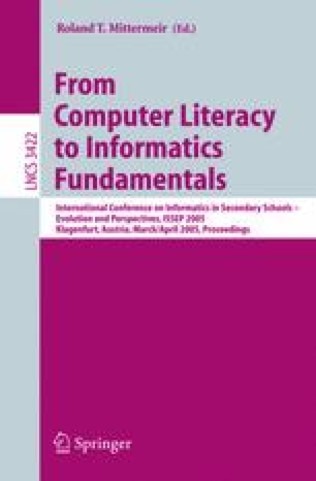
From computer literacy to informatics fundamentals ; International conference on informatics in secondary schools : Evolution and perspectives, ISSEP 2005, Klagenfurt, Austria, March 30-April 1, 2005, Proceedings
Duetothepenetrationofinformationtechnologyintosocietyatlargeandinto schools in particular, the relationship between informatics and education leading togeneralcomputerliteracyortotheuseofIT-basedapproachesinconventional subjects, e-learning in school, is an evident focus of many contributions. According to the broad scope of the conference its proceedings are split into two volumes. This volume, From Computer Literacy to Informatics Fundam- tals, covers papers reporting on national strategies of informatics instruction and their evolution in accordance with the penetration of information proce- ing equipment in our daily life. In one way or another, these strategies strive to accommodate the needs of basic skills in information and communication te- nology (ICT) with educational principles that can be conveyed by informatics instruction in a traditional sense. Hence, the papers on national strategies are complementedintwoways: ?rstly, bycontributionsthatstrivetoidentifyfun- mental issues, informatics can contribute to the general education process of the youth; and, secondly, by papers presenting approaches on how to link or even to combine instruction about such informatics fundamentals with the need to introduce pupils to the productive use of ICT.

Fracture Mechanics of Ceramics ; Active Materials, Nanoscale Materials, Composites, Glass, and Fundamentals
The 8th International Symposium on fracture mechanics of ceramics was held in on the campus of the University of Houston, Houston, TX, USA, on February 25-28, 2003. With the natural maturing of the fields of structural ceramics, this symposium focused on nano-scale materials, composites, thin films and coatings as well as glass. The symposium also addressed new issues on fundamentals of fracture mechanics and contact mechanics, and a session on reliability and standardization.

Fracture Mechanics : With an Introduction to Micromechanics
Concerned with the fundamental concepts and methods of fracture mechanics and micromechanics, Fracture Mechanics primarily focuses on the mechanical description of fracture processes; however, material specific aspects are also discussed. The presentation of continuum mechanical and phenomenological foundations is followed by an introduction into classical failure hypotheses. A major part of the book is devoted to linear elastic and elastic-plastic fracture mechanics. Further subjects are creep fracture, dynamic fracture mechanics, damage mechanics, probabilistic fracture mechanics, failure of thin films and fracture of piezoelectric materials. The book also contains an extensive introduction into micromechanics.

Fractional order systems and applications in engineering
Covers the fundamentals of fractional calculus together with some analytical and numerical techniques, and provides MATLAB® codes for the simulation of fractional-order control (FOC) systems. The use of fractional calculus can improve and generalize well-established control methods and strategies. Many different FOC schemes are presented for control and dynamic systems problems. These extend to the challenging control engineering design problems of robust and nonlinear control. Practical material relating to a wide variety of applications including, among others, mechatronics, civil engineering, irrigation and water management, and biological systems is also provided.

Foundations of Multi-Paradigm Modelling for Cyber-Physical Systems
This book coherently gathers well-founded information on the fundamentals of and formalisms for modelling cyber-physical systems (CPS). Highlighting the cross-disciplinary nature of CPS modelling, it also serves as a bridge for anyone entering CPS from related areas of computer science or engineering.

Foundations of Java for ABAP Programmers
The only beginning book of its kind, this book will teach you SAP/ABAP developers the skills you need for Java 5 programming. The book emphasizes the fundamentals of core Java SE 5 and Java EE 5, to get you up to speed with these technologies. You'll learn about the most important enterprise Java API found in the new Java EE 5 platform, which you can immediately use and integrate. Furthermore, the book elaborates on connecting to a database, SAP Java Connector, servlets, Java Server Pages, Enterprise JavaBeans, and Java Messaging.

Foundations of Hyperbolic Manifolds
The book is divided into three parts. The first part is concerned with hyperbolic geometry and discrete groups. The main results are the characterization of hyperbolic reflection groups and Euclidean crystallographic groups. The second part is devoted to the theory of hyperbolic manifolds. The main results are Mostow’s rigidity theorem and the determination of the global geometry of hyperbolic manifolds of finite volume. The third part integrates the first two parts in a development of the theory of hyperbolic orbifolds. The main result is Poincare«s fundamental polyhedron theorem.
