



الصفحة 187
الصفحة 187
Applied Spatial Data Analysis with R
Applied Spatial Data Analysis with R is divided into two basic parts, the first presenting R packages, functions, classes and methods for handling spatial data, The second part showcases more specialised kinds of spatial data analysis, including spatial point pattern analysis, interpolation and geostatistics, areal data analysis and disease mapping.
Applied scanning probe methods III : Characterization
The sc- ning probes emerged as a new - strument for imaging with a p- cision suf?cient to delineate single atoms. At first there were two – the Scanning Tunneling Microscope, or STM, and the Atomic Force Mic- scope, or AFM. The STM relies on electrons tunneling between tip and sample whereas the AFM depends on the force acting on the tip when it was placed near the sample. These were quickly followed by the M- netic Force Microscope, MFM, and the Electrostatic Force Microscope, EFM. The MFM will image a single magnetic bit with features as small as 10nm. With the EFM one can monitor the charge of a single electron.
Applied Proof Theory : Proof Interpretations and Their Use in Mathematics
Ulrich Kohlenbach presents an applied form of proof theory that has led in recent years to new results in number theory, approximation theory, nonlinear analysis, geodesic geometry and ergodic theory (among others). This applied approach is based on logical transformations (so-called proof interpretations) and concerns the extraction of effective data (such as bounds) from prima facie ineffective proofs as well as new qualitative results such as independence of solutions from certain parameters, generalizations of proofs by elimination of premises. The book first develops the necessary logical machinery emphasizing novel forms of Gödel's famous functional ('Dialectica') interpretation. It then establishes general logical metatheorems that connect these techniques with concrete mathematics. Finally, two extended case studies (one in approximation theory and one in fixed point theory) show in detail how this machinery can be applied to concrete proofs in different areas of mathematics.
Applied Partial Differential Equations : A Visual Approach
This book presents selected topics in science and engineering from an applied-mathematics point of view. The described natural, socioeconomic, and engineering phenomena are modeled by partial differential equations that relate state variables.

Applied Parallel Computing ; State of the Art in Scientific Computing ; 8th International Workshop, PARA 2006, Umea, Sweden, June 18-21, 2006, Revised Selected Papers
It covers partial differential equations, parallel scientific computing algorithms, linear algebra, simulation environments, algorithms and applications for blue gene/L, scientific computing tools and applications, parallel search algorithms, peer-to-peer computing, mobility and security, algorithms for single-chip multiprocessors.
Applied Parallel Computing ; State of the Art in Scientific Computing
Introduction The PARA workshops in the past were devoted to parallel computing methods in science and technology. There have been seven PARA meetings to date: PARA’94, PARA’95 and PARA’96 in Lyngby, Denmark, PARA’98 in Umea, ? Sweden, PARA 2000 in Bergen, N- way, PARA 2002 in Espoo, Finland, and PARA 2004 again in Lyngby, Denmark. The ?rst six meetings featured lectures in modern numerical algorithms, computer science, en- neering, and industrial applications, all in the context of scienti?c parallel computing. This meeting in the series, the PARA 2004 Workshop with the title “State of the Art in Scienti?c Computing.
Applied Parallel Computing ; 6th International Conference, PARA 2002, Espoo, Finland, June 15-18, 2002. Proceeding
These proceedings contain the papers presented at PARA 2002, the Sixth In-ternational Conference on Applied Parallel Computing. PARA 2002 was held inEspoo, Finland, June 15–18, 2002, and hosted by CSC, the Finnish informationtechnology center for science. The general theme of the conference was advancedscientific computing.The conference demonstrated the ability of advanced scientific computing tosolve real-world problems, and highlighted methods, instruments, and trends infuture scientific computing. The conference began with a one-day tutorial sessionon Grid programming.The conference focused on an application-oriented, multi-disciplinary, andmulti-scale approach. A wide variety of scientific computing applications wereintroduced, from semiconductor processing and behavior of the human body tooceanic and atmospheric phenomena.
Applied Mathematics for Restructured Electric Power Systems : Optimization, Control, and Computational Intellige
Discusses the use of applied mathematics to solve challenging power system problems. This book covers such areas as: control, optimization, and computational intelligence. It follows a three-part format: a description of an important power system problem or problems; the practice and/or particular research approaches; and, research directions.
Applied Linguistics and Language Teacher Education
Applied Linguistics and Language Teacher Education is aimed at applied linguists who are interested in understanding more about the learning of novice teachers in their classes. The 21 studies in this volume provide information on the complexity of novice teachers’ learning and use of knowledge in a variety of applied linguistics classes such as SLA, Syntax, Pragmatics, Sociolinguistics, Phonetics and Phonology, L2 Reading and Writing, Testing, and Content Based Instruction. These studies were conducted in a variety of contexts, from North and South America to Europe, Asia and Australia, and look at the preparation of teachers of English, Spanish and Chinese.
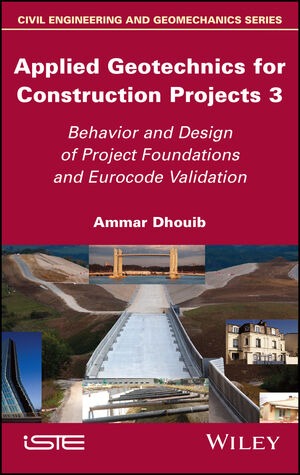
Applied geotechnics for construction projects ; Vol. 3 : Behavior and Design of Project Foundations and Eurocode Validation
Applied Geotechnics for Construction Projects 3 first presents the basic theoretical principles and rules governing the designing and validation of foundations; shallow, semi-deep and deep, then presents real foundation projects with a detailed comparison of the approaches and methods of calculating foundations in relation to the reference systems and rules in force, closely compared to and validated by the Eurocodes. The third chapter presents examples of foundation projects, covering high-side building rafts, strip footings, piles and embankments, enriched by an unprecedented level of experience in the field of foundations for civil and industrial construction projects.
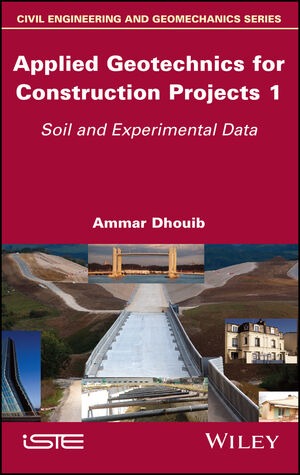
Applied geotechnics for construction projects ; Vol. 1 : Soil and Experimental Data
Applied Geotechnics for Construction Projects 1 first defines, identifies and classifies soils, exploring their complexities and weaknesses, and then outlines the basic principles of stresses and strains that establish and develop within soils. The third chapter of the book introduces and develops methods of soil investigation in order to experimentally determine the geotechnical parameters that are useful in the design stage of construction projects.
Applied Fuzzy Arithmetic : An Introduction with Engineering Applications
Applied Fuzzy Arithmetic provides a well-structured compendium that offers both a deeper knowledge about the theory of fuzzy arithmetic and an extensive view on its applications in the engineering sciences, making it a resource for students, researchers, and practical engineers. The first part of the book gives an introduction to the theory of fuzzy arithmetic, which aims to present the subject in a well-organized and comprehensible form. The derivation of fuzzy arithmetic from the original fuzzy set theory and its evolution towards a successful implementation is presented with existing formulations of fuzzy arithmetic included and integrated in the overall context. The second part of the book presents a diversified exposition of the application of fuzzy arithmetic, addressing different areas of the engineering sciences, such as mechanical, geotechnical, biomedical, and control engineering.
Applied Econometrics with R
This is the first book on applied econometrics using the R system for statistical computing and graphics. It presents hands-on examples for a wide range of econometric models, from classical linear regression models for cross-section, time series or panel data and the common non-linear models of microeconometrics such as logit, probit and tobit models, to recent semiparametric extensions. In addition, it provides a chapter on programming, including simulations, optimization, and an introduction to R tools enabling reproducible econometric research.
Applied Deep Learning with TensorFlow 2 : Learn to Implement Advanced Deep Learning Techniques with Python
Focuses on the fundamental concepts and at the same time on practical aspects of implementing neural networks and deep learning for your research projects. This book is designed so that you can focus on the parts you are interested in. You will explore topics as regularization, optimizers, optimization, metric analysis, and hyper-parameter tuning. In addition, you will learn the fundamentals ideas behind autoencoders and generative adversarial networks. All the code presented in the book will be available in the form of Jupyter notebooks which would allow you to try out all examples and extend them in interesting ways. A companion online book is available with the complete code for all examples discussed in the book and additional material more related to TensorFlow and Keras. All the code will be available in Jupyter notebook format and can be opened directly in Google Colab (no need to install anything locally) or downloaded on your own machine and tested locally. You will: Understand the fundamental concepts of how neural networks work / Learn the fundamental ideas behind autoencoders and generative adversarial networks / Be able to try all the examples with complete code examples that you can expand for your own projects / Have available a complete online companion book with examples and tutorials.
Applied cryptography and network security Workshops ; ACNS 2020 Satellite Workshops, AIBlock, AIHWS, AIoTS, Cloud S&P, SCI, SecMT, and SiMLA, Rome, Italy, October 19–22, 2020, Proceedings
This book constitutes the proceedings of the satellite workshops held around the 18th International Conference on Applied Cryptography and Network Security, ACNS 2020, in Rome, Italy, in October 2020.
Applied cryptography and network security ; Vol. 3531 ; 3rd international conference, ACNS 2005, New York, NY, USA, June 7-10, 2005, Proceedings
The 3rd International Conference on Applied Cryptography and Network Security (ACNS 2005) was sponsored and organized by ICISA (the International Commu- cations and Information Security Association). It was held at Columbia University in New York, USA, 2005. This conference proceedings volume contains papers presented in the academic/research track. ACNS covers a large number of research areas that have been gaining importance in recent years due to the development of the Internet, wireless communication and the increased global exposure of computing resources. The papers in this volume are representative of the state of the art in security and cryptography research, worldwide.
Applied cryptography and network security ; 5th International Conference, ACNS 2007, Zhuhai, China, June 5-8, 2007, Proceedings
The book is organized in topical sections on signature schemes, computer and network security, cryptanalysis, group-oriented security, cryptographic protocols, anonymous authentication, identity-based cryptography, security in wireless, ad-hoc, and peer-to-peer networks, as well as efficient implementation.

Applied cryptography and network security ; 19th International Conference, ACNS 2021, Kamakura, Japan, June 21–24, 2021, Proceedings, Part I
The two-volume set LNCS 12726 + 12727 constitutes the proceedings of the 19th International Conference on Applied Cryptography and Network Security, ACNS 2021, which took place virtually during June 21-24, 2021. The 37 full papers presented in the proceedings were carefully reviewed and selected from a total of 186 submissions. They were organized in topical sections as follows: Part I: Cryptographic protocols; secure and fair protocols; cryptocurrency and smart contracts; digital signatures; embedded system security; lattice cryptography; Part II: Analysis of applied systems; secure computations; cryptanalysis; system security; and cryptography and its applications.
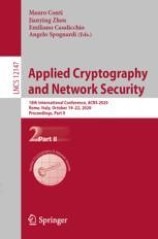
Applied cryptography and network security ; 18th International Conference, ACNS 2020, Rome, Italy, October 19–22, 2020, Proceedings, Part II
This two-volume set of LNCS 12146 and 12147 constitutes the refereed proceedings of the 18th International Conference on Applied Cryptography and Network Security, ACNS 2020, held in Rome, Italy, in October 2020.The conference was held virtually due to the COVID-19 pandemic. The 46 revised full papers presented were carefully reviewed and selected from 214 submissions. The papers were organized in topical sections named: cryptographic protocols cryptographic primitives, attacks on cryptographic primitives, encryption and signature, blockchain and cryptocurrency, secure multi-party computation, post-quantum cryptography.
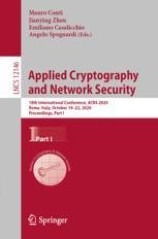
Applied Cryptography and Network Security ; 18th International Conference, ACNS 2020, Rome, Italy, October 19–22, 2020, Proceedings, Part I
This two-volume set of LNCS 12146 and 12147 constitutes the refereed proceedings of the 18th International Conference on Applied Cryptography and Network Security, ACNS 2020, held in Rome, Italy, in October 2020. The conference was held virtually due to the COVID-19 pandemic. The 46 revised full papers presented were carefully reviewed and selected from 214 submissions. The papers were organized in topical sections named: cryptographic protocols cryptographic primitives, attacks on cryptographic primitives, encryption and signature, blockchain and cryptocurrency, secure multi-party computation, post-quantum cryptography.
