



الصفحة 185
الصفحة 185

Fractal Geometry, Complex Dimensions and Zeta Functions : Geometry and Spectra of Fractal Strings
Number theory, spectral geometry, and fractal geometry are interlinked in this in-depth study of the vibrations of fractal strings, that is, one-dimensional drums with fractal boundary. Key Features The Riemann hypothesis is given a natural geometric reformulation in the context of vibrating fractal strings Complex dimensions of a fractal string, defined as the poles of an associated zeta function, are studied in detail, then used to understand the oscillations intrinsic to the corresponding fractal geometries and frequency spectra Explicit formulas are extended to apply to the geometric, spectral, and dynamical zeta functions associated with a fractal Examples of such explicit formulas include a Prime Orbit Theorem with error term for self-similar flows, and a geometric tube formula The method of Diophantine approximation is used to study self-similar strings and flows Analytical and geometric methods are used to obtain new results about the vertical distribution of zeros of number-theoretic and other zeta functions Throughout new results are examined. The final chapter gives a new definition of fractality as the presence of nonreal complex dimensions with positive real parts, and discusses several open problems and extensions.

Fractal Dimensions of Networks
The goal of the book is to provide a unified treatment of fractal dimensions of sets and networks. Since almost all of the major concepts in fractal dimensions originated in the study of sets, the book achieves this goal by first clearly presenting, with an abundance of examples and illustrations, the theory and algorithms for sets, and then showing how the theory and algorithms have been applied to networks. For example, the book presents the classical theory and algorithms for the box counting dimension for sets, and then presents the box counting dimension for networks. All the major fractal dimensions are studied, e.g., the correlation dimension, the information dimension, the Hausdorff dimension, the multifractal spectrum, as well as many lesser known dimensions. Algorithm descriptions are accompanied by worked examples, with many applications of the methods presented.

Fractal Behaviour of the Earth System
In this volume a collection of - pers considers the fractal behavior of the Earth's continental crust. Surface gravity anomalies are known to exhibit power-law spectral behavior under a wide range of conditions and scales. La Manna utilize multifractal models to explain the behavior of well logs from the main KTB borehole in Germany.

FPGA Implementations of Neural Networks
During the 1980s and early 1990s there was signi?cant work in the design and implementation of hardware neurocomputers. Nevertheless, most of these efforts may be judged to have been unsuccessful: at no time have have ha- ware neurocomputers been in wide use. This lack of success may be largely attributed to the fact that earlier work was almost entirely aimed at developing custom neurocomputers, based on ASIC technology, but for such niche - eas this technology was never suf?ciently developed or competitive enough to justify large-scale adoption. On the other hand, gate-arrays of the period m- tioned were never large enough nor fast enough for serious arti?cial-neur- network (ANN) applications.

Fourth IFIP International Conference on Theoretical Computer Science - TCS 2006 ; IFIP 19th World Computer Congress, TC-1, Foundations of Computer Science, August 23-24, 2006, Santiago, Chile
The IFIP series publishes state-of-the-art results in the sciences and technologies of information and communication. The scope of the series includes: foundations of computer science; software theory and practice; education; computer applications in technology; communication systems; systems modeling and optimization; information systems; computers and society; computer systems technology; security and protection in information processing systems; artificial intelligence; and human-computer interaction. Proceedings and post-proceedings of referred international conferences in computer science and interdisciplinary fields are featured. These results often precede journal publication and represent the most current research. The principal aim of the IFIP series is to encourage education and the dissemination and exchange of information about all aspects of computing.

Fourier Transforms of Invariant Functions on Finite Reductive Lie Algebras
In this book the author studies Fourier transforms using Deligne-Lusztig induction and the Lie algebra version of Lusztig’s character sheaves theory. He conjectures a commutation formula between Deligne-Lusztig induction and Fourier transforms that he proves in many cases. As an application the computation of the values of the trigonometric sums (on reductive Lie algebras) is shown to reduce to the computation of the generalized Green functions and to the computation of some fourth roots of unity.

Fourier Transformation for Pedestrians
Meant to serve an "entertaining textbook," this book belongs to a rare genre. It is written for all students and practitioners who deal with Fourier transformation. Fourier series as well as continuous and discrete Fourier transformation are covered, and particular emphasis is placed on window functions. Many illustrations and easy-to-solve exercises make the book especially accessible, and its humorous style will add to the pleasure of learning from it.

Fourier Series in Control Theory
Fourier Series in Control Theory successfully gathers all of the available theory of these "nonharmonic Fourier series" in one place, combining published results with new results, to create a unique source of such material for practicing applied mathematicians, engineers, and other scientific professionals.Starting with an overview of the problems of observability, controllability, and stabilization of linear systems and their interconnections, the text contains complete proofs along with a short, simplified, presentation of some properties of Bessel functions for the convenience of the reader. Only basic knowledge of functional analysis is required.

Founders at Work : Stories of Startups’ Early Days
Founders at Work: Stories of Startups' Early Days is a collection of interviews with founders of famous technology companies about what happened in the very earliest days. These people are celebrities now. What was it like when they were just a couple friends with an idea? Founders like Steve Wozniak (Apple), Caterina Fake (Flickr), Mitch Kapor (Lotus), Max Levchin (PayPal), and Sabeer Bhatia (Hotmail) tell you in their own words about their surprising and often very funny discoveries as they learned how to build a company.

Founders at Work : Stories of Startups' Early Days
These stories are exceptionally interesting, because they're about the early stages, when the founders were younger and inexperienced. Most readers know startup founders only as confident millionaires.

Foundations of Trusted Autonomy
This book establishes the foundations needed to realize the ultimate goals for artificial intelligence, such as autonomy and trustworthiness. Aimed at scientists, researchers, technologists, practitioners, and students, it brings together contributions offering the basics, the challenges and the state-of-the-art on trusted autonomous systems in a single volume. The book is structured in three parts, with chapters written by eminent researchers and outstanding practitioners and users in the field. The first part covers foundational artificial intelligence technologies, while the second part covers philosophical, practical and technological perspectives on trust. Lastly, the third part presents advanced topics necessary to create future trusted autonomous systems. The book augments theory with real-world applications including cyber security, defence and space.

Foundations of Systematics and Biogeography
the book highlights three principal messages: biological classifications and their explanatory mechanisms are separate notions; most, if not all, homology concepts pre-date the works of Darwin; and that the foundation of all comparative biology is the concept of relationship - neither 'similarity' nor 'genealogical hypotheses of descent' are sufficient. Foundations of Systematics and Biogeography is an ideal volume for students, academics, researchers and professionals in the fields of systematics, biogeography, evolutionary biology and palaeontology.

Foundations of SQL Server 2005 Business Intelligence
This book explains how best to use Analysis Services, SQL Server Integration Services, SQL Server Reporting Services, and SQL Server Data Mining. It also describes best practices for implementing end-to-end BI solutions in small, medium, and large business environments. And it provides important information about integrating BI with various client tools.

Foundations of Sport-Related Brain Injuries
A major take-home point from this book should be the assumption that symptom resolution does not necessarily mean injury resolution. As can be seen by research focusing on global metabolic cascades and neural activity of the brain, long-standing dysfunctional pathways continue to exist for extended periods of time even after a minor concussion. Until we completely understand the consequences of short-term perturbations and long-term residual brain dysfunctions, concussions must be treated with respect and given a higher priority for continued research activity.

Foundations of software science and computational structures ; Vol.3441 : 8th International Conference, FOSSACS 2005, Held as part of the joint European conferences on theory and practice of software, ETAPS 2005
ETAPS 2005 was the eighth instance of the European Joint Conferences on Theory and Practice of Software. ETAPS is an annual federated conference that was est- lished in 1998 by combining a number of existing and new conferences. This year it comprised ?ve conferences (CC, ESOP, FASE, FOSSACS, TACAS), 17 satellite wo- shops (AVIS, BYTECODE, CEES, CLASE, CMSB, COCV, FAC, FESCA, FINCO, GCW-DSE, GLPL, LDTA, QAPL, SC, SLAP, TGC, UITP), seven invited lectures (not including those that were speci?c to the satellite events), and several tutorials. We - ceived over 550 submissions to the ?ve conferences this year, giving acceptance rates below 30% for each one. Congratulations to all the authors who made it to the ?nal program! I hope that most of the other authors still found a way of participating in this exciting event and I hope you will continue submitting. The events that comprise ETAPS address various aspects of the system devel- ment process, including speci?cation, design, implementation, analysis and impro- ment. The languages, methodologies and tools which support these activities are all well within its scope.

Foundations of software science and computational structures ; 10th International Conference, FOSSACS 2007, Held as Part of the Joint European Conferences on Theory and Practice of Software, ETAPS 2007, Braga, Portugal, March 24-April 1, 2007, Proceedings
This book constitutes the refereed proceedings of the 10th International Conference on Foundations of Software Science and Computation Structures, FOSSACS 2007, held in Braga, Portugal in March/April 2007 as part of ETAPS 2007. The papers cover a broad spectrum on theories and methods to support analysis, synthesis, transformation and verification of programs and software systems.

Foundations of software science and computation structures ; Vol. 3921 ; 9th International conference, FOSSACS 2006, Held as part of the joint European conferences on theory and practice of software, ETAPS 2006, Vienna, Austria, March 25-31, 2006, proceedings
This book constitutes the refereed proceedings of the 9th International Conference on Foundations of Software Science and Computation Structures, FOSSACS 2006, held in Vienna, Austria in March 2006 as part of ETAPS. The 28 revised full papers presented together with 1 invited paper were carefully reviewed and selected from 107 submissions. The papers are organized in topical sections on mobile processes, software science, distributed computation, categorical models, real time and hybrid systems, process calculi, automata and logic, domains, lambda calculus, types, and security.

Foundations of software science and computation structures ; 25th International conference, FOSSACS 2022, Held as Part of the European joint conferences on theory and practice of software, ETAPS 2022, Munich, Germany, April 2–7, 2022, proceedings
This book constitutes the proceedings of the 25th International Conference on Foundations of Software Science and Computational Structures, FOSSACS 2022, which was held during April 4-6, 2022, in Munich, Germany, as part of the European Joint Conferences on Theory and Practice of Software, ETAPS 2022. They deal with research on theories and methods to support the analysis, integration, synthesis, transformation, and verification of programs and software systems.
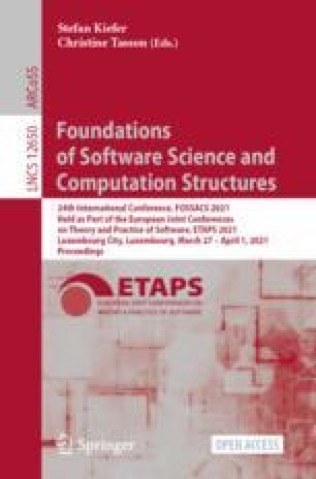
Foundations of software science and computation structures ; 24th International conference, FOSSACS 2021, Held as Part of the European joint conferences on theory and practice of software, ETAPS 2021, Luxembourg City, Luxembourg, March 27 – April 1, 2021, proceedings
This book constitutes the proceedings of the 24th International Conference on Foundations of Software Science and Computational Structures, FOSSACS 2021, which was held during March 27 until April 1, 2021, as part of the European Joint Conferences on Theory and Practice of Software, ETAPS 2021. The conference was planned to take place in Luxembourg and changed to an online format due to the COVID-19 pandemic.

Foundations of software science and computation structures ; 23rd International conference, FOSSACS 2020, Held as part of the European joint conferences on theory and practice of software, ETAPS 2020, Dublin, Ireland, April 25–30, 2020, proceedings
This book constitutes the proceedings of the 23rd International Conference on Foundations of Software Science and Computational Structures, FOSSACS 2020, which took place in Dublin, Ireland, in April 2020, and was held as Part of the European Joint Conferences on Theory and Practice of Software, ETAPS 2020.
