



الصفحة 177
الصفحة 177
Agent-mediated electronic commerce VI ; Theories for and engineering of distributed mechanisms and systems, AAMAS 2004 Workshop, Amec 2004, New York, NY, USA, July 19, 2004, revised selected papers
The design of intelligent trading agents, mechanisms, and systems has receivedgrowing atttention in the agents and multiagent systems communities in aneffort to address the increasing costs of search, transaction, and coordinationwhich follows from the increasing number of Internet-enabled distibuted elec-tronic markets. Furthermore, new technologies and supporting business modelsare resulting in a growing volume of open and horizontally integrated markets fortrading of an increasingly diverse set of goods and services. However, growth oftechnologies for such markets requires innovative solutions to a diverse set of ex-isting and novel technical problems which we are only beginning to understand.Specifically, distributed markets present not only traditional
Agent-Based Simulation : From Modeling Methodologies to Real-World Applications; Post Proceedings of the Third International Workshop on Agent-Based Approaches in Economic and Social Complex Systems 2004
Agent-based modeling/simulation is an emerging field that uses bottom-up and experimental analysis in the social sciences. Selected research from that presented at the Third International Workshop on Agent-Based Approaches in Economic and Social Complex Systems 2004, held in May 2004 in Kyoto, Japan, is included in this book. The aim of the workshop was to employ the bottom-up approach to social and economic problems by modeling, simulation, and analysis using a software agent. This research area is an emerging interdisciplinary field among the social sciences and computer science, attracting broad attention because it introduces a simulation-based experimental approach to problems that are becoming increasingly complex in an era of globalization and innovation in information technology. The state-of-the-art research and findings presented in this book will be indispensable tools for anyone involved in this rapidly growing discipline.
Agent-Based Models of Energy Investment Decisions
This book demonstrates how bounded rational decision models can be standardized and parameterized by socio-economic data. Focusing on private energy technology investment decisions, the author shows how different representative agents can be constructed using search rules, analysis tools and decision strategies. Diffusion curves for energy technologies such as solar collectors, boilers and efficiency upgrades for buildings are calculated. Further, the model is extended to study the impact of firms’ competition on technology diffusion. The modeling approach presented in this book may serve as a template for applications in other domain.
Agent-Based Modeling Meets Gaming Simulation
Provides a good example of the diverse scope and standard of research achieved in simulation and gaming today. The theme of the special session at ISAGA2003 was Agent-Based Modeling Meets Gaming Simulation. Nowadays, agent-based simulation is becoming very popular for modeling and solving complex social phenomena. It is also used to arrive at practical solutions to social problems. At the same time, however, the validity of simulation does not exist in the magni?cence of the model. R. Axelrod stresses the simplicity of the agent-based simulation model through the “Keep it simple, stupid” (KISS) principle: As an ideal, simple modeling is essential.
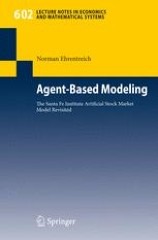
Agent-based modeling : The Santa Fe Institute artificial stock market model revisited
An excellent reference to both the learning, and empirical literature in finance." (Krzysztof Piasecki, Zentralblatt MATH, Vol. 1141, 2008) "Norman Ehrentreich was one of the daring few to take on the model, and he has summarized his work and findings in this excellent book. … It is useful primer for anyone interested in getting started in the area of agent-based finance. … It is essential reading for anyone interested in the dynamics of the SFI market in particular, but I also recommend it for others as a useful resource on agent-based financial market design as well." (Blake LeBaron, Journal of Artificial Societies and Social Simulation, Vol. 12 (2), March, 2009)
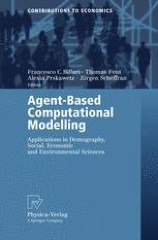
Agent-based computational modelling : Applications in demography, social, economic and environmental sciences
The present book describes the methodology to set up agent-based models and to study emerging patterns in complex adaptive systems resulting from multi-agent interaction. It offers the application of agent-based models in demography, social and economic sciences and environmental sciences. It presents and combines different approaches how to implement agent-based computational models and tools in an integrative manner that can be extended to other cases.
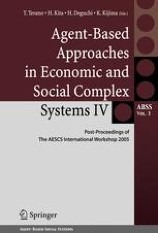
Agent-Based Approaches in Economic and Social Complex Systems IV ; Post Proceedings of The AESCS International Workshop 2005
Agent-Based Modeling/Simulation (ABM/ABS) is an emerging field that enables bottom-up and experimental analysis in social sciences such as economics, management, sociology and politics. The chapters of this book are the selected papers from those presented the Third International Workshop on Agent-Based Approaches in Economic and Social Complex Systems held in Tokyo, Japan in 2005. Articles in this book covers methodological issues, computational model/software, combination with gaming simulation, and real-world applications to economic, management/organizational and social issues.

Agent Computing and Multi-Agent Systems ; 9th Pacific Rim International Workshop on Multi-Agents, PRIMA 2006, Guilin, China, August 7-8, 2006, Proceedings
PRIMA is a series of workshops on agent computing and multi-agent systems, integrating the activities in Asia and Pacific Rim countries. Agent computing and multi-agent systems are computational systems in which several autonomous or se- autonomous agents interact with each other or work together to perform some set of tasks or satisfy some set of goals. These systems may involve computational agents that are homogeneous or heterogeneous, they may involve activities on the part of agents having common or distinct goals, and they may involve participation on the part of humans and intelligent agents. The aim of PRIMA 2006 was to bring together Asian and Pacific Rim researchers and developers from academia and industry to report on the latest technical advances or domain applications and to discuss and explore scientific and practical problems as raised by the participants. PRIMA 2006 received 203 submitted papers.
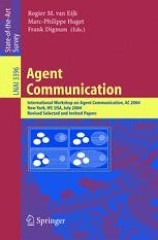
Agent communication ; International workshop on agent communication, AC 2004, New York, NY, July 19, 2004
In this book, we present a collection of papers around the topic of agent com- nication. The communication between agents has been one of the major topics of research in multiagent systems. The current work can therefore build on a number of previous Workshops of which the proceedings have been published in earlier volumes in this series. The basis of this collection is formed by the accepted submissions of the Workshop on Agent Communication held in c- junction with the AAMAS Conference in July 2004 in New York. the current collection comprises a very good and quite complete overview of the state of the art in this area of research and gives a good indication of the topics that are of major interest at the moment. The papers can roughly be divided over the following ?ve themes: – social commitments – multiparty communication – content languages – dialogues and conversations – speech acts Although these themes are of course not mutually exclusive they indicate some main directions of research. We therefore have arranged the papers in the book according to the topics indicated above.

Agent and Multi-Agent Systems : Technologies and Applications ; 2nd KES International Symposium, KES-AMSTA 2008, Incheon, Korea, March 26-28, 2008. Proceedings
The KES-AMSTA Symposium Series is a sub-series of the KES Conference Series. The aim of the symposium was to provide an international forum for scientific research into the technologies and applications of agent and multi-agent systems.

Agent and multi-agent systems : Technologies and applications ; 1st KES International Symposium, KES-AMSTA 2007, Wroclaw, Poland, May 31-June 1, 2007, Proceedings
The aim of the symposium was to provide an international forum for scientific - search in the technologies and applications of agent and multi-agent systems. Agents and multi-agent systems are related to the modern software which has long been r- ognized as a promising technology for constructing autonomous, complex and intel- gent systems. A key development in the field of agent and multi-agent systems has been the specification of agent communication languages and formalization of - tologies. Agent communication languages are intended to provide standard decla- tive mechanisms for agents to communicate knowledge and make requests of each other, whereas ontologies are intended for conceptualization of the knowledge - main.

Africa-Europe Research and Innovation Cooperation : Global Challenges, Bi-regional Responses
Concerned with the evolution and achievements of cooperation in research and innovation between Africa and Europe, and points to the need for more diversified funding and finance mechanisms, and for novel models of collaboration to attract new actors and innovative ideas. It reflects on the political, economic, diplomatic and scientific rationale for cooperation, while also examining practical developments, illustrated with examples, in the fields of food security, health, and climate change. The need to mobilise scientific knowledge and to ensure equality and fairness in the cooperation are recurrent themes. Africa-Europe Cooperation in Research and Innovation is essential reading for policy makers and researchers in international relations and science diplomacy.

Affective computing and intelligent interaction ; 2nd International Conference, ACII 2007, Lisbon, Portugal, September 12-14, 2007, Proceedings
Organized in topical sections on affective facial expression and recognition, affective body expression and recognition, affective speech processing, affective text and dialogue processing, recognising affect using physiological measures, computational models of emotion and theoretical foundations, affective databases, annotations, tools and languages, affective sound and music processing, affective interactions: systems and applications, as well as evaluating affective systems.

Affect and Mathematics Education : Fresh Perspectives on Motivation, Engagement, and Identity
Presents the latest trends in research in the area. Following an introduction and a survey chapter providing a concise overview of the state-of-art in the field of mathematics-related affect, the book is divided into three main sections: motivation and values, engagement, and identity in mathematics education. Each section comprises several independent chapters based on original research, as well as a reflective commentary by an expert in the area. Collectively, the chapters present a rich methodological spectrum, from narrative analysis to structural equation modelling.
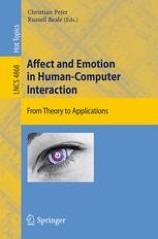
Affect and Emotion in Human-Computer Interaction : From Theory to Applications
The present book provides an account of the latest work on a variety of aspects related to affect and emotion in human-technology interaction. It covers theoretical issues, user experience and design aspects as well as sensing issues, and reports on a number of affective applications that have been developed in recent years.

Aesthetic Surgery of the Abdominal Wall
We have come a long way since the days when abdominal wall contouring was p- formed by simple dermolipectomies, with no attention to diastasis correction and muscular reinforcement, and little regard for the final aesthetic result. Nowadays, an abdominoplasty may be indicated for even the most demanding of patients. Details such as placement of the incision and umbilicoplasty are meticulously planned so as to conceal undesirable scars. Since the advent of suction-assisted lipectomy, in as- ciation with a classical operation or as an isolated procedure, the plastic surgeon has become capable of remodeling the entire trunk, assuring removal of considerable amounts of adipose tissue.
Advertising management : Concepts, theories, research and trends
Explores the concept of advertising and the different ways advertising is understood and evaluated. It dives deep into planning, designing, and executing advertising campaigns on different mediums. It discusses the theoretical and research parts of advertising by critically examining how over the years various hierarchical models and theories are developed by advertising experts. It examines various models and theories that explain why and how advertising is successful in persuading customers target audiences to buy a product or accept an idea for behavioural change.
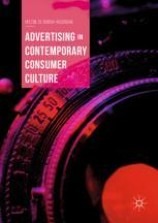
Advertising in contemporary consumer culture
This is the first scholarly book dedicated to reading the work of contemporary filmmakers and their impact on modern marketing and advertising. Drawing from consumer culture theory, film and media studies, the author presents an expansive analysis of a range of renowned filmmakers who have successfully applied their aesthetic and narrative vision to commercial advertising. It challenges some traditional advertising tropes and sheds light on the changing nature of advertising in the contemporary media context. Utilising Deleuze and Guattari’s notion of assemblage, This book addresses themes of spatiality and time, narrative and aesthetics and consumer reception within a new frame of reference that re-contextualises classical concepts of genre, platform and aesthetic categories. These diverse elements are embedded into a larger discussion of the resonance of contemporary advertising for consumer culture and the implications of the hybridity characteristic of convergent media platforms for understanding the potential of advertising in the twenty-first century.
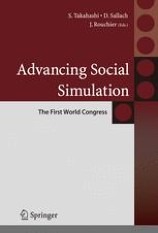
Advancing Social Simulation: The First World Congress
Agent-based modeling and social simulation have emerged as both developments of and challenges to the social sciences. The developments include agent-based computational economics and investigations of theoretical sociological concepts using formal simulation techniques. Among the challenges are the development of qualitative modeling techniques, implementation of agent-based models to investigate phenomena for which conventional economic, social, and organizational models have no face validity, and the application of physical modeling techniques to social processes. Bringing together diverse approaches to social simulation and research agendas.
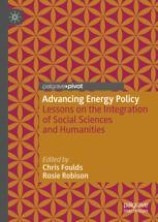
Advancing Energy Policy : Lessons on the integration of Social Sciences and Humanities
Advocates for the Social Sciences and Humanities to be more involved in energy policymaking. It forms part of the European platform for energy-related Social Sciences and Humanities’ activities, and works on the premise that crossing disciplines is essential. All of its contributions are highly interdisciplinary, with each chapter grounded in at least three different Social Sciences and Humanities disciplines. These varying perspectives come together to cover an array of issues relevant to the energy transition, including: energy poverty, justice, political ecology, governance, behaviours, imaginaries, systems approaches, modelling, as well as the particular challenges faced by interdisciplinary work. As a whole, the book presents new ideas for future energy policy, particularly at the European level. It is a valuable resource for energy researchers interested in interdisciplinary and society-relevant perspectives. Those working outside the Social Sciences and Humanities will find this book an accessible way of learning more about how these subjects can constructively contribute to energy policy.
