



الصفحة 17
الصفحة 17

Multiple Classifier Systems ; 7th International Workshop, MCS 2007, Prague, Czech Republic, May 23-25, 2007, Proceedings
These proceedings are a record of the Multiple Classifier Systems Workshop, MCS 2007, held at the Institute of Information Theory and Automation, Czech Academy of Sciences, Prague in May 2007. the workshop achieved its objective of bringing together researchers from diverse communities (neural networks, pattern rec- nition, machine learning and statistics) concerned with this research topic.

Multiple Classifier Systems ; 6th International Workshop, MCS 2005, Seaside, CA, USA, June 13-15, 2005, Proceedings
Constitutes the refereed proceedings of the 6th International Workshop on Multiple Classifier Systems, MCS 2005. This book contains papers that are organized in topical sections on boosting, combination methods, performance analysis, and applications. They exemplify the advances in the theory and applications of multiple classifier systems

Multiple Classifier Systems ; 2nd International Workshop, MCS 2001 Cambridge, UK, July 2-4, 2001 Proceedings
Driven by the requirements of a large number of practical and commercially - portant applications, the last decade has witnessed considerable advances in p- tern recognition. Better understanding of the design issues and new paradigms, such as the Support Vector Machine, have contributed to the development of - proved methods of pattern classi cation. However, while any performance gains are welcome, and often extremely signi cant from the practical point of view, it is increasingly more challenging to reach the point of perfection as de ned by the theoretical optimality of decision making in a given decision framework. The asymptoticity of gains that can be made for a single classi er is a re?- tion of the fact that any particular design, regardless of how good it is, simply provides just one estimate of the optimal decision rule.

Multiple Bonds between Metal Atoms
The 3rd edition of the Multiple Bonds between Metal Atoms deals with one of the most active fields of inorganic chemistry … . It presents an extensive, critical review and discussion of preparations, reactions, bonding, and physical properties of more than 4000 compounds … heartily recommend it to inorganic and materials chemists, and to all scientists concerned with the synthesis, spectroscopy, and structures of transition-metal compounds. It also belongs in academic, industrial, and government research libraries.

Multiple Abstraction Hierachies for Mobile Robot Operation in Large Environments
This book focuses on the efficient performance of mobile robots through the use of multi-hierarchical symbolic representations of the environment. A mobile robot intended to perform deliberative actions must possess some symbolic representation of its workspace, but such representations of real environments usually become so large that should be conveniently arranged in order to facilitate and, in some cases, make possible their use. This book addresses all these issues considering symbolic multi-hierarchical structures. Such structures, based on the concept of abstraction, allow a robot to speed up its operation in large environments. Practical solutions tested on real robots (for instance, a robotic wheelchair for elder people) are provided.

Multiphase Reacting Flows : Modelling and Simulation
This book entitled ''Multiphase reacting flows: modelling and simulation'' contains the lecture notes of the CISM (International Centre for Mechanical Sciences) course held in Udine, Italy, on July 3-7, 2006, and it describes various modelling approaches for dealing with polydisperse multiphase reacting flows. A multiphase reacting system is characterized by the presence of multiple phases and in this book we focus on disperse multiphase systems, where one phase can be considered as a continuum, whereas the additional phases are dispersed in the continuous one. In other words, in this book we deal with multiphase systems constituted by particles, droplets or bubbles (i.e., solid particles suspended in a continuous liquid phase, liquid droplets in a gaseous phase, or gas bubbles in liquid.) The other important characteristic elements of the systems discussed in this book are the presence of one or more chemical reactions and the turbulent nature of the flow. The chemical reactions usually involve all the phases present in the system and might be responsible for the formation or disappearance of the disperse and/or continuous phases.
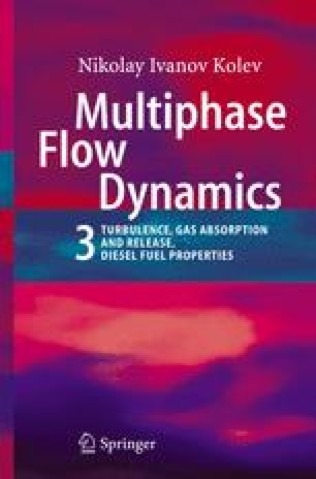
Multiphase Flow Dynamics 3 : Turbulence, Gas Absorption and Release, Diesel Fuel Properties
Volume 3 is devoted to selected Chapters of the multiphase fluid dynamics that are important for practical applications. The state of the art of the turbulence modeling in multiphase flows is presented. As introduction, some basics of the single-phase boundary layer theory including some important scales and flow oscillation characteristics in pipes and rod bundles are presented. Then the scales characterizing the dispersed flow systems are presented. The description of the turbulence is provided at different level of complexity: simple algebraic models for eddy viscosity, algebraic models based on the Boussinesq hypothesis, modification of the boundary layer share due to modification of the bulk turbulence, modification of the boundary layer share due to nucleate boiling. Then the role of the following forces on the matematical description of turbulent flows is discussed: the lift force, the lubrication force in the wall boundary layer, and the dispersion force.

Multiphase Flow Dynamics 2 : Thermal and Mechanical Interactions ; 3rd ed.
Multi-phase flows are part of our natural environment such as tornadoes, typhoons, air and water pollution and volcanic activities as well as part of industrial technology such as power plants, combustion engines, propulsion systems, or chemical and biological industry. The industrial use of multi-phase systems requires analytical and numerical strategies for predicting their behavior. In its third extended edition this book contains theory, methods and practical experience for describing complex transient multi-phase processes in arbitrary geometrical configurations. This book provides a systematic presentation of the theory and practice of numerical multi-phase fluid dynamics. In the present second volume the mechanical and thermal interactions in multiphase dynamics are provided. This third edition includes various updates, extensions, improvements and corrections.

Multiphase Flow Dynamics 2 : Thermal and Mechanical Interactions ; 2nd ed.
This book provides a systematic presentation of the theory and practice of numerical multi-phase fluid dynamics. In the present second volume the mechanical and thermal interactions in multiphase dynamics are provided.

Multiphase Flow Dynamics 1 : Fundamentals ; 3rd ed.
Multi-phase flows are part of our natural environment such as tornadoes, typhoons, air and water pollution and volcanic activities as well as part of industrial technology such as power plants, combustion engines, propulsion systems, or chemical and biological industry. The industrial use of multi-phase systems requires analytical and numerical strategies for predicting their behavior. In its third extended edition this monograph contains theory, methods and practical experience for describing complex transient multi-phase processes in arbitrary geometrical configurations, providing a systematic presentation of the theory and practice of numerical multi-phase fluid dynamics. This third edition includes various updates, extensions and improvements in all book chapters.

Multiphase Flow Dynamics 1 : Fundamentals ; 2nd ed.
In its second extended edition this monograph contains theory, methods and practical experience for describing complex transient multi-phase processes in arbitrary geometrical configurations. In the present first volume the fundamentals of multiphase dynamics are provided, as well as various interactive multimedia demonstrations on an accompanying CD-ROM.

Multiparadigm Programming in Mozart/Oz ; 2nd International Conference, MOZ 2004, Charleroi, Belgium, October 7-8, 2004, Revised Selected Papers
Oz's concurrency model yields simplicity and clarity (because Oz makes it easier to express complex programs with many interacting components), g- erality, and better interfaces (because the data?ow model automatically makes interfaces more lightweight). Constraint programming in Oz again yields simplicity and clarity (because theprogrammercanexpresswhatneedstobetrueratherthanthemorecomplex issue of how to make it true), and o?ers a powerful mathematical notation that is di?cult to implement on top of languages that do not support it natively. Mozart's distributed computing model makes for improved interfaces and eases the evolution of systems. In my own work, one of the most important concernsistobeabletoquicklyscaleupaprototypeimplementationintoalar- scale service that can run reliably on thousands of computers, serving millions of users.

Multiobjective Problem Solving from Nature : From Concepts to Applications
he book focuses on how MOEAs and related techniques can be used to solve problems, particularly in the disciplines of science and engineering. Contributions by leading researchers show how the concepts of multiobjective optimization can be used to reformulate and resolve problems in broad areas such as constrained optimization, coevolution, classification, inverse modelling and design. The book is distinguished from other texts on MOEAs in that it is not primarily about the algorithms, nor specific applications, but about the concepts and processes involved in solving problems using a multiobjective approach. Each chapter contributes to the central, deep concepts and themes of the book: evaluating the utility of the multiobjective approach; discussing alternative problem formulations; showing how problem formulation affects the search process; and examining solution selection and decision making.

Multiobjective Optimization : Interactive and Evolutionary Approaches
Multiobjective optimization deals with solving problems having not only one, but multiple, often conflicting, criteria. Such problems can arise in practically every field of science, engineering and business, and the need for efficient and reliable solution methods is increasing. The task is challenging due to the fact that, instead of a single optimal solution, multiobjective optimization results in a number of solutions with different trade-offs among criteria, also known as Pareto optimal or efficient solutions. Hence, a decision maker is needed to provide additional preference information and to identify the most satisfactory solution. Depending on the paradigm used, such information may be introduced before, during, or after the optimization process. Clearly, research and application in multiobjective optimization involve expertise in optimization as well as in decision support.

Multiobjective Evolutionary Algorithms and Applications
Multiobjective Evolutionary Algorithms and Applications provides comprehensive treatment on the design of multiobjective evolutionary algorithms and their applications in domains covering areas such as control and scheduling. Emphasizing both the theoretical developments and the practical implementation of multiobjective evolutionary algorithms, a profound mathematical knowledge is not required. Written for a wide readership, engineers, researchers, senior undergraduates and graduate students interested in the field of evolutionary algorithms and multiobjective optimization with some basic knowledge of evolutionary computation will find this book a useful addition to their book case.

Multimodal Texts in Disciplinary Education : A Comprehensive Framework
This book provides an introduction to multimodality and the role of multimodal texts in today’s education. Presenting a comprehensive framework for analysing and working with multimodal texts in disciplinary education, it serves as a tool for researchers and teachers alike. The second part of the book focuses on sample analyses of a variety of educational texts for different age groups and from different disciplines, including games and online resources. The authors also comment on the specific challenges of each text, and how teachers can discuss such texts with their students to enhance both their understanding of the content and their multimodal literacy.

Multimodal Technologies for Perception of Humans ; International Evaluation Workshops CLEAR 2007 and RT 2007, Baltimore, MD, USA, May 8-11, 2007, Revised Selected Papers
This book constitutes the thoroughly refereed joint post-workshop proceedings of two co-located events: the Second International Workshop on Classification of Events, Activities and Relationships, CLEAR 2007, and the 5th Rich Transcription 2007 Meeting Recognition evaluation, RT 2007, held in succession in Baltimore, MD, USA, in May 2007.The workshops had complementary evaluation efforts; CLEAR for the evaluation of human activities, events, and relationships in multiple multimodal data domains; and RT for the evaluation of speech transcription-related technologies from meeting room audio collections.

Multimodal Technologies for Perception of Humans ; 1st International Evaluation Workshop on Classification of Events, Activities and Relationships, CLEAR 2006, Southampton, UK, April 6-7, 2006, Revised Selected Papers
This book constitutes the thoroughly refereed post-proceedings of the First International CLEAR 2006 Evaluation Campaign and Workshop on Classification of Events, Activities and Relationships for evaluation of multimodal technologies for the perception of humans, their activities and interactions. The workshop was held in the UK in April 2006.
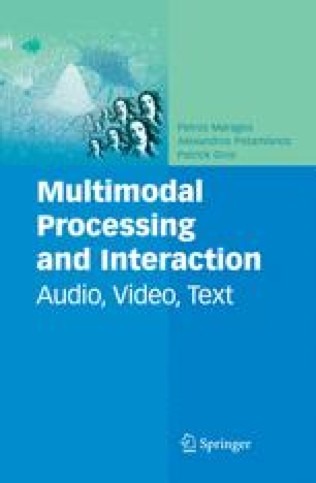
Multimodal Processing and Interaction : Audio, Video, Text
Multimodal Processing and Interaction: Audio, Video and Text presents high quality, state-of-the-art research ideas and results from theoretic, algorithmic and application viewpoints. This edited volume contains both state-of-the-art reviews and original contributions by leading experts in the scientific and technological field of multimedia. It grew out of a four-year collaboration among research groups participating in the European network of Excellence on Multimedia Understanding, Semantics, Computation and Learning (MUSCLE).

Multimodal Intelligent Information Presentation
Intelligent Multimodal Information Presentation relates to the ability of a computer system to automatically produce interactive information presentations, taking into account the specifics about the user, such as needs, interests and knowledge, and engaging in a collaborative interaction that helps the retrieval of relevant information and its understanding on the part of the user.The volume includes descriptions of some of the most representative recent works on Intelligent Information Presentation and a view of the challenges ahead.
