



الصفحة 17
الصفحة 17

Computational science and its applications – ICCSA 2007 ; International Conference, Kuala Lumpur, Malaysia, August 26-29, 2007. Proceedings, Part I
This volume feature outstanding papers that present a wealth of original research results in the field of computational science, from foundational issues in computer science and mathematics to advanced applications in almost all sciences that use computational techniques.

Computational science and its applications - ICCSA 2006 ; Vol. 3983 ; International Conference, Glasgow, UK, May 8-11, 2006, Proceedings, Part IV
This ?ve-volume set was compiled following the 2006 International Conference on Computational Science and its Applications, ICCSA 2006. It represents the outstanding collection of almost 664 refereed papers selected from over 2,450 submissions to ICCSA 2006. Computational science has ?rmly established itself as a vital part of many scienti?c investigations, a?ecting researchers and practitioners in areas ranging from applications such as aerospace and automotive, to emerging technologies such as bioinformatics and nanotechnologies, to core disciplines such as ma- ematics, physics, and chemistry.

Computational science and its applications - ICCSA 2006 ; Vol. 3982 ; International Conference, Glasgow, UK, May 8-11, 2006, Proceedings, Part III
This ?ve-volume set was compiled following the 2006 International Conference on Computational Science and its Applications, ICCSA 2006. It represents the outstanding collection of almost 664 refereed papers selected from over 2,450 submissions to ICCSA 2006. Computational science has ?rmly established itself as a vital part of many scienti?c investigations, a?ecting researchers and practitioners in areas ranging from applications such as aerospace and automotive, to emerging technologies such as bioinformatics and nanotechnologies, to core disciplines such as ma- ematics, physics, and chemistry.

Computational science and its applications - ICCSA 2006 ; Vol. 3981 ; International Conference, Glasgow, UK, May 8-11, 2006, Proceedings, Part II
This ?ve-volume set was compiled following the 2006 International Conference on Computational Science and its Applications, ICCSA 2006. It represents the outstanding collection of almost 664 refereed papers selected from over 2,450 submissions to ICCSA 2006. Computational science has ?rmly established itself as a vital part of many scienti?c investigations, a?ecting researchers and practitioners in areas ranging from applications such as aerospace and automotive, to emerging technologies such as bioinformatics and nanotechnologies, to core disciplines such as ma- ematics, physics, and chemistry.

Computational science and its applications - ICCSA 2006 ; Vol. 3980 ; International Conference, Glasgow, UK, May 8-11, 2006, Proceedings, Part I
This ?ve-volume set was compiled following the 2006 International Conference on Computational Science and its Applications, ICCSA 2006. It represents the outstanding collection of almost 664 refereed papers selected from over 2,450 submissions to ICCSA 2006. Computational science has ?rmly established itself as a vital part of many scienti?c investigations, a?ecting researchers and practitioners in areas ranging from applications such as aerospace and automotive, to emerging technologies such as bioinformatics and nanotechnologies, to core disciplines such as ma- ematics, physics, and chemistry.

Computational science and its applications - ICCSA 2006 ;Vol. 3984 ; International Conference, Glasgow, UK, May 8-11, 2006, Proceedings, Part V
This ?ve-volume set was compiled following the 2006 International Conference on Computational Science and its Applications, ICCSA 2006. It represents the outstanding collection of almost 664 refereed papers selected from over 2,450 submissions to ICCSA 2006. Computational science has ?rmly established itself as a vital part of many scienti?c investigations, a?ecting researchers and practitioners in areas ranging from applications such as aerospace and automotive, to emerging technologies such as bioinformatics and nanotechnologies, to core disciplines such as ma- ematics, physics, and chemistry.

Computational science and its applications - ICCSA 2005 ; Vol. 3483 ; International Conference, Singapore, May 9-12, 2005, Proceedings, Part IV
The four volume set assembled following The 2005 International Conference on Computational Science and its Applications, ICCSA 2005, held in Suntec International Convention and Exhibition Centre, Singapore, from 9 May 2005 till 12 May 2005, represents the ?ne collection of 540 refereed papers selected from nearly 2,700 submissions. Computational Science has ?rmly established itself as a vital part of many scienti?c investigations, a?ecting researchers and practitioners in areas ranging from applications such as aerospace and automotive, to emerging technologies such as bioinformatics and nanotechnologies, to core disciplines such as ma- ematics, physics, and chemistry. Due to the shear size of many challenges in computational science, the use of supercomputing, parallel processing, and - phisticated algorithms is inevitable and becomes a part of fundamental t- oretical research as well as endeavors in emerging ?elds.

Computational science and its applications - ICCSA 2005 ; Vol. 3482 ; International Conference, Singapore, May 9-12. 2005, Proceedings, Part III
The four volume set assembled following The 2005 International Conference on Computational Science and its Applications, ICCSA 2005, held in Suntec International Convention and Exhibition Centre, Singapore, from 9 May 2005 till 12 May 2005, represents the ?ne collection of 540 refereed papers selected from nearly 2,700 submissions. Computational Science has ?rmly established itself as a vital part of many scienti?c investigations, a?ecting researchers and practitioners in areas ranging from applications such as aerospace and automotive, to emerging technologies such as bioinformatics and nanotechnologies, to core disciplines such as ma- ematics, physics, and chemistry. Due to the shear size of many challenges in computational science, the use of supercomputing, parallel processing, and - phisticated algorithms is inevitable and becomes a part of fundamental t- oretical research as well as endeavors in emerging ?elds.

Computational science and its applications - ICCSA 2005 ; International Conference, Singapore, May 9-12, 2005, Proceedings, Part II
The four volume set assembled following The 2005 International Conference on Computational Science and its Applications, ICCSA 2005, held in Suntec International Convention and Exhibition Centre, Singapore, from 9 May 2005 till 12 May 2005, represents the ?ne collection of 540 refereed papers selected from nearly 2,700 submissions. Computational Science has ?rmly established itself as a vital part of many scienti?c investigations, a?ecting researchers and practitioners in areas ranging from applications such as aerospace and automotive, to emerging technologies such as bioinformatics and nanotechnologies, to core disciplines such as ma- ematics, physics, and chemistry. Due to the shear size of many challenges in computational science, the use of supercomputing, parallel processing, and - phisticated algorithms is inevitable and becomes a part of fundamental t- oretical research as well as endeavors in emerging ?elds.

Computational intelligence for agent-based systems
In these last years the digital technology explosion has spawned so many new lifestyle models that the boundaries between "real" and "digital" are fiercely debated. This scenario has deeply changed the viewpoint about computer applications: computers become smaller, cheapest and hugely distributed in wired or unwired networks, applications become so flexible and intelligent as to tailor its communication facilities in order to increase the usability of the system. Such data-intensive, unstructured spaces featured by minimal or no centralized control flow, present a challenge for traditional methods of analysis, design and integration of advanced, distributed and intelligent computer systems. Within this challenge, an important role is played by two important research areas : Fuzzy Technology, thanks to its ability to exploit the tolerance for imprecision to achieve tractability and Agent Technology, thanks to its nature to employ agent-wise communities to carry out complex goals by means of smart interaction, cooperation, and pro-activeness.
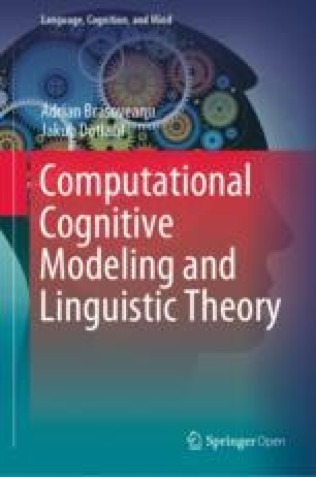
Computational Cognitive Modeling and Linguistic Theory
This book introduces a general framework that allows natural language researchers to enhance existing competence theories with fully specified performance and processing components. Gradually developing increasingly complex and cognitively realistic competence-performance models, it provides running code for these models and shows how to fit them to real-time experimental data. This computational cognitive modeling approach opens up exciting new directions for research in formal semantics, and linguistics more generally, and offers new ways of (re)connecting semantics and the broader field of cognitive science.
Collective Consciousness and its Discontents: Institutional distributed cognition, racial policy, and public health in the United States
This book expands a recent mathematical treatment of the Baars model of individual consciousness to an institutional venue in which multiple ‘Global Workspaces’ cooperate, communicate, and compete. The result is an expansion of Dretske’s necessary conditions communications theory approach to high level cognition.

Coherence, Truth and Testimony
Coherence is a burgeoning topic of research. Diverse methodologies have been applied to shed light on the topic and its relevance to fundamental questions throughout philosophy. The collection brings together the full scope of this research in a single volume. The first group of essays attack the core topic of the book: coherence. Authors in this section take up the challenging and controversial task of measuring the coherence of an information set, while others criticize this endeavor. The second group of papers in the collection relate this foundational research to a wide array of epistemological and metaphysical challenges. For example, some papers consider the relationship between truth and coherence. Is coherence truth conducive, and if yes, under which conditions? A related issue taken up in this volume is the connection between coherence and testimony. Are we justified in believing coherent reports by independent, though only partially reliable witnesses more than a single report? If yes, under which conditions does this claim hold true? By the end of the book, the reader should have a comprehensive understanding of topic of coherence, the controversy surrounding it, and its implications across the discipline of philosophy.

Coercion and the State
A signal feature of legal and political institutions is that they exercise coercive power. The essays in this volume examine institutional coercion with the aim of trying to understand its nature, justification and limits. Included are essays that take a fresh look at perennial questions – what, if anything, can legitimate state exercises of coercive force? What is coercion in politics and law? – and essays that take a first or nearly first look at newer questions – may the state coercively hold certain terrorists indefinitely? Leading scholars from philosophy, political science and law examine these and related questions shedding new light on an apparently inescapable feature of political and legal life: Coercion.

Coding, shaping, making : experiments in form and form-making
Combines inspiration from architecture, mathematics, biology, chemistry, physics and computation to look towards the future of architecture, design and art. It presents ongoing experiments in the search for fundamental principles of form and form-making in nature so that we can better inform our own built environment.

Clocks in the Sky : The Story of Pulsars
In this book, Geoff McNamara explores the history, subsequent discovery and contemporary research into pulsar astronomy. The story of pulsars is brought right up to date with the announcement in 2006 of a new breed of pulsar, Rotating Radio Transients (RRATs), which emit short bursts of radio signals separated by long pauses. These may outnumber conventional radio pulsars by a ratio of four to one. Geoff McNamara ends by pointing out that, despite the enormous success of pulsar research in the second half of the twentieth century, the real discoveries are yet to be made including, perhaps, the detection of the hypothetical pulsar black hole binary system by the proposed Square Kilometre Array - the largest single radio telescope in the world.
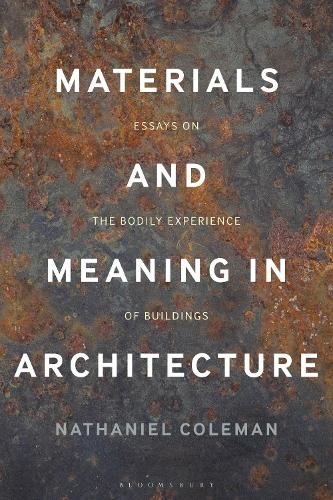
Materials and meaning in architecture : Essays on the bodily experience of buildings
Interweaving architecture, philosophy and cultural history, Materials and Meaning in Architecture develops a rich and multi-dimensional exploration of materials and materiality, in an age when architectural practice seems otherwise preoccupied with image and visual representation.

Material Agency : Towards a Non-Anthropocentric Approach
This book is a groundbreaking attempt to address questions of non-human and material agency from a wide range of perspectives and disciplines: archaeology, anthropology, sociology, cognitive science, philosophy, and economics. The editors and authors demostrate that a distributed, relational approach to agency, incorporating both humans and artifacts, has important ramifications for how we understand material culture.

Mass Terms : Some Philosophical Problems
MASS TERMS, COUNT TERMS, AND SORTAL TERMS Central examples of mass terms are easy to come by. 'Water', 'smoke', 'gold', etc. , differ in their syntactic, semantic, and pragmatic properties from count terms such as 'man', 'star', 'wastebasket', etc. Syntactically, it seems, mass terms do, but singular count terms do not, admit the quantifier phrases 'much', 'an amount of', 'a little', etc. The typical indefinite article for them is 'some' (unstressed)!, and this article cannot be used with singular count terms. Count terms, but not mass terms, use the quantifiers 'each', 'every', 'some', 'few', 'many'; and they use 'a(n)' as the indefinite article. They can, unlike the mass terms, take numerals as prefixes.

Mary and Early Christian Women : Hidden Leadership
This book reveals exciting early Christian evidence that Mary was remembered as a powerful role model for women leaders—women apostles, baptizers, and presiders at the ritual meal. Early Christian art portrays Mary and other women clergy serving as deacon, presbyter/priest, and bishop. In addition, the two oldest surviving artifacts to depict people at an altar table inside a real church depict women and men in a gender-parallel liturgy inside two of the most important churches in Christendom—Old Saint Peter’s Basilica in Rome and the second Hagia Sophia in Constantinople. Dr. Kateusz’s research brings to light centuries of censorship, both ancient and modern, and debunks the modern imagination that from the beginning only men were apostles and clergy.
