



الصفحة 16
الصفحة 16

Fuzzy systems and knowledge discovery ; Vol. 3613 ; 2nd International Conference, FSKD 2005, Changsha, China, August 27-29, 2005, Proceedings, Part I
This book and its sister volume, LNAI 3613 and 3614, constitute the proce- ings of the Second International Conference on Fuzzy Systems and Knowledge Discovery (FSKD 2005), jointly held with the First International Conference on Natural Computation (ICNC 2005, LNCS 3610, 3611, and 3612) from - gust 27–29, 2005 in Changsha, Hunan, China. FSKD 2005 successfully attracted 1249 submissions from 32 countries/regions (the joint ICNC-FSKD 2005 received 3136 submissions). After rigorous reviews, 333 high-quality papers, i. e. , 206 long papers and 127 short papers, were included in the FSKD 2005 proceedings, r- resenting an acceptance rate of 26. 7%. The ICNC-FSKD 2005 conference featured the most up-to-date research - sults in computational algorithms inspired from nature, including biological, e- logical, and physical systems. It is an exciting and emerging interdisciplinary area in which a wide range of techniques and methods are being studied for dealing with large, complex, and dynamic problems. The joint conferences also promoted cross-fertilization over these exciting and yet closely-related areas, which had a signi?cant impact on the advancement of these important technologies. Speci?c areas included computation with words, fuzzy computation, granular com- tation, neural computation, quantum computation, evolutionary computation, DNA computation, chemical computation, information processing in cells and tissues, molecular computation, arti?cial life, swarm intelligence, ants colony, arti?cial immune systems, etc. , with innovative applications to knowledge d- covery, ?nance, operations research, and more.

Fundamentals of Solid State Engineering
Fundamentals of Solid State Engineering, 2nd Edition, provides a multi-disciplinary introduction to Solid State Engineering, combining concepts from physics, chemistry, electrical engineering, materials science and mechanical engineering. Basic physics concepts are introduced, followed by a thorough treatment of the technology for solid state engineering. Topics include compound semiconductor bulk and epitaxial thin films growth techniques, current semiconductor device processing and nano-fabrication technologies. Examples of semiconductor devices and a description of their theory of operation are then discussed, including transistors, semiconductor lasers and photodetectors.

Fundamentals of quantum optics and quantum information
This book is an introduction to the two closely related subjects of quantum optics and quantum information. Essentially, the physical aspects of quantum information processing have now become an integral part of quantum optics.

Fundamentals of Protein NMR Spectroscopy
NMR spectroscopy has proven to be a powerful technique to study the structure and dynamics of biological macromolecules. Fundamentals of Protein NMR Spectroscopy is a comprehensive textbook that guides the reader from a basic understanding of the phenomenological properties of magnetic resonance to the application and interpretation of modern multi-dimensional NMR experiments on 15N/13C-labeled proteins. Beginning with elementary quantum mechanics, a set of practical rules is presented and used to describe many commonly employed multi-dimensional, multi-nuclear NMR pulse sequences. A modular analysis of NMR pulse sequence building blocks also provides a basis for understanding and developing novel pulse programs.

Frontiers of Optical Spectroscopy ; Investigating Extreme Physical Conditions with Advanced Optical Techniques
Advanced spectroscopic techniques allow the probing of very small systems and very fast phenomena, conditions that can be considered "extreme" at the present status of our experimentation and knowledge. Quantum dots, nanocrystals and single molecules are examples of the former and events on the femtosecond scale examples of the latter. The purpose of this book is to examine the realm of phenomena of such extreme type and the techniques that permit their investigations. Each author has developed a coherent section of the program starting at a somewhat fundamental level and ultimately reaching the frontier of knowledge in the field in a systematic and didactic fashion. The formal lectures are complemented by additional seminars.

Frontiers in Quantum Systems in Chemistry and Physics
The basic theory of matter on the nanoscale is quantum mechanics and the application of quantum mechanics to the study of the many-body problem in molecules and materials is a rapidly developing field of research. Frontiers in Quantum Systems in Chemistry and Physics defines the leading edge; hence it describes the new theoretical developments available to a wider audience and presents theories which provide, for example, new insights into the structure of increasing complex molecular systems or molecules in a variety of environments. New computational techniques and practices are accessed, exploiting the wide range of equipment available to the researcher from “leadership” class supercomputers to distributed workstations and the internet.

Frontiers in Number Theory, Physics, and Geometry I : On Random Matrices, Zeta Functions, and Dynamical Systems
This book presents pedagogical contributions on selected topics relating Number Theory, Theoretical Physics and Geometry. The parts are composed of long self-contained pedagogical lectures followed by shorter contributions on specific subjects organized by theme. Most courses and short contributions go up to the recent developments in the fields; some of them follow their author?s original viewpoints. There are contributions on Random Matrix Theory, Quantum Chaos, Non-commutative Geometry, Zeta functions, and Dynamical Systems. The chapters of this book are extended versions of lectures given at a meeting entitled Number Theory, Physics and Geometry, held at Les Houches in March 2003, which gathered mathematicians and physicists.
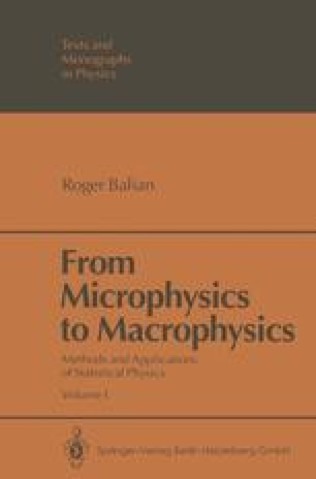
From microphysics to macrophysics : Methods and applications of statistical physics; Vol.1
Volume 1 discusses in detail the probabilistic description of quantum or classical systems, the Boltzmann-Gibbs distributions, the conservation laws, and the interpretation of entropy as missing information. Thermodynamics and electromagnetism in matter are dealt with, as well as applications to gases, both dilute and condensed, and to phase transitions.

From microphysics to macrophysics : Methods and applications of statistical physics ; Vol.2
Volume 2 applies statistical methods to systems governed by quantum effects, in particular to solid state physics, explaining properties due to the crystal structure or to the lattice excitations or to the electrons. Liquid helium is discussed and radiative equilibrium and transport are studied. The last chapters are devoted to non-equilibrium processes and to kinetic equations, with many applications included.

From Hyperbolic Systems to Kinetic Theory : A Personalized Quest
Equations of state are not always effective in continuum mechanics. Maxwell and Boltzmann created a kinetic theory of gases, using classical mechanics. How could they derive the irreversible Boltzmann equation from a reversible Hamiltonian framework? By using probabilities, which destroy physical reality! Forces at distance are non-physical as we know from Poincaré's theory of relativity. Yet Maxwell and Boltzmann only used trajectories like hyperbolas, reasonable for rarefied gases, but wrong without bound trajectories if the "mean free path between collisions" tends to 0. Tartar relies on his H-measures, a tool created for homogenization, to explain some of the weaknesses, e.g. from quantum mechanics: there are no "particles", so the Boltzmann equation and the second principle, can not apply. He examines modes used by energy, proves which equation governs each mode, and conjectures that the result will not look like the Boltzmann equation, and there will be more modes than those indexed by velocity!

From Geometry to quantum mechanics : In Honor of Hideki Omori
This volume is composed of invited expository articles by well-known mathematicians in differential geometry and mathematical physics that have been arranged in celebration of Hideki Omori's recent retirement from Tokyo University of Science and in honor of his fundamental contributions to these areas.The papers focus on recent trends and future directions in symplectic and Poisson geometry, global analysis, infinite-dimensional Lie group theory, quantizations and noncommutative geometry, as well as applications of partial differential equations and variational methods to geometry.

Free Energy Calculations : Theory and Applications in Chemistry and Biology
This volume sets out to present a coherent and comprehensive account of the concepts that underlie different approaches devised for the determination of free energies. The reader will gain the necessary insight into the theoretical and computational foundations of the subject and will be presented with relevant applications from molecular-level modelling and simulations of chemical and biological systems. Both formally accurate and approximate methods are covered using both classical and quantum mechanical descriptions. A central theme of the book is that the wide variety of free energy calculation techniques available today can be understood as different implementations of a few basic principles.

Free Energy and Self-Interacting Particles
This book examines a system of parabolic-elliptic partial differential eq- tions proposed in mathematical biology, statistical mechanics, and chemical kinetics. In the context of biology, this system of equations describes the chemotactic feature of cellular slime molds and also the capillary formation of blood vessels in angiogenesis. There are several methods to derive this system. One is the biased random walk of the individual, and another is the reinforced random walk of one particle modelled on the cellular automaton. In the context of statistical mechanics or chemical kinetics, this system of equations describes the motion of a mean field of many particles, interacting under the gravitational inner force or the chemical reaction

Foundations of Quantum Theory : From Classical Concepts to Operator Algebras
This book studies the foundations of quantum theory through its relationship to classical physics. This idea goes back to the Copenhagen Interpretation (in the original version due to Bohr and Heisenberg), which the author relates to the mathematical formalism of operator algebras originally created by von Neumann. The book therefore includes comprehensive appendices on functional analysis and C*-algebras, as well as a briefer one on logic, category theory, and topos theory. Matters of foundational as well as mathematical interest that are covered in detail include symmetry (and its "spontaneous" breaking), the measurement problem, the Kochen-Specker, Free Will, and Bell Theorems, the Kadison-Singer conjecture, quantization, indistinguishable particles, the quantum theory of large systems, and quantum logic, the latter in connection with the topos approach to quantum theory.

Foundations of Quantum Physics
Intended to be used as a textbook for an introductory course in quantum mechanics at the undergraduate level, Foundations of Quantum Physics is also meant to be retained by the student for later use as a reference. The presentation begins with the solution of some basic quantum mechanical problems. The emphasis is on those features of the solutions that are unique to quantum physics. It is only after these aspects of quantum physics are thoroughly discussed that the mathematical formalism of quantum mechanics is presented and related to the previous chapters. Throughout the book, the emphasis is on understanding the concepts and relating them to known phenomena.

Fluctuations, Information, Gravity and the Quantum Potential
A main theme of the book outlines the role of the quantum potential in quantum mechanics and general relativity and one of its origins via fluctuations formulated in terms of Fisher information. Another theme is the description of various approaches to Bohmian mechanics and their role in quantum mechanics and general relativity. Along the way various approaches to, for instance, the Dirac equation, the Einstein equations, the Klein-Gordon equation, the Maxwell equations and the Schr?dinger equations are described. Statistics and geometry are intertwined in various ways and, among other matters, the aether, cosmology, entropy, fractals, quantum Kaehler geometry, the vacuum and the zero point field are discussed. There is also some speculative material and some original work along with material extracted from over 1000 references and the work is current up to April 2005.

First Light in the Universe : Saas-Fee Advanced Course 36. Swiss Society for Astrophysics and Astronomy
The exploration of the first billion years of the history of the Universe, from the so-called Dark Ages to cosmic reionisation, represents one of the great challenges of contemporary astrophysics and one of the main drivers for future observational facilities. The book contains the elaborated notes of lectures given at the 36th Saas-Fee Advanced Course "First Light in the Universe" by three eminent scientists in the field: Abraham Loeb, Andrea Ferrara, and Richard Ellis. The formation of the first stars and black holes, the initial mass function, feedback effects, early dust formation, the history of cosmic star formation, distant galaxies, cosmic reionisation and the cosmic infrared background are the main topics treated. This book provides an accessible and up-to-date review of the field and will be useful to graduate students of astronomy, cosmologists, physicists and researchers.

Field Emission in Vacuum Microelectronics
Field emission is a phenomenon described by quantum mechanics. Its emission capability is millions times higher than that of any other known types of electron emission. Nowadays this phenomenon is experiencing a new life due to wonderful applications in the atomic resolution microscopy, in electronic holography, and in the vacuum micro- and nanoelectronics in general. The main field emission properties, and some most remarkable experimental facts and applications, are described in this book.

Feynman Integral Calculus
The problem of evaluating Feynman integrals over loop momenta has existed from the early days of perturbative quantum field theory. The goal of the book is to summarize those methods for evaluating Feynman integrals that have been developed over a span of more than fifty years. `Feynman Integral Calculus' characterizes the most powerful methods in a systematic way. It concentrates on the methods that have been employed recently for most sophisticated calculations and illustrates them with numerous examples, starting from very simple ones and progressing to nontrivial examples. It also shows how to choose adequate methods and combine them in a non-trivial way.

Factorization Method in Quantum Mechanics
Introduces the factorization method in quantum mechanics at an advanced level with an aim to put mathematical and physical concepts and techniques like the factorization method, Lie algebras, matrix elements and quantum control at the Reader’s disposal.
