



الصفحة 16
الصفحة 16
Logic for Computer Scientists
This book introduces the notions and methods of formal logic from a computer science standpoint, covering propositional logic, predicate logic, and foundations of logic programming. It presents applications and themes of computer science research such as resolution, automated deduction, and logic programming in a rigorous but readable way.The style and scope of the work, rounded out by the inclusion of exercises, make this an excellent textbook for an advanced undergraduate course in logic for computer scientists.

Literature-based Discovery
When Don Swanson hypothesized a connection between Raynaud’s phenomenon and dietary fish oil, the field of literature-based discovery (LBD) was born. During the subsequent two decades a steady stream of researchers have published articles about LBD and the field has made steady progress in laying foundations and creating an identity. LBD is an inherently multi-disciplinary enterprise where collaborations between the information and biomedical sciences are readily encountered. It is the hope and intention that this volume will plant a flag in the ground and inspire new researchers to the LBD challenge.

Lise Meitner and the Dawn of the Nuclear Age
Documenting the extraordinary life of an aspiring woman scientist whose life was filled with adversity. Surviving both World Wars and gender discrimination, Meitner was a pioneer at the forefront of her discipline involving the study of radio-elements and nuclear fission.

Linked Democracy : Foundations, Tools, and Applications
This book shows the factors linking information flow, social intelligence, rights management and modelling with epistemic democracy, offering licensed linked data along with information about the rights involved. This model of democracy for the web of data brings new challenges for the social organisation of knowledge, collective innovation, and the coordination of actions. Licensed linked data, licensed linguistic linked data, right expression languages, semantic web regulatory models, electronic institutions, artificial socio-cognitive systems are examples of regulatory and institutional design (regulations by design). The web has been massively populated with both data and services, and semantically structured data, the linked data cloud, facilitates and fosters human-machine interaction. Linked data aims to create ecosystems to make it possible to browse, discover, exploit and reuse data sets for applications. Rights Expression Languages semi-automatically regulate the use and reuse of content.
Linear Programming : Foundations and Extensions
Linear Programming: Foundations and Extensions is an introduction to the field of optimization. The book emphasizes constrained optimization, beginning with a substantial treatment of linear programming, and proceeding to convex analysis, network flows, integer programming, quadratic programming, and convex optimization. The book is carefully written. Specific examples and concrete algorithms precede more abstract topics. Topics are clearly developed with a large number of numerical examples worked out in detail.

Linear Estimation and Detection in Krylov Subspaces
Focuses on the foundations of linear estimation theory which is essential for effective signal processing. In its first part, it gives a comprehensive overview of several key methods like reduced-rank signal processing and Krylov subspace methods of numerical mathematics. Based on the derivation of the multistage Wiener filter in its most general form, the relationship between statistical signal processing and numerical mathematics is presented. In the second part, the theory is applied to iterative multiuser detection receivers (Turbo equalization) which are typically desired in wireless communication systems.

Learning to Live in the Knowledge Society ; IFIP 20th World Computer Congress, IFIP TC 3 ED-L2L Conference September 7–10, 2008, Milano, Italy
The IFIP series publishes state-of-the-art results in the sciences and technologies of information and communication. The scope of the series includes: foundations of computer science; software theory and practice; education; computer applications in technology; communication systems; systems modeling and optimization; information systems; computers and society; computer systems technology; security and protection in information processing systems; artificial intelligence; and human-computer interaction. Proceedings and post-proceedings of refereed international conferences in computer science and interdisciplinary fields are featured. These results often precede journal publication and represent the most current research.

Lean Business Systems and Beyond ; 1st IFIP TC 5 Advanced Production Management Systems Conference (APMS’2006), Wroclaw, Poland, September 18-20, 2006
Includes : foundations of computer science; software theory and practice; education; computer applications in technology; communication systems; systems modeling and optimization; information systems; computers and society; computer systems technology; security and protection in information processing systems; artificial intelligence; and human-computer interaction. Proceedings and post-proceedings of referred international conferences in computer science and interdisciplinary fields are featured.

Laws of Nature
The book is concerned with the laws of nature and in particular with the laws of physics. The authors discuss three important questions: First, whether the observed regularities are based on strict "laws of nature" that hold rigorously and without any exception. Second, what we call a "law of nature" is studied by comparing this concept with invariance principles, causality principles, teleological principles and means of predicting future events. Finally, on the basis of these investigations the authors treat the ambitious and intricate third question, why the laws of nature hold. Are there rational reasons for this largely unexplained phenomenon? This book addresses students as well as researchers. It will be an excellent reference for those interested in the philosophical foundations of the natural sciences.
Lattice Boltzmann Modeling : An Introduction for Geoscientists and Engineers
Lattice Boltzmann models have a remarkable ability to simulate single- and multi-phase fluids and transport processes within them. A rich variety of behaviors, including higher Reynolds numbers flows, phase separation, evaporation, condensation, cavitation, buoyancy, and interactions with surfaces can readily be simulated. This book provides a basic introduction that emphasizes intuition and simplistic conceptualization of processes. It avoids the more difficult mathematics that underlies LB models. The model is viewed from a particle perspective where collisions, streaming, and particle-particle/particle-surface interactions constitute the entire conceptual framework. Beginners and those with more interest in model application than detailed mathematical foundations will find this a powerful "quick start" guide. Example simulations, exercises, and computer codes are included. Working code is provided on the Internet

Lacroix and the Calculus
Lacroix and the Calculus is the first major study of Lacroix’s large Traité. It uses the unique and massive bibliography given by Lacroix to explore late 18th-century calculus, and the way it is reflected in Lacroix’s account. Several particular aspects are addressed in detail, including: the foundations of differential calculus, analytic and differential geometry, conceptions of the integral, and types of solutions of differential equations (singular/complete/general integrals, geometrical interpretations, and generality of arbitrary functions).

Labyrinth of Thought : A History of Set Theory and Its Role in Modern Mathematics
Labyrinth of Thought discusses the emergence and development of set theory and the set-theoretic approach to mathematics during the period 1850-1940. Rather than focusing on the pivotal figure of Georg Cantor, it analyzes his work and the emergence of transfinite set theory within the broader context of the rise of modern mathematics. The text has a tripartite structure.A new Epilogue for this second edition offers further reflections on the foundations of set theory, including the "dichotomy conception" and the well-known iterative conception.
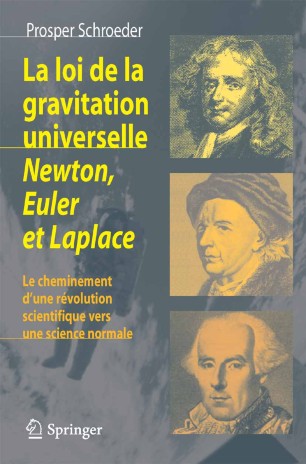
La loi de la gravitation universelle Newton, Euler et Laplace : Le cheminement d’une révolution scientifique vers une science normale = The law of universal gravitation Newton, Euler and Laplace : The progress of a scientific revolution towards a normal science
An analysis of Newton's ideas dismisses this hypothesis by the simple fact that the Principia sought to demonstrate the fallacy of earlier approaches. However, Newton suffered a failure in the application of his theory of gravitation to the explanation of the movement of the Moon, failure which marked the development of celestial mechanics throughout the 18th century. Clairaut, d'Alembert and Euler doubted the validity of Newtonian law almost at the same time and their ideas advanced celestial mechanics which reached the state of "normal science" with Laplace's treatise on celestial mechanics, a century after Newton.
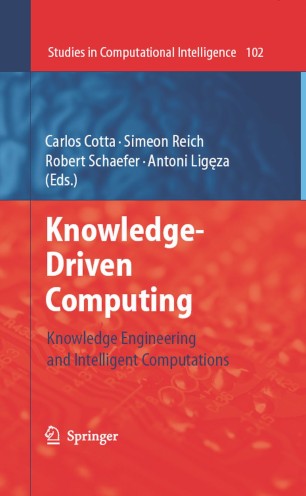
Knowledge-Driven Computing : Knowledge Engineering and Intelligent Computations
Knowledge-Driven Computing constitutes an emerging area of intensive research located at the intersection of Computational Intelligence and Knowledge Engineering with strong mathematical foundations. It embraces methods and approaches coming from diverse computational paradigms, such as evolutionary computation and nature-inspired algorithms, logic programming and constraint programming, rule-based systems, fuzzy sets and many others. The use of various knowledge representation formalisms and knowledge processing and computing paradigms is oriented towards the efficient resolution of computationally complex and difficult problems.

Knowledge Sharing in the Integrated Enterprise : Interoperability Strategies for the Enterprise Architect
The IFIP series publishes state-of-the-art results in the sciences and technologies of information and communication. The scope of the series includes: foundations of computer science; software theory and practice; education; computer applications in technology; communication systems; systems modeling and optimization; information systems; computers and society; computer systems technology; security and protection in information processing systems; artificial intelligence; and human-computer interaction. Proceedings and post-proceedings of referred international conferences in computer science and interdisciplinary fields are featured. These results often precede journal publication and represent the most current research. The principal aim of the IFIP series is to encourage education and the dissemination and exchange of information about all aspects of computing.

Knowledge Management In Action ; IFIP 20th World Computer Congress, Conference on Knowledge Management in Action, September 7-10, 2008, Milano, Italy
The IFIP series publishes state-of-the-art results in the sciences and technologies of information and communication. The scope of the series includes: foundations of computer science; software theory and practice; education; computer applications in technology; communication systems; systems modeling and optimization; information systems; computers and society; computer systems technology; security and protection in information processing systems; artificial intelligence; and human-computer interaction. Proceedings and post-proceedings of refereed international conferences in computer science and interdisciplinary fields are featured.

Computational and Ambient Intelligence ; 9th International Work-Conference on Artificial Neural Networks, IWANN 2007, San Sebastián, Spain, June 20-22, 2007, Proceedings
This biennial meeting focuses on the foundations, theory, models and applications of systems inspired by nature (neural networks, fuzzy logic and evo- tionary systems).These new computational techniques are used in applications that try to bring a new situation of well-being to the user. The conjunction of a more and more miniaturized hardware together with the growing computational intelligence embodied in this hardware leads us towards fully integrated embedded systems-on- chip and opens the door for truly ubiquitous electronics.

Computation and Logic in the Real World ; 3rd Conference on Computability in Europe, CiE 2007, Siena, Italy, June 18-23, 2007, Proceedings
This volume, Computation and Logic in the Real World, is the proceedings of the third in a series of conferences of CiE Computability in Europe, (CiE) is an informal network working on computability theory including its foundations, technical development, and applications. It performed with discrete or continuous data by all kinds of algorithms, programs, and machines. The sources of new ideas and methods include practical developments in areas such as neural networks, quantum computation, natural computation, molecular computation, computational learning.

Complexity Theory and Cryptology : An Introduction to Cryptocomplexity
Modern cryptology employs mathematically rigorous concepts and methods from complexity theory. Conversely, current research in complexity theory often is motivated by questions and problems arising in cryptology. This book takes account of this trend, and therefore its subject is what may be dubbed "cryptocomplexity,'' some sort of symbiosis of these two areas. This textbook is suitable for undergraduate and graduate students of computer science, mathematics, and engineering, and can be used for courses on complexity theory and cryptology, preferably by stressing their interrelation. Starting from scratch, it is an accessible introduction to cryptocomplexity and works its way to the frontiers of current research. It provides the necessary mathematical background, has numerous figures, exercises, and examples, and presents some central, up-to-date research topics and challenges. Due to its comprehensive bibliography and subject index, it is also a valuable source for researchers, teachers, and practitioners working in these fields.
Completeness theory for propositional logics
Completeness is one of the most important notions in logic and the foundations of mathematics. Many variants of the notion have been de?ned in literature. We shallconcentrateonthesevariants,andaspects,of completenesswhicharede?ned in propositional logic. Completeness means the possibility of getting all correct and reliable sc- mata of inference by use of logical methods. The word ‘all’, seemingly neutral, is here a crucial point of distinction. Assuming the de?nition as given by E. Post we get, say, a global notion of completeness in which the reliability refers only to syntactic means of logic and outside the correct schemata of inference there are only inconsistent ones. It is impossible, however, to leave aside local aspects of the notion when we want to make it relative to some given or invented notion of truth. Completeness understood in this sense is the adequacy of logic in relation to some semantics, and the change of the logic is accompanied by the change of its semantics.
