



الصفحة 159
الصفحة 159

Global Smoothness and Shape Preserving Interpolation by Classical Operators
This monograph examines and develops the Global Smoothness Preservation Property (GSPP) and the Shape Preservation Property (SPP) in the field of interpolation of functions. The study is developed for the univariate and bivariate cases using well-known classical interpolation operators of Lagrange, Grünwald, Hermite-Fejér and Shepard type. One of the first books on the subject, it presents interesting new results alongwith an excellent survey of past research.

Global Risk Governance : Concept and Practice Using the IRGC Framework
This book innovative risk governance framework, the careful reviews it received from internationally recognized scientists, and the results of several case studies in which the framework has been applied to a number of significant but different risks.

Global RFID : The Value of the EPCglobal Network for Supply Chain Management
At the same time, I was a junior Brand Manager at Procter & Gamble w- ried about a much more mundane problem: how to keep my products on the shelf. Embedding RFID tags in the products, and RFID readers in the shelf, seemed like the perfect – indeed the only – way to do this. But I needed RFID to be cheaper, better, and standardized in an open system. In early 1999, by sheer chance, I met Brock and Sarma. The result was a potent meeting of minds. I was looking to fund research, and Brock, Sarma and Siu were looking for research funding. Working with Alan Haberman of the Uniform Code Council, one of the founding fathers of the UPC bar code, and Allan Boath of the Gillette C- pany, we developed a plan for a new industry funded research consortium at MIT.

Global Production : A Handbook for Strategy and Implementation
What is the best configuration for a global production network? What are the different dynamics in low-cost vs. high-cost countries? Getting the answers right is key to building a competitive and efficient global production network. Centers of economic activity are shifting profoundly, globally and even regionally. Production is shifting even more dramatically than the economy as a whole, making it critical for decision makers to know what criteria matter most and how to make the right decisions on where to invest. Regardless of the industry involved, an optimized global footprint can translate to a competitive advantage. A comprehensive redesign typically yields a 20 to 40 percent reduction in manufacturing costs. Global production and purchasing operations create a platform for entry into new markets. Planning and implementing a sustainable globalization strategy, however, takes considerable effort; this book is there to help in that task.

Global Product : Strategy, Product Lifecycle Management and the Billion Customer Question
In the early years of the 21st Century, as a result of many changes, it has become possible for the first time for tens of thousands of companies to offer manufactured products to customers across six continents. For many of these "global products", there are potentially more than a billion customers. In 2007, Wall Street hit new highs as the enormous opportunity for increased sales and profits became clear. However the new environment is not easy to manage and the risks are high. Meeting the various requirements of customers from a range of countries, choosing the most suitable locations for the different stages of development and manufacturing, deciding what can be global and what must be local, implementing suitable processes and systems, accommodating different national regulations, and efficiently dividing the workload between diverse sites are among the many challenges faced by providers of global products.

Global Price Fixing
The book describes and analyzes the formation, operation, and impacts of modern global cartels. It provides a broad picture of the economics, competition law and history of international price fixing. A deeper understanding of the phenomenon is afforded by intensive case studies of collusion in the markets for lysine, citric acid, and vitamins. Particular attention is given to the economic injuries sustained by the cartels' customers. The author assesses whether antitrust enforcement by the European Union, the United States, and other countries is capable of deterring cartels in the foreseeable future.

Global Political Demography : The Politics of Population Change
This book draws the big picture of how population change interplays with politics across the world from 1990 to 2040.

Global perspectives on recognising non-formal and Informal Learning : Why recognition matters
This book deals with the relevance of recognition and validation of non-formal and informal learning in education and training, the workplace and society. In an increasing number of countries, it is at the top of the policy and research agenda ranking among the possible ways to redress the glaring lack of relevant academic and vocational qualifications and to promote the development of competences and certification procedures which recognise different types of learning, including formal, non-formal and informal learning. The aim of the book is therefore to present and share experience, expertise and lessons in such a way that enables its effective and immediate use across the full spectrum of country contexts, whether in the developing or developed world. It examines the importance of meeting institutional and political requirements that give genuine value to the recognition of non-formal and informal learning; it shows why recognition is important and clarifies its usefulness and the role it serves in education, working life and voluntary work; it emphasises the importance of the coordination, interests, motivations, trust and acceptance by all stakeholders.

Global perspectives on health promotion effectiveness
This edited volume ... raises important questions about 'what counts as evidence and who gets to decide.' It presents important challenges to dominant biomedical approaches assessing evidence and effectiveness within health promotion ... offers an introduction to the key debates and challenges involved in the evaluation of health promotion programs, as well as some useful strategies for measuring their impact ... the authors acknowledge the value and legitimacy of a wide range of epistemological positions and scientific approaches and present their arguments using language and logic likely to be accessible and acceptable to researchers using different paradigms.

Global perspectives on AI, ethics, and business economics : Charting the future
Offers an in-depth exploration of the complex and rapidly evolving world of artificial intelligence (AI), focusing on its ethical, economic, and business dimensions. it provides a comprehensive analysis that intertwines historical context, philosophical ethics, global economic impacts, regulatory landscapes, workforce dynamics, corporate governance, consumer behavior, data ethics, and the use of AI for the good of society. after reviewing the evolution of AI, it offers insights into its historical milestones and the trajectory it may take in the future. this sets the stage for a broader discussion on how AI is not just a technological phenomenon but also a catalyst for ethical, economic, and societal transformation. the book emphasizes the importance of understanding AI’s historical development in order to gauge its potential impacts on our future.

Global Pathways to Education : Cultural Spheres, Networks, and International Organizations
The research presented in this volume is a wide-ranging analysis and explanation of the dynamics of emergence, diffusion, and change in relation to state education systems. The chapters offer an empirical investigation into whether the global diffusion of Western-rational educational content and organizational forms occurs as expected by neoinstitutionalist theory, or whether culturally specific developmental paths dominate in different parts of the world.

Global optimization and constraint satisfaction ; 2nd International Workshop, COCOS 2003, Lausanne, Switzerland, Nevember 18-21, 2003, Revised Selected Papers
Theformulationofmanypracticalproblemsnaturallyinvolvesconstraintsonthe variables entering the mathematical model of a real-life situation to be analyzed. It is of great interest to ?nd the possible scenarios satisfying all constraints, and, iftherearemanyofthem,eitherto?ndthebestsolution,ortoobtainacompact, explicit representation of the whole feasible set. The 2nd Workshop on Global Constrained Optimization and Constraint S- isfaction, COCOS 2003, which took place during November 18–21, 2003 in L- sanne, Switzerland, was dedicated to theoretical, algorithmic, and application oriented advances in answering these questions. Here global optimization refers to ?nding the absolutely best feasible point, while constraint satisfaction refers to?ndingallpossiblefeasiblepoints.AsinCOCOS2002,the?rstsuchworkshop (see the proceeedings [1]), the emphasis was on complete solving techniques for problems involving continuous variables that provide all solutions with full rigor, and on applications which, however, were allowed to have relaxed standards of rigor.

Global optimization ; Vol. 85 : Scientific and engineering case studies
Optimization models based on a nonlinear systems description often possess multiple local optima. The objective of global optimization (GO) is to find the best possible solution of multiextremal problems. Global Optimization: Selected Case Studies illustrates the applicability of GO modeling techniques and solution strategies to real-world problems.The contributed chapters cover a broad range of applications from agroecosystem management, assembly line design, bioinformatics, biophysics, black box systems optimization, cellular mobile network design, chemical process optimization, chemical product design, composite structure design, computational modeling of atomic and molecular structures, controller design for induction motors, electrical engineering design, feeding strategies in animal husbandry, the inverse position problem in kinematics, laser design, learning in neural nets, mechanical engineering design, numerical solution of equations, radiotherapy planning, robot design, and satellite data analysis. The solution strategies discussed encompass a range of practically viable methods, including both theoretically rigorous and heuristic approaches.

Global Optimization ; Vol. # 84 : From Theory to Implementation
Global optimization describe the theory of the algorithms, whereas a given implementation’s quality never depends exclusively on the theoretical soundness of the algorithms that are implemented. The literature rarely discusses the tuning of algorithmic parameters, implementation tricks, software architectures, and the embedding of local solvers within global solvers. And yet, there are many good software implementations "out there” from which the entire community could learn something. The scope of this book is moving a few steps toward the systematization of the path that goes from the invention to the implementation and testing of a global optimization algorithm.

Global mobile satellite communications : For maritime, Land and aeronautical applications
This book is important for modern shipping, truck, train and aeronautical societies because GMSC in the present millennium provides more effective business and trade, with emphasis on safety and commercial communications. Global Mobile Satellite Communications is written to make bridges between potential readers and current GMSC trends, mobile system concepts and network architecture using a simple mode of style with understandable technical information, characteristics, graphicons, illustrations and mathematics equations

Global Lessons from the AIDS Pandemic : Economic, Financial, Legal and Political Implications
This book examines the global HIV/AIDS pandemic from a multidisciplinary perspective, analyzing its economic impact, the reasons behind the political response to the pandemic, international laws relating to public health and patents and mechanisms for financing global and national responses. The authors paint a global picture of the HIV/AIDS pandemic one issue, one country and one region at a time and show why prevention, treatment and human rights protection must each form part of a comprehensive HIV/AIDS strategy. The book analyzes the successes and failures of national governments, international organizations and the private sector in fighting the HIV/AIDS pandemic and recommends changes to our international economic, financial, legal and political institutions. This book highlights the lessons the world has to learn from our experience with HIV/AIDS in order to improve the way we address global diseases.

Global history with Chinese characteristics : Autocratic States along the Silk Road in the decline of the Spanish and Qing Empires 1680-1796
This book examines perceptions and dialogues between China and Europe by analysing strategic geopolitical sites which fostered commerce, consumption and socioeconomic networks between China and Europe through a particular case study: Macau, connecting with South China, and Marseille in Mediterranean Europe from 1680 to 1800

Global History and New Polycentric Approaches : Europe, Asia and the Americas in a World Network System
Examines how the discipline had evolved in various historiographies, from Anglo Saxon to southern European, and its emergence in Asia with the rapid development of the Chinese economy motivation to legitimate the current uniqueness of the history and economy of the nation. It contributes to the revitalization of the field of global history in Chinese historiography, which have been dominated by national narratives and promotes a debate to open new venues in which important features such as scholarly mobility, diversity and internationalization are firmly rooted, putting aside national specificities.

Global Health Collaboration : Challenges and Lessons
Details the innovative work of the Pan Institution Network for Global Health in creating collaborative research-based answers to large-scale health issues. Equitable partnerships among member universities representing North America, Africa, Asia, and Europe reverse standard cross-national dynamics to develop locally relevant responses to health challenges as well as their underlying disparities. Case studies focusing on multiple morbidities and effects of urbanization on health illustrate open dialogue in addressing HIV, maternal/child health, diabetes, and other major concerns. These instructive examples model collaborations between global North and South as meaningful steps toward the emerging global future of public health.
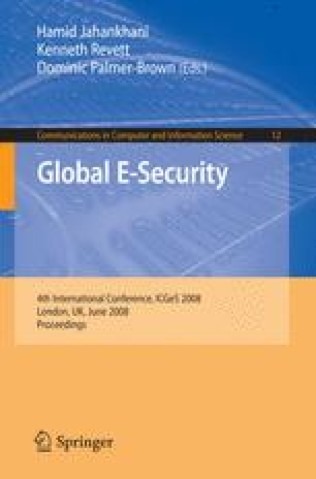
Global E-Security ; 4th International Conference, ICGeS 2008, London, UK, June 23-25, 2008. Proceedings
This book constitutes the refereed proceedings of the 4th International Conference on Global E-Security, ICGeS 2008, held in London, UK, in June 2008.The 36 revised full papers presented were carefully reviewed and selected from numerous submissions. The papers are organized in topical sections on cybercrime and digital forensics investigation, voice and video over internet protocols security, computer security, security architecture and authorisations, and IT governance.
