



الصفحة 159
الصفحة 159

Agent Technology from a Formal Perspective
The field of agent & multi-agent systems is experiencing tremendous growth. At the same time the field of formal methods is blossoming and has proven its importance in industrial and government applications. The FAABS (Formal Approaches to Agent-Based Systems) workshops, merging the concerns of the two fields, provided a timely and compelling platform on which the growing concerns and requirement of agent-based systems users that systems should be accompanied by behavioral assurances, could be discussed. This book has arisen from the overwhelming response to FAABS ’00, ’02 & ’04 and all chapters are updated or represent new research, and are designed to provide a more in-depth treatment of the topic. Examples of how others have applied formal methods to agent-based systems are included, plus formal method tools & techniques that readers can apply to their own systems.

Agent Intelligence Through Data Mining
AGENT INTELLIGENCE THROUGH DATA MINING offers a self-contained overview of a relatively young but important area of research: the intersection of agent technology and data mining. This intersection leads to considerable advancements in the area of information technologies, drawing the increasing attention of both research and industrial communities. It can take two forms: a) the more mundane use of intelligent agents for improved data mining and; b) the use of data mining for smarter, more efficient agents. The second approach is the main focus of this volume. this book presents a methodology for developing multi-agent systems, describes available open-source tools to support this process, and demonstrates the application of the methodology on three different cases. AGENT INTELLIGENCE THROUGH DATA MINING is designed for a professional audience composed of researchers and practitioners in industry.

Agent Computing and Multi-Agent Systems ; 9th Pacific Rim International Workshop on Multi-Agents, PRIMA 2006, Guilin, China, August 7-8, 2006, Proceedings
PRIMA is a series of workshops on agent computing and multi-agent systems, integrating the activities in Asia and Pacific Rim countries. Agent computing and multi-agent systems are computational systems in which several autonomous or se- autonomous agents interact with each other or work together to perform some set of tasks or satisfy some set of goals. These systems may involve computational agents that are homogeneous or heterogeneous, they may involve activities on the part of agents having common or distinct goals, and they may involve participation on the part of humans and intelligent agents. The aim of PRIMA 2006 was to bring together Asian and Pacific Rim researchers and developers from academia and industry to report on the latest technical advances or domain applications and to discuss and explore scientific and practical problems as raised by the participants. PRIMA 2006 received 203 submitted papers.

Agent and Multi-Agent Systems : Technologies and Applications ; 2nd KES International Symposium, KES-AMSTA 2008, Incheon, Korea, March 26-28, 2008. Proceedings
The KES-AMSTA Symposium Series is a sub-series of the KES Conference Series. The aim of the symposium was to provide an international forum for scientific research into the technologies and applications of agent and multi-agent systems.

Agent and multi-agent systems : Technologies and applications ; 1st KES International Symposium, KES-AMSTA 2007, Wroclaw, Poland, May 31-June 1, 2007, Proceedings
The aim of the symposium was to provide an international forum for scientific - search in the technologies and applications of agent and multi-agent systems. Agents and multi-agent systems are related to the modern software which has long been r- ognized as a promising technology for constructing autonomous, complex and intel- gent systems. A key development in the field of agent and multi-agent systems has been the specification of agent communication languages and formalization of - tologies. Agent communication languages are intended to provide standard decla- tive mechanisms for agents to communicate knowledge and make requests of each other, whereas ontologies are intended for conceptualization of the knowledge - main.

Affective computing and intelligent interaction ; 2nd International Conference, ACII 2007, Lisbon, Portugal, September 12-14, 2007, Proceedings
Organized in topical sections on affective facial expression and recognition, affective body expression and recognition, affective speech processing, affective text and dialogue processing, recognising affect using physiological measures, computational models of emotion and theoretical foundations, affective databases, annotations, tools and languages, affective sound and music processing, affective interactions: systems and applications, as well as evaluating affective systems.

Affect and Emotion in Human-Computer Interaction : From Theory to Applications
The present book provides an account of the latest work on a variety of aspects related to affect and emotion in human-technology interaction. It covers theoretical issues, user experience and design aspects as well as sensing issues, and reports on a number of affective applications that have been developed in recent years.

Advertising culture and translation : From colonial to global
A first comprehensive study combining and integrating advertising, culture and translation within the framework of colonial, Commonwealth, and postcolonial studies, and globalization. It addresses a number of controversial issues evident in two relatively young disciplines, as a result of decades of research and teaching in university courses. A cross-cultural approach to translational issues and the translatability of advertising cohesively is adopted here, exploring the dynamics of the conflict between the 'centre' and the 'periphery'. It introduces the concept of advertising English as lingua franca (AELF), marking new trends in the domain of varieties of English around the world (VEAW). The data examined here show the ambivalent polarity conditioning advertising and translation: both have been mutually exclusive, and both have been subject to bans, censorship and ideological control, racism, propaganda, and stereotyping. In their fundamental principles and concepts of theories and applications, however, neither discipline cannot exist outside a free market and total freedom of expression and trust

Advancing Social Simulation: The First World Congress
Agent-based modeling and social simulation have emerged as both developments of and challenges to the social sciences. The developments include agent-based computational economics and investigations of theoretical sociological concepts using formal simulation techniques. Among the challenges are the development of qualitative modeling techniques, implementation of agent-based models to investigate phenomena for which conventional economic, social, and organizational models have no face validity, and the application of physical modeling techniques to social processes. Bringing together diverse approaches to social simulation and research agendas.

Advancing Computational Intelligence Techniques for Security Systems Design
Security systems have become an integral part of the building and large complex setups, and intervention of the computational intelligence (CI) paradigm plays an important role in security system architecture. This book covers both theoretical contributions and practical applications in security system design by applying the Internet of Things (IoT) and CI. It further explains the application of IoT in the design of modern security systems and how IoT blended with computational intel- ligence can make any security system improved and realizable. Focuses on the computational intelligence techniques of security system design / Covers applications and algorithms of discussed computational intelligence techniques / Includes convergence-based and enterprise integrated security systems with their applications / Explains emerging laws, policies, and tools affecting the landscape of cyber security / Discusses application of sensors toward the design of security systems

Advances of Computational Intelligence in Industrial Systems
Advances of Computational Intelligence in Industrial Systems reports the exploration of CI frontiers with an emphasis on a broad spectrum of real-world applications. Section I – Theory and Foundation presents some of the latest developments in CI.

Advances in web-age information management ; Vol. 4016 : 7th International Conference, WAIM 2006, Hong Kong, China, June 17-19, 2006, Proceedings
This book constitutes the refereed proceedings of the 7th International Conference on Web-Age Information Management, WAIM 2006, held in Hong Kong, China in June 2006. The 50 revised full papers presented were carefully reviewed and selected from 290 submissions. The papers are organized in topical sections on, indexing, XML query processing, information retrieval, sensor networks and grid computing, peer-to-peer systems, Web services, Web searching, caching and moving objects, temporal database, clustering, clustering and classification, data mining, data stream processing, XML and semistructured data, data distribution and query processing, and advanced applications.

Advances in web-age information management ; Vol. 3739 ; 6th international conference, WAIM 2005, Hangzhou, China, October 11-13, 2005, proceedings
Constitutes the proceedings of the 6th International Conference, WAIM 2005, Hangzhou, China, October 11 – 13, 2005. including Topics Data Structures and Information Theory Popular Computer Science Database Management Information Storage and Retrieval Information Systems Applications (incl. Internet) Artificial Intelligence

Advances in web mining and web usage analysis ; 6th International workshop on knowledge discovery on the web, WEBKDD 2004, Seattle, WA, USA, August 22-25, 2004, Revised Selected Papers
The Webisaliveenvironmentthatmanagesanddrivesawidespectrumofapp- cations in which a user may interact with a company, a governmental authority, a non-governmental organization or other non-pro?t institution or other users. User preferences and expectations, together with usage patterns, form the basis for personalized, user-friendly and business-optimal services. Key Web business metrics enabled by proper data capture and processing are essential to run an e?ective business or service. Enabling technologies include data mining, sc- able warehousing and preprocessing, sequence discovery, real time processing, document classi?cation, user modeling and quality evaluation models for them. Recipient technologies required for user pro?ling and usage patterns include recommendation systems, Web analytics applications, and application servers, coupled with content management systems and fraud detectors.

Advances in web intelligence ; 1st International symposium, ISVC 2005, Lake Tahoe, NV, USA, December 5-7, 2005, proceedings
In recent years the Internet has become a source of data and information of indisputable importance and has immensely gained in acceptance and popularity. The World Wide Web (WWW or Web, for short), frequently named “the nervous system of the infor- tion society,” offers numerous valuable services leaving no doubt about the signi?cance of the Web in our daily activities at work and at home. Consequently, we have a clear aspiration to meet the obvious need for effective use of its potential by making - provements in both the methods and the technology applied. Among the new research directions observable in Web-related applications, intelligent methods from within the broadly perceived topic of soft computing occupy an important place. AWIC, the “Atlantic Web Intelligence Conferences” are intended to be a forum for exchange of new ideas and novel practical solutions in this new and exciting ?eld.
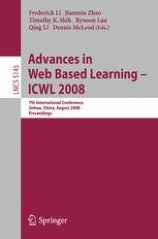
Advances in web based learningng - ICWL 2008 ; 7th International conference, Jinhua, China, August 20-22, 2008. Proceedings
This book constitutes the refereed proceedings of the 7th International Conference on Web-Based Learning, ICWL 2008, held in Jinhua, China, in August 2008.
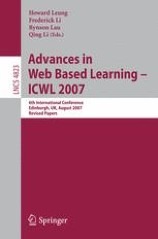
Advances in web based learning - ICWL 2007 ; 6th International conference Edinburgh, UK, August 15-17, 2007 Revised Papers
This book contributes the thoroughly refereed post-conference proceedings of the 6th International Conference on Web-Based Learning, ICWL 2007, held in Edinburgh, UK, in August 2007.

Advances in web and network technologies, and information management ; APWeb/WAIM 2007 International Workshops : DBMAN 2007, WebETrends 2007, PAIS 2007 and ASWAN 2007, Huang Shan, China, June 16-18, 2007, Proceedings
With the increasing ubiquity of personal computing devices, such as mobile phones and PDAs, and the increasing deployment of sensor networks, new distributed applications are developed over networked databases posing interesting challenges. It aimed to bring together researchers in different fields related to database management and application over networks and to provide a forum where researchers and practitioners could share and exchange their knowledge and experience.

Advances in Visual Information Systems ; 9th International Conference, VISUAL 2007 Shanghai, China, June 28-29, 2007 Revised Selected Papers
The visual information systems paradigm continues to evolve, and the unrelenting exponential growth in the amount of digital visual data underlines the escalating importance of how such data are effectively managed and deployed.It covered image and video retrieval, visual biometrics, intelligent visual information processing, visual data mining, ubiquitous and mobile visual information systems, visual semantics, 2D/3D graphical visual data retrieval and applications of visual information systems.

Advances in visual computing ; 4th International symposium, ISVC 2008, Las Vegas, NV, USA, December 1-3, 2008. Proceedings, Part II
The two volume set LNCS 5358 and LNCS 5359 constitutes the refereed proceedings of the 4th International Symposium on Visual Computing, ISVC 2008, held in Las Vegas, NV, USA, in December 2008.
