



الصفحة 15
الصفحة 15

Information security and cryptology ; Vol. 4318 ; 2nd SKLOIS Conference, Inscrypt 2006, Beijing, China, November 29 - December 1, 2006, Proceedings
The second SKLOIS Conference on Information Security and Cryptology 2006 (Inscrypt, formerly CISC) was organized by the State Key Laboratory of Inf- mation Security of the Chinese Academy of Sciences. This international conf- ence was held in Beijing, China and was sponsored by the Institute of Software, the Chinese Academy of Sciences, the Graduate University of Chinese Academy of Sciences and the National Natural Science Foundations of China. The c- ference proceedings, with contributed papers, are published by Springer in this volume of Lecture Notes in Computer Science (LNCS).

Information Security and Cryptology – ICISC 2006; 9th International Conference, Busan, Korea, November 30 - December 1, 2006, Proceedings
This book constitutes the refereed proceedings of the 9th International Conference on Information Security and Cryptology, ICISC 2006, held in Busan, Korea in November/December 2006. The 26 revised full papers cover such topics as hash functions, block and stream ciphers, network security and access control, mobile communications security, forensics, copyright protection, biometrics, public key cryptosystems, and digital signatures.

Information Security ; 10th International Conference, ISC 2007, Valparaiso, Chile, October 9-12, 2007, Proceedings
The 10th Information Security Conference (ISC 2007) was held in Valpara´ ?so, Chile, October 9–12, 2007. ISC is an annual international conference covering research in theory and applications of information security, aiming to attract high quality papers in all of its technical aspects.

Information Processing with Evolutionary Algorithms : From Industrial Applications to Academic Speculations
The last decade of the 20th century has witnessed a surge of interest in num- ical, computation-intensive approaches to information processing. The lines that draw the boundaries among statistics, optimization, arti cial intelligence and information processing are disappearing, and it is not uncommon to nd well-founded and sophisticated mathematical approaches in application - mains traditionally associated with ad-hoc programming. Heuristics has - come a branch of optimization and statistics. Clustering is applied to analyze soft data and to provide fast indexing in the World Wide Web. Non-trivial matrix algebra is at the heart of the last advances in computer vision. The breakthrough impulse was, apparently, due to the rise of the interest in arti cial neural networks, after its rediscovery in the late 1980s. Disguised as ANN, numerical and statistical methods made an appearance in the - formation processing scene, and others followed. A key component in many intelligent computational processing is the search for an optimal value of some function. Sometimes, this function is not evident and it must be made explicit in order to formulate the problem as an optimization problem. The search - ten takes place in high-dimensional spaces that can be either discrete, or c- tinuous or mixed. The shape of the high-dimensional surface that corresponds to the optimized function is usually very complex. Evolutionary algorithms are increasingly being applied to information processing applications that require any kind of optimization.

Information networking : Convergence in broadband and mobile networking ; International conference, ICOIN 2005, Jeju Island, Korea, January 31 - February 2, 2005, Proceedings
Welcome to ICOIN 2005,the International Conference on Information Netwo- ing, held at Ramada Plaza Jeju Hotel, Jeju Island, Korea during January 31– February2,2005.ICOIN2005followedthesuccessofpreviousconferences.Since 1986, the conference has provided a technical forum for various issues in inf- mation networking. The theme of each conference re?ects the historic events in the computer communication industry. (Please refer to www.icoin2005.or.kr for details.) The theme of ICOIN 2004, “Convergence in Broadband and Mobile Networking,” was used again for ICOIN 2005 since we believed it was ongoing. This year we received 427 submissions in total, which came from 22 co- tries. Upon submission, authors were asked to select one of the categories listed in the Call for Papers. The most popular category chosen was network se- rity, followed by mobile networks and wireless LANs. Other areas with strong showings included QoS and resource management, ad hoc and sensor networks, and wireless multimedia systems. From the outset, we could see where recent research interest lay and could make sure that the theme was still going in the right direction.

Information and its role in nature
Infromation and Its Role in Nature presents an in-depth interdisciplinary discussion of the concept of information and its role in the control of natural processes. After a brief review of classical and quantum information theory, the author addresses numerous central questions, including: Is information reducible to the laws of physics and chemistry? Does the Universe, in its evolution, constantly generate new information? Or are information and information-processing exclusive attributes of living systems, related to the very definition of life? If so, what is the role of information in classical and quantum physics? In what ways does information-processing in the human brain bring about self-consciousness? Accessible to graduate students and professionals from all scientific disciplines, this stimulating book will help to shed light on many controversial issues at the heart of modern science.

Information and Communications Security ; Vol. 4307 ; 8th International Conference, ICICS 2006, Raleigh, NC, USA, December 4-7, 2006, Proceedings
It is our great pleasure to welcome you to the Eighth International Conference on Information and Communications Security (ICICS 2006), held in Raleigh, North Carolina, USA, December 4–7, 2006. The ICICS conference series is an established forum that brings together researchersand scholars involved in m- tiple disciplines of Information and Communications Security in order to foster exchangeof ideas. The past sevenICICS conferences wereheld in Beijing, China (ICICS 1997); Sydney, Australia (ICICS 1999); Xi’an China (ICICS 2001); S- gapore (ICICS 2002); Hohhot City, China (ICICS 2003); Malaga, Spain (ICICS 2004); and Beijing, China (ICICS 2005). The conference proceedings of the past seven events have been published by Springer in the Lecture Notes in Computer Science series, in LNCS1334,LNCS1726,LNCS2229,LNCS 2513,LNCS 2836, LNCS 3269, and LNCS 3783, respectively. This year we received a total of 119 submissions on various aspects of - hoc and sensor network security. The Program Committee selected 22 regular papers and 17 short papers that cover a variety of topics, including security protocols, applied cryptography and cryptanalysis, access control in distributed systems, privacy, malicious code, network and systems security, and security implementations. Putting together ICICS 2006 was a team e?ort. First of all, we would like to thank the authors of every paper, whether accepted or not, for submitting their papers to ICICS 2006. We would like to express our gratitude to the Program Committee members and the external reviewers, who worked very hard in - viewing the papers and providing suggestions for their improvements.

Information and communications security ; Vol. 3783 ; 7th International conference, ICICS 2005, Beijing, China, December 10-13, 2005, Proceedings
The Seventh International Conference on Information and Communications - curity,ICICS2005,washeldinBeijing,China,10-13December2005. TheICICS conference series is an established forum for exchanging new research ideas and development results in the areas of information security and applied crypt- raphy. The ?rst event began here in Beijing in 1997. Since then the conference series has been interleaving its venues in China and the rest of the world: ICICS 1997 in Beijing, China; ICICS 1999 in Sydney, Australia; ICICS 2001 in Xi’an, China; ICICS 2002 in Singapore; ICICS 2003 in Hohhot City, China; and ICICS 2004 in Malaga, Spain. The conference proceedings of the past events have - ways been published by Springer in the Lecture Notes in Computer Science series, with volume numbers, respectively: LNCS 1334,LNCS 1726,LNCS 2229, LNCS 2513, LNCS 2836, and LNCS 3269. ICICS 2005 was sponsored by the Chinese Academy of Sciences (CAS); the Beijing Natural Science Foundation of China under Grant No. 4052016; the National Natural Science Foundation of China under Grants No. 60083007 and No. 60573042;the NationalGrandFundamentalResearch973ProgramofChina under Grant No. G1999035802, and Hewlett-Packard Laboratories, China. The conference was organized and hosted by the Engineering Research Center for Information Security Technology of the Chinese Academy of Sciences (ERCIST, CAS) in co-operation with the International Communications and Information Security Association (ICISA). The aim of the ICICS conference series has been to o?er the attendees the opportunity to discuss the latest developments in theoretical and practical - pects of information and communications security.

Information and communications security ; 9th International Conference, ICICS 2007, Zhengzhou, China, December 12-15, 2007, Proceedings
This book constitutes the refereed proceedings of the 9th International Conference on Information and Communications Security, ICICS 2007, held in Zhengzhou, China, in December 2007. The papers are organized in topical sections on authentication and key exchange, digital signatures, applications, watermarking, fast implementations, applied cryptography, cryptanalysis, formal analysis, system security, and network security.

Information and Communications Security ; 10th International Conference, ICICS 2008 Birmingham, UK, October 20 - 22, 2008 Proceedings
This book constitutes the refereed proceedings of the 10th International Conference on Information and Communications Security, ICICS 2008, held in Birmingham, UK, in October 2008.The 27 revised full papers presented together with one invited paper were carefully reviewed and selected from 125 submissions. The papers are organized in topical sections on authentication, side channel analysis, cryptanalysis, access control, software security, system security, applied cryptography, and security protocols.
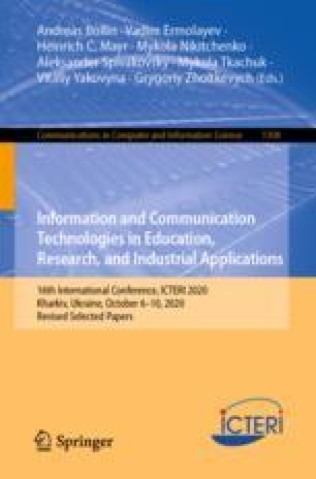
Information and communication technologies in education, research, and industrial applications ; 16th International Conference, ICTERI 2020, Kharkiv, Ukraine, October 6–10, 2020, Revised Selected Papers
This book contains revised and extended versions of the best papers presented at the 16th International Conference on Information and Communication Technologies in Education, Research, and Industrial Applications, ICTERI 2020, held in Kherson, Ukraine, in October 2020. Due to the COVID-19 pandemic the conference was held online. The 8 revised full papers included in this volume were carefully reviewed and selected from 347 initial submissions. The papers are organized in the following topical sections: ICT in education; ICT in research and industry.

Information — Consciousness — Reality : How a New Understanding of the Universe Can Help Answer Age-Old Questions of Existence
This book chronicles the rise of a new scientific paradigm offering novel insights into the age-old enigmas of existence. It is explores a radical paradigm shift uncovering the ontology of reality. It is found to be information-theoretic and participatory, yielding a computational and programmable universe.

Informatics in Control, Automation and Robotics II
Informatics in Control, Automation and Robotics II is a collection of the best papers presented at the 2nd International Conference on Informatics in Control, Automation and Robotics (ICINCO). The purpose of ICINCO was to bring together researchers, engineers and practitioners interested in the application of informatics to Control, Automation and Robotics.

Informatics in Control, Automation and Robotics I
The present book includes a set of selected papers from the first “International Conference on Informatics in Control Automation and Robotics” (ICINCO 2004), held in Setúbal, Portugal, from 25 to 28 August 2004. The conference was organized in three simultaneous tracks: “Intelligent Control Systems and Optimization”, “Robotics and Automation” and “Systems Modeling, Signal Processing and Control”. The book is based on the same structure.

Informatics in Control Automation and Robotics : Selected Papers from the International Conference on Informatics in Control Automation and Robotics 2006
The present book includes a set of selected papers from the 3rd “International Conference on Informatics in Control Automation and Robotics” (ICINCO 2006), held in Setúbal, Portugal, 1-5 August 2006.

Inference for change point and post change means after a CUSUM test
This monograph is the first to systematically study the bias of estimators and construction of corrected confidence intervals for change-point and post-change parameters after a change is detected by using a CUSUM procedure. Researchers in change-point problems and sequential analysis, time series and dynamic systems, and statistical quality control will find that the methods and techniques are mostly new and can be extended to more general dynamic models where the structural and distributional parameters are monitored. Practitioners, who are interested in applications to quality control, dynamic systems, financial markets, clinical trials and other areas, will benefit from case studies based on data sets from river flow, accident interval, stock prices, and global warming. Readers with an elementary probability and statistics background and some knowledge of CUSUM procedures will be able to understand most results as the material is relatively self-contained.The exponential family distribution is used as the basic model that includes changes in mean, variance, and hazard rate as special cases. There are fundamental differences between the sequential sampling plan and fixed sample size. Although the results are given under the CUSUM procedure, the methods and techniques discussed provide new approaches to deal with inference problems after sequential change-point detection, and they also contribute to the theoretical aspects of sequential analysis. Many results are of independent interests and can be used to study random walk related stochastic models.

Inference Control in Statistical Databases : From Theory to Practice
Inference control in statistical databases, also known as statistical disclosure limitation or statistical confidentiality, is about finding tradeoffs to the tension between the increasing societal need for accurate statistical data and the legal and ethical obligation to protect privacy of individuals and enterprises which are the source of data for producing statistics. Techniques used by intruders to make inferences compromising privacy increasingly draw on data mining, record linkage, knowledge discovery, and data analysis and thus statistical inference control becomes an integral part of computer science. This coherent state-of-the-art survey presents some of the most recent work in the field. The papers presented together with an introduction are organized in topical sections on tabular data protection, microdata protection, and software and user case studies.

Infection Control in the Intensive Care Unit
Infection Control in the Intensive Care Unit has been entirely rewritten in this second edition. All statements are justified by the best available evidence, avoiding unsubstantiated expert opinion. The book contains a new section dedicated to the microbiology of the critically ill, specifically, how to process and interpret surveillance cultures to distinguish the ‘normal’ from the ‘abnormal’ carrier state. There are five totally new chapters dealing with evidence-based infection control molecular techniques for outbreak analysis; clinical virology in neonatal, paediatric and adult intensive care; the six basic principles of the therapy of an infection; and the role of the pharmacist in infection control. Attention is given to special topics such as nutrition, gut mucosal protection and the control of antimicrobial resistance. The addition of enteral to parenteral antimicrobials contributes to the control of multi-resistant micro-organisms. This completely revised second edition is a ‘must have’ for anyone requiring in depth knowledge in the ever expanding field of infection control.

Infection control in the dental office in the era of COVID-19
Discusses the treatment of dental patients in the post-COVID pandemic years and the required compliance with recommended infection control practices to ensure the safe delivery of oral health care.

Infection control in the dental office : A global perspective
This book reviews the principles of infection control and the guidelines and standards of care in multiple countries, discussing them within the context of the practice of dentistry. The aim is to enable dental practitioners to ensure that the appropriate measures are adopted for each patient contact, thereby minimizing the risk of transmission of infection – a goal that is becoming ever more important given the threats posed by new or re-emerging infectious diseases and drug-resistant infections.
