



الصفحة 15
الصفحة 15

Frontiers of Ferroelectricity : A Special Issue of the Journal of Materials Science
The book presents theory, fundamentals and applications of ferroelectricity. It describes the current levels of understanding of various aspects of the subject as presented by authorities in the field. Reviews and research reports cover the spectrum of ferroelectricity. Topics include relaxors, piezoelectrics, microscale and nanoscale studies, polymers and composites, unusual properties, and techniques and devices. The information in this book is intended for physicists, engineers and materials scientists working with ferroelectric materials including ceramics, single crystals, polymers, composites and even some biological materials.

Frontiers of Computational Science ; Proceedings of the International Symposium on Frontiers of Computational Science 2005
With the dramatic increase in speed and capacity of modern computers, computational approaches are becoming of crucial importance in various fields of science and engineering. Computational science is the interdisciplinary science, which promotes systematic development of methodologies and framework of computational approaches, basic studies of algorithms and soft-computation technologies and vast areas of applications. This volume is the proceedings of International Symposium on Frontiers of Computational Science 2005, containing papers from 7 plenary and keynote lecturers, 17 invited lecturers and 33 contributed papers. This book discusses the high-level use of computers in a wide variety of areas such as fluid mechanics, material and genome sciences.

Frontiers in Planar Lightwave Circuit Technology : Design, Simulation, and Fabrication
This book is the result of the NATO Advanced Research Workshop on Frontiers in Planar Lightwave Circuit Technology, which took place in Ottawa, Canada from September 21-25, 2004. In this volume the reader will find detailed overviews of experimental and theoretical work in high index contrast waveguide systems, micro-optical resonators, nonlinear optics, and advanced optical simulation methods, as well as articles describing emerging applications of integrated optics for medical and biological applications.

From Nano to Space : Applied Mathematics Inspired by Roland Bulirsch
Graduate students and postgraduates in Mathematics, Engineering and the Natural Sciences want to understand Applied Mathematics for the solution of everyday problems. Scholars of Roland Bulirsch working at universities, at research institutions and in industry combine research and review papers in this anthology. Their work is summed up under the title "From Nano to Space – Applied Mathematics Inspired by Roland Bulirsch". More than 20 contributions are divided into scales: nano, micro, macro, space and real life. The contributions survey current research and present case studies very interesting and informative for both graduate students and postgraduates. The contributions show how modern Applied Mathematics influences our everyday lives. Several contributions include complex graphics and illustrations, many of them in color.

From globular proteins to amyloids
Proposes a model and mechanism for explaining protein misfolding. Concepts presented are based on a model originally intended to show how proteins attain their native conformations. This model is quantitative in nature and founded upon arguments derived from information theory. It facilitates prediction and simulation of the amyloid fibrillation process, also identifying the progressive changes that occur in native proteins that lead to the emergence of amyloid aggregations. Introduces basic rules for protein folding, along with the conditions that result in misfolding Presents research that lies in treating the aqueous environment as a continuum rather than a set of individual water molecules (i.e. the classic representation) Provides practical applications for helping the prevention of amyloidosis and improving drug design

From Data to Models and Back ; 9th International Symposium, DataMod 2020, Virtual Event, October 20, 2020, Revised Selected Papers
This book constitutes the refereed proceedings of the 9th International Symposium on From Data Models and Back, DataMod 2020, held virtually, in October 2020. The 11 full papers and 3 short papers presented in this book were selected from 19 submissions. The papers are grouped in these topical sections: machine learning; simulation-based approaches, and data mining and processing related approaches.

From Animals to Animats 9 ; 9th International Conference on Simulation of Adaptive Behavior, SAB 2006, Rome, Italy, September 25-29, 2006, Proceedings
This book constitutes the refereed proceedings of the 9th International Conference on Simulation of Adaptive Behavior, SAB 2006. The 35 revised full papers and 35 revised poster papers presented are organized in topical sections on the animat approach to adaptive behaviour, perception and motor control, action selection and behavioral sequences, navigation and internal world models, learning and adaptation, evolution, collective and social behaviours, applied adaptive behavior and more.
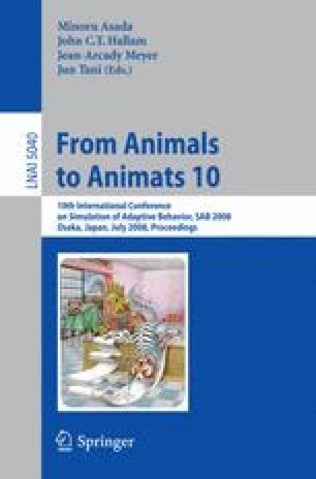
From Animals to Animats 10 ; 10th International Conference on Simulation of Adaptive Behavior, SAB 2008, Osaka, Japan, July 7-12, 2008. Proceedings
This book constitutes the refereed proceedings of the 10th International Conference on Simulation of Adaptive Behavior, SAB 2008, held in Osaka, Japan in July 2008.The 30 revised full papers and 21 revised poster papers presented were carefully reviewed and selected from 110 submissions. The papers are organized in topical sections on the animat approach to adaptive behaviour, evolution, navigation and internal world models, perception and control, learning and adaptation, cognition, emotion and behaviour, collective and social behaviours, adaptive behaviour in language and communication, and applied adaptive behaviour.

Free Energy Calculations : Theory and Applications in Chemistry and Biology
This volume sets out to present a coherent and comprehensive account of the concepts that underlie different approaches devised for the determination of free energies. The reader will gain the necessary insight into the theoretical and computational foundations of the subject and will be presented with relevant applications from molecular-level modelling and simulations of chemical and biological systems. Both formally accurate and approximate methods are covered using both classical and quantum mechanical descriptions. A central theme of the book is that the wide variety of free energy calculation techniques available today can be understood as different implementations of a few basic principles.

Fractional order systems and applications in engineering
Covers the fundamentals of fractional calculus together with some analytical and numerical techniques, and provides MATLAB® codes for the simulation of fractional-order control (FOC) systems. The use of fractional calculus can improve and generalize well-established control methods and strategies. Many different FOC schemes are presented for control and dynamic systems problems. These extend to the challenging control engineering design problems of robust and nonlinear control. Practical material relating to a wide variety of applications including, among others, mechatronics, civil engineering, irrigation and water management, and biological systems is also provided.

Foundations of software science and computational structures ; Vol.3441 : 8th International Conference, FOSSACS 2005, Held as part of the joint European conferences on theory and practice of software, ETAPS 2005
ETAPS 2005 was the eighth instance of the European Joint Conferences on Theory and Practice of Software. ETAPS is an annual federated conference that was est- lished in 1998 by combining a number of existing and new conferences. This year it comprised ?ve conferences (CC, ESOP, FASE, FOSSACS, TACAS), 17 satellite wo- shops (AVIS, BYTECODE, CEES, CLASE, CMSB, COCV, FAC, FESCA, FINCO, GCW-DSE, GLPL, LDTA, QAPL, SC, SLAP, TGC, UITP), seven invited lectures (not including those that were speci?c to the satellite events), and several tutorials. We - ceived over 550 submissions to the ?ve conferences this year, giving acceptance rates below 30% for each one. Congratulations to all the authors who made it to the ?nal program! I hope that most of the other authors still found a way of participating in this exciting event and I hope you will continue submitting. The events that comprise ETAPS address various aspects of the system devel- ment process, including speci?cation, design, implementation, analysis and impro- ment. The languages, methodologies and tools which support these activities are all well within its scope.

Foundations of 3D Graphics Programming : Using JOGL and Java3D ; 2nd ed.
This thoroughly updated and enhanced second edition of Foundations of 3D Graphics Programming is an innovative shortcut to graphics theory and programming using JOGL, a new vehicle of 3D graphics programming in Java. This revised edition of the successful, reader-friendly text covers all graphics basics and several advanced topics, as well as some basic concepts in Java programming for those who currently are C/C++ programmers. Specifically, it provides all the core aspects of OpenGL programming in Java using JOGL, along with concisely presented computer graphics theories. In addition, it uses a top-down approach to lead the reader into programming and applications up-front. The content about theory provides a high-level understanding of all basic graphics, and of using JOGL instead of implementing a graphics system. Explanations are integrated with the sample programs, which are specifically designed for learning and accompanying this book.
Formal Techniques for Networked and Distributed Systems - FORTE 2008 ; 28th IFIP WG 6.1 International Conference Tokyo, Japan, June 10-13, 2008 Proceedings
This book constitutes the refereed proceedings of the 28th IFIP WG 6.1 International Conference on Formal Techniques for Networked and Distributed Systems, FORTE 2008, held in Tokyo, Japan, in June 2008 co-located with TestCom/FATES 2008.The 19 revised full papers and 1 revised short paper presented together with 1 invited talk were carefully reviewed and selected from 44 submissions. The papers cover new approaches, concepts and experience in the application of formal methods for the specification and verification of distributed systems and applications.

Formal techniques for networked and distributed systems - FORTE 2005 ; 25th IFIP WG 6.1 International Conference, Taipei, Taiwan, October 2-5, 2005, Proceedings
FORTE (Formal Techniques for Networked and Distributed Systems) 2005 was sp- sored by Working Group 6.1, Technical Committee 6 (TC6) of the International Fed- ation for InformationProcessing (IFIP).The conferenceseries started in 1981underthe name PSTV (ProtocolSpeci?cation, Testing, and Veri?cation).In 1988,a second series under the name FORTE was started. Both series merged to FORTE/PSTV in 1996. The conference name was changed to FORTE in 2001. During its 24-year history, many important contributions have been reported in the conference series. The last ?ve me- ings of FORTE were held in Pisa (Italy), Cheju Island (Korea), Houston (USA), Berlin (Germany), and Madrid (Spain). The 25th FORTE was held from Sunday to Wednesday, October 2–5, 2005 on the beautiful campus of the National Taiwan University (NTU), Taipei, Taiwan, ROC.

Formal Modelling in Electronic Commerce
Advances in automation for electronic commerce require improved understanding and formalization of the objects, processes, and policies of commerce itself. These include business objects such as bills of lading and contracts; processes such as workflows and trade procedures; and policies covering such problems as contract or procedure validation and strategic behaviour. This book is about theory, formalization, and proof-of-concept implementation of these and related matters. In addition to presenting state-of-the-art results, the book places this work in the context of nearly twenty years of developments in formal modelling for electronic commerce. A comprehensive bibliography and index are provided.
Formal Modeling and Analysis of Timed Systems ; Vol.4202 ; 4th International Conference, FORMATS 2006, Paris, France, September 25-27, 2006, Proceedings
The aim of FORMATS is to promote the study of fundamental and practical aspects of timed systems, and to bring together researchers from di?erent d- ciplines that share interests in modelling and analysis of timed systems. In this volume, there are articles on: – Foundations and Semantics: contributions to the theoretical foundations of timed systems and timed formal languages as well as comparison between di?erentmodelsusedbydi?erentcommunities(timedautomata,timedPetri nets, timed MSCs, hybrid automata, timed process algebra, timed temporal logics, timed abstract state machines, as well as probabilistic models). – Methods and Tools: techniques, algorithms, data structures, and software toolsforanalyzingtimedsystemsandresolvingtemporalconstraints(mod- checking, simulation, robustness analysis, scheduling, etc).
Formal Modeling and Analysis of Timed Systems ; 6th International Conference, FORMATS 2008, Saint Malo, France, September 15-17, 2008. Proceedings
This book constitutes the refereed proceedings of the 6th International Conference on Formal Modeling and Analysis of Timed Systems, FORMATS 2008, held in Saint Malo, France, September 2008.The 17 revised full papers presented together with 3 invited talks were carefully reviewed and selected from 37 submissions. The papers are organized in topical sections on extensions of timed automata and semantics; timed games and logic; case studies; model-checking of probabilistic systems; verification and test; timed petri nets.
Formal Methods in Systems Biology ; 1st International Workshop, FMSB 2008, Cambridge, UK, June 4-5, 2008. Proceedings
This book constitutes the refereed proceedings of the First International Workshop on Formal Methods in Systems Biology, FMSB 2008, held in Cambridge, UK, in June, 2008.The 9 revised full papers presented were carefully reviewed and selected from the workshop lectures that all were invited contributions. The purpose of this meeting was to identify techniques for the specification, development and verification of biological models. It also focused on the design of tools to execute and analyze biological models that can significantly advance our understanding of biological systems.
Formal Methods for Hardware Verification ; 6th International School on Formal Methods for the Design of Computer, Communication, and Software Systems, SFM 2006, Bertinoro, Italy, May 22-27, 2006, Advances Lectures
This book presents 8 papers accompanying the lectures of leading researchers given at the 6th edition of the International School on Formal Methods for the Design of Computer, Communication and Software Systems (SFM 2006). SFM 2006 was devoted to formal techniques for hardware verification and covers several aspects of the hardware design process, including hardware design languages and simulation, property specification formalisms, automatic test pattern generation, symbolic trajectory evaluation, and more.

Formal Methods and Software Engineering ; Vol. 3785 ; 7th International Conference on Formal Engineering Methods, ICFEM 2005, Manchester, UK, November 1-4, 2005, Proceedings
This volume contains papers presented at the 7th International Conference on Formal Engineering Methods (ICFEM 2005), 1-4 November 2005, Manchester, UK. Formal engineering methods are changing the way that systems are dev- oped. With language and tool support, these methods are being used for se- automatic code generation, and for the automatic abstraction and checking of implementations. In the future, they will be used at every stage of development: requirements, speci?cation, design, implementation, testing, anddocumentation. The aim of ICFEM 2005 was to bring together those interested in the - plication of formal engineering methods to computer systems. Researchers and practitioners, from industry, academia, and government, were encouraged to - tend, and to help advance the state of the art. The conference was supported by sponsorships from Microsoft Research, USA, the Software Engineers Association of Japan, the University of Man- ester, Manchester City Council, FormalMethods Europe (FME) and the British Computer Society FormalAspects ofComputing Specialist Group(BCS-FACS). We wish to thank these sponsors for their generosity. The ?nal programme consisted of 3 invited talks and 30 technical papers selected from a total of 74 submissions. The invited speakers were: Anthony Hall, independent consultant, UK; Egon B] orger, University of Pisa, Italy; John Rushby, SRI, USA. Their talks were sponsored by BCS-FACS, Microsoft - search and FME respectively. We wish to thank the invited speakers for their inspiring talks.
