



الصفحة 15
الصفحة 15

Infinite dimensional algebras and quantum integrable systems
This volume presents the invited lectures of the workshop "Infinite Dimensional Algebras and Quantum Integrable Systems'' .ecent developments in the theory of infinite dimensional algebras and their applications to quantum integrable systems are reviewed by some of the leading experts in the field. The volume will be of interest to a broad audience from graduate students to researchers in mathematical physics and related fields.

Inelastic Light Scattering of Semiconductor Nanostructures : Fundamentals and Recent Advances
Semiconductor nanostructures are a field of enormous and still-growing research interest. On one hand, they are already realized in mass products, e.g., in high-electron-mobility field-effect transistors and quantum-well lasers. On the other hand, they allow, in specially tailored systems, the investigation of fundamental properties, such as many-particle interactions of electrons in reduced dimensions. This book attempts to fill the gap between general semiconductor textbooks and research articles. It provides (i) an introduction into the basic concepts of inelastic light scattering on semiconductor nanostructures and into their fabrication and basic properties, and, (ii) a description of the most striking recent advances in this field. Each chapter is as self-contained as possible.

In Memoriam Paul-André Meyer - Séminaire de Probabilités XXXIX
The 39th volume of Séminaire de Probabilités is a tribute to the memory of Paul André Meyer. His life and achievements are recalled in this book, and tributes are paid by his friends and colleagues. This volume also contains mathematical contributions to classical and quantum stochastic calculus, the theory of processes, martingales and their applications to mathematical finance and Brownian motion. These contributions provide an overview on the current trends of stochastic calculus.

Implementation and application of automata ; Vol. 3317 ; 9th International Conference, CIAA 2004, Kingston, Canada, July 22-24, 2004, Revised Selected Papers
Contains the revised versions of the papers presented at the 9th International Conference on Implemen- tion and Application of Automata, CIAA 2004. Also included are the extended abstracts of the posters accepted to the conference. The conference was held at Queen’s University in Kingston, Ontario, Canada on July 22–24, 2004. As for its predecessors, the theme of CIAA 2004 was the implementation of automata and grammars of all types and their application in other fields. The topics of the papers presented at the conference range from applications of automata in natural language and speech processing to protein sequencing and genecompression, and from state complexity and new algorithms for automata operations to applications of quantum finite automata.

Il bizzarro mondo dei quanti = The bizarre world of quanta
Written before the final exams by an exceptionally talented young woman, this book bridges the gap between the popular literature on quantum physics, which normally avoids any mathematical formula, and specialized literature, well filled with advanced mathematics.

IFAE 2007 ; Incontri di Fisica delle Alte Energie = Italian Meeting on High Energy Physics Napoli, 11–13 April 2007
This book collects the Proceedings of the Workshop "Incontri di Fisica delle Alte Energie (IFAE) 2007, Napoli, 11-13 April 2007". This is the sixth edition of a series of meetings on fundamental research in particle physics and was attended by about 160 researchers. Presentations, both theoretical and experimental, addressed the status of Physics of the Standard Model and beyond, Flavour phyisc, Neutrino and Astroparticle physics, new technology in high energy physics. Special emphasis was given to the expectations of the forthcoming Large Hadron Collider, due in operation at the end of 2007.

Hybrid Methods of Molecular Modeling
Hybrid Methods of Molecular Modeling is a self-contained advanced review volume. It provides a step by step derivation of the consistent theoretical picture of hybrid modeling methods and a thorough analysis of the concepts and current practical methods of hybrid modeling based on this theory. The book presents its material sequentially, paying attention both to the physical soundness of the approximations used and to the mathematical rigor necessary for the practical development of the robust modeling code.

Hilbert Space Operators in Quantum Physics
The second edition of this course-tested book provides a detailed and in-depth discussion of the foundations of quantum theory as well as its applications to various systems. The exposition is self-contained; in the first part the reader finds the mathematical background in chapters about functional analysis, operators on Hilbert spaces and their spectral theory, as well as operator sets and algebras. This material is used in the second part to a systematic explanation of the foundations, in particular, states and observables, properties of canonical variables, time evolution, symmetries and various axiomatic approaches. In the third part, specific physical systems and situations are discussed. Two chapters analyze Schrödinger operators and scattering, two others added in the second edition are devoted to new important topics, quantum waveguides and quantum graphs.
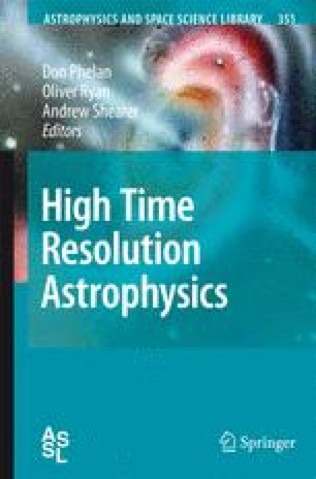
High Time Resolution Astrophysics
High Time Resolution Astrophysics (HTRA) is an important new window to the universe and a vital tool in understanding a range of phenomena from diverse objects and radiative processes. This importance is demonstrated in this volume with the description of a number of topics in astrophysics, including quantum optics, cataclysmic variables, pulsars, X-ray binaries and stellar pulsations to name a few. Underlining this science foundation, technological developments in both instrumentation and detectors are described. These instruments and detectors combined cover a wide range of timescales and can measure fluxes, spectra and polarisation. These advances make it possible for HTRA to make a big contribution to our understanding of the Universe in the next decade.

Handbook of Materials Modeling
The first reference of its kind in the rapidly emerging field of computational approachs to materials research, this is a compendium of perspective-providing and topical articles written to inform students and non-specialists of the current status and capabilities of modelling and simulation. From the standpoint of methodology, the development follows a multiscale approach with emphasis on electronic-structure, atomistic, and mesoscale methods, as well as mathematical analysis and rate processes. Basic models are treated across traditional disciplines, not only in the discussion of methods but also in chapters on crystal defects, microstructure, fluids, polymers and soft matter. Written by authors who are actively participating in the current development, this collection of 150 articles has the breadth and depth to be a major contributor toward defining the field of computational materials. In addition, there are 40 commentaries by highly respected researchers, presenting various views that should interest the future generations of the community.

Greens Functions in Quantum Physics
The main part of this book is devoted to the simplest kind of Green's functions, namely the solutions of linear differential equations with a -function source. It is shown that these familiar Green's functions are a powerful tool for obtaining relatively simple and general solutions of basic problems such as scattering and bound-level information. The bound-level treatment gives a clear physical understanding of "difficult" questions such as superconductivity, the Kondo effect, and, to a lesser degree, disorder-induced localization. The more advanced subject of many-body Green's functions is presented in the last part of the book.

Green Function Theory of Chemisorption
The book provides an introduction to the Green-Function (GF) theory of chemisorption. It is self-contained, and requires only a basic knowledge of quantum mechanics and solid-state physics. The GF approach lends itself well to the pedagogically desirable modellistic treatment of the subject. Throughout each chapter, step-by-step details are provided by which the calculations are performed, so that readers are led from the simple to the more advanced aspects, in a straightforward manner. In this way, students gain confidence to read the current literature on their own.

Gravity, Black Holes, and the Very Early Universe : An Introduction to General Relativity and Cosmology
In the early 1900s, Albert Einstein formulated two theories that would forever change the landscape of physics: the Special Theory of Relativity and the General Theory of Relativity. By 1925, quantum mechanics had been born out of the dissection of these two theories, and shortly after that, relativistic quantum field theory. We now had in place some important ties between the laws of physics and the types of particle interactions the new physics was uncovering. Gravity is one of the four types of forces that are found throughout the universe. In fact, although it is a relatively weak force, it operates at huge distances, and so must be accounted for in any cosmological system. Unfortunately, gravity continues to defy our neat categorization of how all the forces in nature work together.

Geometry of Quantum Theory ; 2nd ed.
This book a classic on the foundations of quantum theory. This view, which is essentially geometric and relies on the concept of symmetry. The mathematical treatment of symmetry in quantum theory is based on the theory of group representations, and this book includes a self-contained treatment of the parts of this theory that are most useful in quantum physics.

Geometry and Topology in Hamiltonian Dynamics and Statistical Mechanics
This book explores the foundations of hamiltonian dynamical systems and statistical mechanics, in particular phase transition, from the point of view of geometry and topology. A broad participation of topology in these fields has been lacking and this book will provide a welcome overview of the current research in the area, in which the author himself is a pioneer. Using geometrical thinking to solve fundamental problems in these areas, compared to the purely analytical methods usually used in physics could be highly productive. The author skillfully guides the reader, whether mathematician or physicists through the background needed to understand and use these techniques.

Geometric mechanics on riemannian manifolds : Applications to partial differential equations
This work presents a purely geometric treatment of problems in physics involving quantum harmonic oscillators, quartic oscillators, minimal surfaces, and Schrödinger's, Einstein's and Newton's equations. Historically, problems in these areas were approached using the Fourier transform or path integrals, although in some cases (e.g., the case of quartic oscillators) these methods do not work. New geometric methods are introduced in the work that have the advantage of providing quantitative or at least qualitative descriptions of operators, many of which cannot be treated by other methods. And, conservation laws of the Euler–Lagrange equations are employed to solve the equations of motion qualitatively when quantitative analysis is not possible. It includes : Lagrangian formalism on Riemannian manifolds; energy momentum tensor and conservation laws; Hamiltonian formalism; Hamilton–Jacobi theory; harmonic functions, maps, and geodesics; fundamental solutions for heat operators with potential; and a variational approach to mechanical curves.

Geometric and Topological Methods for Quantum Field Theory
This volume offers an introduction, in the form of four extensive lectures, to some recent developments in several active topics at the interface between geometry, topology and quantum field theory. The first lecture is by Christine Lescop on knot invariants and configuration spaces, in which a universal finite-type invariant for knots is constructed as a series of integrals over configuration spaces. This is followed by the contribution of Raimar Wulkenhaar on Euclidean quantum field theory from a statistical point of view. The author also discusses possible renormalization techniques on noncommutative spaces. The third lecture is by Anamaria Font and Stefan Theisen on string compactification with unbroken supersymmetry. The authors show that this requirement leads to internal spaces of special holonomy and describe Calabi-Yau manifolds in detail. The last lecture, by Thierry Fack, is devoted to a K-theory proof of the Atiyah-Singer index theorem and discusses some applications of K-theory to noncommutative geometry. These lectures notes, which are aimed in particular at graduate students in physics and mathematics, start with introductory material before presenting more advanced results. Each chapter is self-contained and can be read independently.

General Theory of Information Transfer and Combinatorics
This book constitutes the thoroughly refereed research papers contributed to a research project on the `General Theory of Information Transfer and Combinatorics' that was hosted from 2001-2004 at the Center for Interdisciplinary Research (ZIF) of Bielefeld University and also papers of several incorporated meetings thereof. The 63 revised full papers presented were carefully reviewed and selected for inclusion in the book. The papers are organized in topical sections on probabilistic models, cryptology, pseudo random sequences, quantum models, statistics, probability theory, information measures, error concepts, performance criteria, search, sorting, ordering, planning, language evolution, pattern discovery, reconstructions, network coding, combinatorial models, and a problem section.

Galaxy Formation
This second edition of Galaxy Formation is an up-to-date text on astrophysical cosmology, expounding the structure of the classical cosmological models from a contemporary viewpoint. This forms the background to a detailed study of the origin of structure and galaxies in the Universe. The derivations of many of the most important results are derived by simple physical arguments which illuminate the results of more advanced treatments. A very wide range of observational data is brought to bear upon these problems, including the most recent results from WMAP, the Hubble Space Telescope, galaxy surveys like the Sloan Digital Sky Survey and the 2dF Galaxy Redshift Survey, studies of Type 1a supernovae, and many other observations.

Fuzzy systems and knowledge discovery ; Vol. 3614 ; 2nd International Conference, FSKD 2005, Changsha, China, August 27-29, 2005, Proceedings, Part II
This book and its sister volume, LNAI 3613 and 3614, constitute the proce- ings of the Second International Conference on Fuzzy Systems and Knowledge Discovery (FSKD 2005), jointly held with the First International Conference on Natural Computation (ICNC 2005, LNCS 3610, 3611, and 3612) from - gust 27–29, 2005 in Changsha, Hunan, China. FSKD 2005 successfully attracted 1249 submissions from 32 countries/regions (the joint ICNC-FSKD 2005 received 3136 submissions). After rigorous reviews, 333 high-quality papers, i. e. , 206 long papers and 127 short papers, were included in the FSKD 2005 proceedings, r- resenting an acceptance rate of 26. 7%. The ICNC-FSKD 2005 conference featured the most up-to-date research - sults in computational algorithms inspired from nature, including biological, e- logical, and physical systems. It is an exciting and emerging interdisciplinary area in which a wide range of techniques and methods are being studied for dealing with large, complex, and dynamic problems. The joint conferences also promoted cross-fertilization over these exciting and yet closely-related areas, which had a signi?cant impact on the advancement of these important technologies. Speci?c areas included computation with words, fuzzy computation, granular com- tation, neural computation, quantum computation, evolutionary computation, DNA computation, chemical computation, information processing in cells and tissues, molecular computation, arti?cial life, swarm intelligence, ants colony, arti?cial immune systems, etc. , with innovative applications to knowledge d- covery, ?nance, operations research, and more.
