



الصفحة 15
الصفحة 15

Concepts and Semantics of Programming Languages 1 : A Semantical Approach with OCaml and Python
Explores the syntactical constructs of the most common programming languages, and sheds a mathematical light on their semantics, while also providing an accurate presentation of the material aspects that interfere with coding. It is dedicated to functional and imperative features. Included is the formal study of the semantics of typing and execution; their acquisition is facilitated by implementation into OCaml and Python, as well as by worked examples. Data representation is considered in detail: endianness, pointers, memory management, union types and pattern-matching, etc., with examples in OCaml, C and C++. The second volume introduces a specific model for studying modular and object features and uses this model to present Ada and OCaml modules, and subsequently Java, C++, OCaml and Python classes and objects.

Computing and combinatorics ; Vol. 3595 ; 11th Annual International Conference, COCOON 2005, Kunming, China, August 16-19, 2005, Proceedings
The papers in this volume were presented at theEleventh Annual InternationalComputing and Combinatorics Conference(COCOON 2005), The topics cover most aspects of theoretical computerscience and combinatorics related to computing.Submissions to the conference this year were conducted electronically. A totalof 353 papers were submitted, of which 96 were accepted.

Computer Vision - ACCV 2006 ; Vol. 3852 ; 7th Asian Conference on Computer Vision, Hyderabad, India, January 13-16, 2006, Proceedings, Part II
ACCV has been making its rounds through the Asian landscape and came to India this year. Interest in computer vision is increasing and ACCV 2006 attracted about 500 submission. The evaluation team consisted of 27 experts serving as Area Chairs and about 270 reviewers in all. The whole process was conducted electronically in a double-blind manner,a ?rstfor ACCV.

Computer Vision - ACCV 2006 ; Vol. 3851 ; 7th Asian Conference on Computer Vision, Hyderabad, India, January 13-16, 2006, Proceedings, Part I
proceedings. ACCV has been making its rounds through the Asian landscape and came to India this year. Interest in computer vision is increasing and ACCV 2006 attracted about 500 submission. The evaluation team consisted of 27 experts serving as Area Chairs and about 270 reviewers in all. The whole process was conducted electronically in a double-blind manner,a ?rstfor ACCV.

Computer simulation studies in condensed-matter physics XVIII ; Proceedings of the Eighteenth Workshop, Athens, GA, USA, March 7-11, 2005
This volume represents a "status report" emanating from presentations made during the 18th Annual Workshop on Computer Simulations Studies in Condensed Matter Physics at the Center for Simulational Physics at the University of Georgia in March 2005. It provides a broad overview of the most recent advances in the field, spanning the range from statistical physics to soft condensed matter and biological systems. Results on nanostructures and materials are included as are several descriptions of advances in quantum simulations and quantum computing as well as.methodological advances.

Computer simulation studies in condensed-matter physics XVI ; Proceedings of the Seventeenth Workshop, Athens, GA, USA, February 16-20, 2004
This status report features the most recent developments in the field, spanning a wide range of topical areas in the computer simulation of condensed matter/materials physics. Both established and new topics are included, ranging from the statistical mechanics of classical magnetic spin models to electronic structure calculations, quantum simulations, and simulations of soft condensed matter. The book presents new physical results as well as novel methods of simulation and data analysis. Highlights of this volume include various aspects of non-equilibrium statistical mechanics, studies of properties of real materials using both classical model simulations and electronic structure calculations, and the use of computer simulations in teaching.
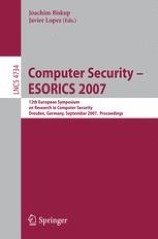
Computer Security – ESORICS 2007 ; 12th European Symposium On Research In Computer Security, Dresden, Germany, September 24 - 26, 2007, Proceedings
This book address issues such as data protection; security protocols; systems; web and network security; privacy; threat modeling and detection; information flow; and security in emerging applications such as cryptocurrencies, the Internet of Things and automotive.

Computer Security - ESORICS 2005
These proceedings contain the papers selected for presentation at the 10th - ropean Symposium on Research in Computer Security (ESORICS), held S- tember 12–14, 2005 in Milan, Italy. In response to the call for papers 159 papers were submitted to the conf- ence. These paperswere evaluated on the basis of their signi?cance, novelty,and technical quality. Each paper was reviewed by at least three members of the program committee. The program committee meeting was held electronically,

Computational Techniques for Voltage Stability Assessment and Control
The key concepts of both saddle node and Hopf bifurcation are covered. These are illustrated with the differential-algebraic equation (DAE) model of the system. The model is complex enough to include Load Tap-Changing transformers as well as HVDC models. The dynamic model of the generating unit includes the exciter since it plays a crucial role in voltage stability. A promising decoupled dynamic simulation technique is introduced for time domain analysis. Computational Techniques for Voltage Stability Assessment and Control provides the computational tools and algorithms needed for development of on-line voltage security assessment

Computational studies of RNA and DNA
Computational Studies of RNA and DNA includes, in an integrated way, modern computational studies of nucleic acids, ranging from advanced electronic structure quantum chemical calculations through explicit solvent molecular dynamics (MD) simulations up to mesoscopic modelling, with the main focus given to the MD field. It gives an equal emphasis to the leading methods and applications while successes as well as pitfalls of the computational techniques are discussed.The systems and problems studied include: Accurate calculations of base pairing energies / Electronic properties of nucleic acids and electron transfer, through various types of nucleic acid / Calculating DNA elasticity

Computational Quantum Mechanics for Materials Engineers : The EMTO Method and Applications
Computational Quantum Mechanics for Materials Engineers describes new approaches to the modelling of disordered alloys that combine the most efficient quantum-level theories of random alloys with the most sophisticated numerical techniques to establish a theoretical insight into the electronic structure of complex materials such as stainless steels, Hume-Rothery alloys and silicates. The practical success of these approaches to applications in all of these areas are covered in detail. The new EMTO-CPA method is detailed, including its application in alloys to model structural stability and elastic properties of random alloys of arbitrary composition and the effect of alloying elements on elastic stiffnesses stacking fault energies and structural parameters. The EMTO-CPA method makes new approaches to computational alloy design feasible. Computational Quantum Mechanics for Materials Engineers shows how the technique will soon allow materials engineers to become "quantum blacksmiths

Computational Materials Chemistry : Methods and Applications
As a result of the advancements in algorithms and the huge increase in speed of computers over the past decade, electronic structure calculations have evolved into a valuable tool for characterizing surface species and for elucidating the pathways for their formation and reactivity. It is also now possible to calculate, including electric field effects, STM images for surface structures. To date the calculation of such images has been dominated by density functional methods, primarily because the computational cost of - curate wave-function based calculations using either realistic cluster or slab models would be prohibitive. DFT calculations have proven especially valuable for elucidating chemical processes on silicon and other semiconductor surfaces. However, it is also clear that some of the systems to which DFT methods have been applied have large non-dynamical correlation effects, which may not be properly handled by the current generation of Kohn-Sham-based density functionals. For example, our CASSCF calculations on the Si(001)/acetylene system reveal that at some geometries there is extensive 86 configuration mixing. This, in turn, could signal problems for DFT cal- lations on these systems.

Computational Electronic Circuits : Simulation and Analysis with MATLAB®
This textbook teaches in one, coherent presentation the three distinct topics of analysis of electronic circuits, mathematical numerical algorithms and coding in a software such as MATLAB®. By combining the capabilities of circuit simulators and mathematical software, the author teaches key concepts of circuit analysis and algorithms, using a modern approach. The DC, Transient, AC, Noise and behavioral analyses are implemented in MATLAB to study the complete characteristics of a variety of electronic circuits, such as amplifiers, rectifiers, hysteresis circuits, harmonic traps and passes, polyphaser filters, directional couplers, electro-static discharge and piezoelectric crystals. This book teaches basic and advanced circuit analysis, by incorporating algorithms and simulations that teach readers how to develop their own simulators and fully characterize and design electronic circuits.

Computational Contact Mechanics
This is the second edition of the valuable reference source for numerical simulations of contact mechanics suitable for many fields like civil engineering, car design, aeronautics, metal forming, or biomechanics. Boundary value problems involving contact are of great importance in industrial applications in engineering such as bearings, metal forming processes, rubber seals, drilling problems, crash analysis of cars, rolling contact between car tires and the road, cooling of electronic devices... Other applications are related to biomechanical engineering design where human joints, implants or teeth are of consideration. Due to this variety, contact problems are today combined either with large elastic or inelastic deformations including time dependent responses. Thermal coupling also might have to be considered. Even stability behaviour has to be linked to contact.

Coherent Dynamics of Complex Quantum Systems
A large number of modern problems in physics, chemistry, and quantum electronics require a consideration of population dynamics in complex multilevel quantum systems. The purpose of this book is to provide a systematic treatment of these questions and to present a number of exactly solvable problems. It considers the different dynamical problems frequently encountered in different areas of physics from the same perspective, based mainly on the fundamental ideas of group theory and on the idea of ensemble average. Also treated are concepts of complete quantum control and correction of decoherence induced errors that are complementary to the idea of ensemble average. "Coherent Dynamics of Complex Quantum Systems" is aimed at senior-level undergraduate students in the areas of Atomic, Molecular, and Laser Physics, Physical Chemistry, Quantum Optics and Quantum Informatics. It should help them put particular problems in these fields into a broader scientific context and thereby take advantage of the well-elaborated technique of the adjacent fields.

Codes et turbocodes = Codes and turbo codes
Devoted to one of the essential functions of modern telecommunications systems: channel coding, or error-correcting coding. At the crossroads of information theory, mathematics, and electronics, channel coding has undergone numerous developments since the foundational work of Claude Shannon. Algebraic codes, convolutional codes, and concatenated codes decoded iteratively form the core of the book, which also includes a presentation of digital modulations, to which channel coding is closely linked, forming the heart of the physical layer of telecommunications systems. The most important theoretical aspects are presented, and the construction of the codes is detailed and justified. Decoding algorithms are developed and, where possible, accompanied by simulation results that demonstrate their error-correcting capabilities and applications.

CMOS Hotplate Chemical Microsensors
Covers all aspects of successful sensor prototyping: theory of transducer modelling, microelectronics design considerations, system design issues, and issues related to system and device microfabrication, packaging, and testing. A variety of different hotplates for different operation conditions is detailed and a family of metal-oxide-covered microhotplate-based microsensor systems with increasing complexity is presented. These systems belong to a new generation of chemical microsensors and represent examples of the successful integration of nanomaterials, microtechnology and microelectronics.The book provides students, scientists and engineers with an accessible introduction to the field of microhotplate-based chemical sensing, with all the necessary fundamental knowledge included. Beyond that, it also provides detailed information on all important issues concerning complex high-performance CMOS chemical microsensor systems; hence it will also be valuable to experts already familiar with the field.

CMOS Biotechnology
"CMOS Biotechnology reviews the recent research and developments joining CMOS technology with biology. Written by leading researchers these chapters delve into four areas including: Microfluidics for electrical engineers / CMOS Actuators CMOS Electrical Sensors CMOS Optical Sensors Bioanalytical instruments have been miniaturized on ICs to study various biophenomena or to actuate biosystems. These bio-lab-on-IC systems utilize the IC to facilitate faster, repeatable, and standardized biological experiments at low cost with a small volume of biological sample. CMOS Biotechnology will interest electrical engineers, bioengineers, biophysicists as well as researchers in MEMS, bioMEMS, microelectronics, microfluidics, and circuits and systems."

Clinical text mining : Secondary use of electronic patient records
Describes the results of natural language processing and machine learning methods applied to clinical text from electronic patient records. It is divided into twelve chapters. Chapters 1-4 discuss the history and background of the original paper-based patient records, their purpose, and how they are written and structured. These initial chapters do not require any technical or medical background knowledge. The remaining eight chapters are more technical in nature and describe various medical classifications and terminologies such as ICD diagnosis codes, SNOMED CT, MeSH, UMLS, and ATC. Chapters 5-10 cover basic tools for natural language processing and information retrieval, and how to apply them to clinical text. The book’s closing chapters present a number of applications in clinical text mining and summarise the lessons learned from the previous chapters.

Materials Handbook : A Concise Desktop Reference
The unique and practical Materials Handbook (second edition) provides quick and easy access to data on the physical and chemical properties of all classes of materials. The second edition has been much expanded to include whole new families of materials while many of the existing families are broadened and refined with new material and up-to-date information. Particular emphasis is placed on the properties of common industrial materials in each class.
