



الصفحة 15
الصفحة 15

Intelligent interactive multimedia systems for e-Healthcare applications
includes high-quality research on various aspects of intelligent interactive multimedia technologies in healthcare services. The topics covered in the book focus on state-of-the-art approaches, methodologies, and systems in the design, development, deployment, and innovative use of multimedia systems, tools, and technologies in healthcare. The volume provides insights into smart healthcare service demands. It presents all information about multimedia uses in e-healthcare applications. The book also includes case studies and self-assessment problems for readers and future researchers. This book proves to be a valuable resource to know how AI can be an alternative tool for automated and intelligent analytics for e-healthcare applications.
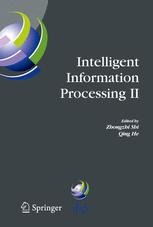
Intelligent information processingg II ; IFIP TC12/WG12.3 International Conference on Intelligent Information Processing (IIP2004) October 21-23, 2004, Beijing, China
This book is based on IIP2004, which provides a forum for engineers and scientists in academia, university and industry to present their latest research findings in any aspect of intelligent information processing. Papers on intelligence science, intelligent agents, machine learning, and autonomic computing, as well as papers that highlight bioinformatics, e-commerce, and business intelligence were presented. IIP2004 meets the needs of a large and diverse community.

Intelligent information processing III ; IFIP TC12 International Conference on Intelligent Information Processing (IIP 2006), September 20-23, Adelaide, Australia
The IFIP series publishes state-of-the-art results in the sciences and technologies of information and communication. The principal aim of the IFIP series is to encourage education and the dissemination and exchange of information about all aspects of computing.

Intelligent Computing ; International Conference on Intelligent Computing, ICIC 2006, Kunming, China, August 16-19, 2006, Proceedings, Part I
The International Conference on Intelligent Computing (ICIC) was formed to provide an annual forum with dedication to the emerging and challenging topics in artificial intelligence, machine learning, bioinformatics, and computational biology, etc. It aims to bring together researchers and practitioners from both the academia and industry to share ideas, problems and solutions related to the multifaceted aspects of intelligent computing. The ICIC 2006 to be held in Kunming, Yunnan, China, 16-19 August 2006 is the second International Conference on Intelligent Computing, which is built upon the success of ICIC 2005 held in Hefei, China, 2005. This year, the conference mainly concentrates on the theories & methodologies as well as the emerging applications of intelligent computing. It intends to unify the contemporary intelligent computing techniques within an integral framework that highlights the trends in advanced computational intelligence and bridges the theoretical research with the applications. In particular, the bio-inspired computing emerges as a key role in pursuing for novel technology in recently years. The resulting techniques vitalize the life science engineering and daily life applications. In light of this trend, the theme for this conference is the Emerging Intelligent Computing Technology and Applications. Papers related to this theme were especially solicited, including theories, methodologies, and applications in science and technology.

Intelligence in communication systems ; IFIP international onference on intelligence in communication systems, INTELLCOMM 2005, Montreal, Canada, October 17-19, 2005
International Federation for Information Processing The IFIP series publishes state-of-the-art results in the sciences and technologies of information and communication. The scope of the series includes: foundations of computer science; software theory and practice; education; computer applications in technology; communication systems; systems modeling and optimization; information systems; computers and society; computer systems technology; security and protection in information processing systems; artificial intelligence; and human-computer interaction. Proceedings and post-proceedings of referred international conferences in computer science and interdisciplinary fields are featured. These results often precede journal publication and represent the most current research. The principal aim of the IFIP series is to encourage education and the dissemination and exchange of information about all aspects of computing.

Intelligence and security informatics ; 1st European Conference, EuroISI 2008, Esbjerg, Denmark, December 3-5, 2008. Proceedings
This book constitutes the refereed proceedings of the First European Conference on Intelligence and Security Informatics, EuroISI 2008, held in Esbjerg, Denmark, in December 2008.The 23 revised full papers and 2 revised poster papers presented were carefully reviewed and selected from 48 submissions. The papers are organized in topical sections on criminal and social network analysis, intelligence analysis and knowledge discovery, Web-based intelligence monitoring and analysis, privacy protection, access control, and digital rights management, malware and intrusion detection, as well as surveillance and crisis management.

Integrative Oncology : Incorporating Complementary Medicine into Conventional Cancer Care
Integrative Oncology: Incorporating Complementary Medicine into Conventional Cancer Care is a platform from which accomplished professionals describe the various aspects of their programs and present their insights to those seeking to start or improve an integrative oncology program.

Integration and innovation orient to e-society ; Vol.2 ; 7th IFIP International Conference on e-business, e-Services, and e-Society (I3E2007), October 10-12, Wuhan, China
The IFIP series publishes state-of-the-art results in the sciences and technologies of information and communication. The principal aim of the IFIP series is to encourage education and the dissemination and exchange of information about all aspects of computing.

Integration and innovation orient to e-society ; Vol.1 ; 7th IFIP International Conference on e-Business, e-Services, and e-Society (I3E2007), October 10-12, Wuhan, China
The IFIP series publishes state-of-the-art results in the sciences and technologies of information and communication. The principal aim of the IFIP series is to encourage education and the dissemination and exchange of information about all aspects of computing.

Integration / Interaction of Oncologic Growth
The present multi-volume Book Series, CANCER GROWTH AND PROGRESSION, encompasses the widest possible framework of cutting edge research in the field of neoplastic pathology and other integrated fields. The individual volumes in this series focus on the topics of highest scientific interest for basic and clinical researchers, pathologists, medical and surgical oncologists and allied multidisciplinary teams interested in the study of these aspects of neoplastic growth, progression and inhibition. The range of topics covered is extensive.

Integrating lifestyle medicine for prediabetes, type 2 diabetes, and cardiometabolic disease
Provides clinical evidence for and a mechanistic understanding of the six pillars of lifestyle medicine. It guides the reader to identify opportunities for early intervention rather than focus on the diagnosis and treatment of the established disease. Interventions at earlier points have the potential to mitigate progression, prevent complications, reduce costs, and improve a patient’s overall health at all points in their lifetime.

Integrating Human Aspects in Production Management ; IFIP TC5 / WG5.7 Proceedings of the International Conference on Human Aspects in Production Management 5-9 October 2003, Karlsruhe, Germany
This book is composed of six parts, each focusing on a specific theme: Human Resource Planning; Human Aspects in the Digital Factory; Human Aspects in Production Planning & Control; Knowledge Management; Management of Distributed Work; and Service Engineering. The included papers were presented at the IFIP International Working Conference "Human Aspects in Production Management." Following this conference, the papers were extended by the authors and passed a peer review process.

Integrated Water Management : Practical Experiences and Case Studies
This book introduced a whole range of specific definitions, objectives and constraints regarding the various aspects of water management, including water quality management, policies, economic aspects, ecology, price, and sustainable development. These issues all require the formulation of common, integrated, sustainable approaches for managing the water system from a multidisciplinary perspective, and the definition of new professional skills, requirements which become even more evident where transboundary areas are concerned.

Integrated Urban Water Resources Management
Growing populations and rising standards of living exert stress on water supply and the quality of drinking water. In wastewater management, new challenges are caused by new chemicals of concern, including endocrine disrupters, pharmaceuticals, hormones, and personal care products, which often pass through wastewater treatment plants unabated, but may cause serious impacts on receiving aquatic ecosystems. Advanced wastewater treatment leads to production of biosolids, which are processed in various ways, including on-land applications in agriculture. Municipal effluents, combined with increasing withdrawals of water, lead to the worsening of receiving water quality. Expert opinions indicate that the only way to deal with the current urban water management dilemmas is by integrated management and innovative delivery of water services. This book presents important aspects of Challenges in Management of Urban Water Resources, Challenges in Urban Water Supply, Urban Drainage and Water Bodies, Wastewater Treatment and Security, and Wastewater Treatment and Reuse.

Integrated Market and Credit Portfolio Models : Risk Measurement and Computational Aspects
Due to their business activities, banks are exposed to many different risk types. Aggregating various risk exposures to a comprehensive risk position is an important but up-to-date not satisfactorily solved task. This shortfall goes back to conceptual problems of constructing an appropriate risk model and to the computational burden of determining a loss distribution that comprises all relevant risk types. Peter Grundke deals with both problems. On the one hand, he extends a standard credit portfolio model by correlated interest rate and credit spread risk. The analysis shows that the economic capital needed as a buffer to absorb unexpected losses in a portfolio can be severely underestimated when relevant market risk factors are neglected. On the other hand, computational aspects are addressed.

Integrated Management and Biocontrol of Vegetable and Grain Crops Nematodes
The second volume of the IMPD series describes aspects related to most important phytoparasitic nematodes, considering the integration of biological control methods with other management practices and technologies, including the use of predatory nematodes and microbial rhizosphere antagonists. Chapters cover topics like the mode of action and interactions of nematophagous fungi, the efficacy of controll and management of plant parasitic nematode communities through a soil conservation approach, and exploitation of nematodes-bacteria antagonistic relationships.

Integrated formal methods ; 6th International Conference, IFM 2007, Oxford, UK, July 2-5, 2007, Proceedings
It addresses all aspects of formal methods integration, including of a process of analysis or design application of formal methods to analysis or design, extension of one method based upon the inclusion of ideas or concepts from others, and semantic integration or practical application.

Integrated formal methods ; 3rd International Conference, IFM 2002, Turku, Finland, May 15-18, 2002. Proceedings.
IFM 2002 explored the relations between formal methods and graphical notations, especially the industrial standard language for software design, the Unified Modeling Language (UML). The themes of IFM 2002 reflect what we believe is a growing trend in the Formal Methods and Software Engineering research communities. Over the last threedecades,computer scientists have developed a range of formalisms focusing on particular aspects of behavior or analysis, such as sequential program structures, concurrent program structures, data and information structures, temporal reasoning, deductive proof, and model checking. Much effort is now being devoted to integrating these methods in order to combine their advantages and ensure they scale up to industrial needs. Graphical notations are now widely used in software engineering and there is growing recognition of the importance of providing these with the for mal underpinnings and form alanalysis capabilities found in formal methods.

Integrated Circuit and System Design. Power and Timing Modeling, Optimization and Simulation ; Vol. 4148 ; 16th International Workshop, PATMOS 2006, Montpellier, France, September 13-15, 2006, Proceedings
Welcome to the proceedings of PATMOS 2006, the 16th in a series of international workshops. PATMOS 2006 was organized by LIRMM with CAS technical - sponsorship and CEDA sponsorship. Over the years, the PATMOS workshop has evolved into an important European event, where researchers from both industry and academia discuss and investigate the emerging challenges in future and contemporary applications, design methodologies, and tools required for the development of upcoming generations of integrated circuits and systems. The technical program of PATMOS 2006 contained state-of-the-art technical contributions, three invited talks, a special session on hearing-aid design, and an embedded tutorial. The technical program focused on timing, performance and power consumption, as well as architectural aspects with particular emphasis on modeling, design, characterization, analysis and optimization in the nanometer era. The Technical Program Committee, with the assistance of additional expert reviewers, selected the 64 papers presented at PATMOS. The papers were organized into 11 technical sessions and 3 poster sessions. As is always the case with the PATMOS workshops, full papers were required, and several reviews were received per manuscript.

Integrated Circuit and System Design. Power and Timing Modeling, Optimization and Simulation ; Vol. 3728 ; 15th International Workshop, PATMOS 2005, Leuven, Belgium, September 21-23, 2005, Proceedings
Welcome to the proceedings of PATMOS 2005, the 15th in a series of international workshops.PATMOS2005wasorganizedbyIMECwithtechnicalco-sponsorshipfrom the IEEE Circuits and Systems Society. Over the years, PATMOS has evolved into an important European event, where - searchers from both industry and academia discuss and investigate the emerging ch- lenges in future and contemporary applications, design methodologies, and tools - quired for the developmentof upcominggenerationsof integrated circuits and systems. The technical program of PATMOS 2005 contained state-of-the-art technical contri- tions, three invited talks, a special session on hearing-aid design, and an embedded - torial. The technical program focused on timing, performance and power consumption, as well as architectural aspects with particular emphasis on modeling, design, char- terization, analysis and optimization in the nanometer era. The Technical Program Committee, with the assistance of additional expert revi- ers, selected the 74 papers to be presented at PATMOS. The papers were divided into 11 technical sessions and 3 poster sessions. As is always the case with the PATMOS workshops, the review process was anonymous, full papers were required, and several reviews were carried out per paper. Beyond the presentations of the papers, the PATMOS technical program was - riched by a series of speeches offered by world class experts, on important emerging research issues of industrial relevance. Prof. Jan Rabaey, Berkeley, USA, gave a talk on “Traveling the Wild Frontier of Ulta Low-Power Design”, Dr. Sung Bae Park, S- sung, gave a presentation on “DVL (Deep Low Voltage): Circuits and Devices”, Prof.
