



الصفحة 15
الصفحة 15
Linear Algebra Thoroughly Explained
Linear Algebra Thoroughly Explained provides a comprehensive introduction to the subject suitable for adoption as a self-contained text for courses at undergraduate and postgraduate level. The clear and comprehensive presentation of the basic theory is illustrated throughout with an abundance of worked examples. The book is written for teachers and students of linear algebra at all levels and across mathematics and the applied sciences, particularly physics and engineering.
Lifting Modules : Supplements and Projectivity in Module Theory
Extending modules are generalizations of injective modules and, dually, lifting modules generalize projective supplemented modules. There is a certain asymmetry in this duality. While the theory of extending modules is well documented in monographs and text books, the purpose of our monograph is to provide a thorough study of supplements and projectivity conditions needed to investigate classes of modules related to lifting modules. The text begins with an introduction to small submodules, the radical, variations on projectivity, and hollow dimension. The subsequent chapters consider preradicals and torsion theories (in particular related to small modules), decompositions of modules (including the exchange property and local semi-T-nilpotency), supplements in modules (with specific emphasis on semilocal endomorphism rings), finishing with a long chapter on lifting modules, leading up their use in the theory of perfect rings, Harada rings, and quasi-Frobenius rings.
Lie Theory Vol.229 : Unitary Representations and Compactifications of Symmetric Spaces
It focuses on two fundamental questions in the theory of semisimple Lie groups: the geometry of Riemannian symmetric spaces and their compactifications; and branching laws for unitary representations, i.e., restricting unitary representations to (typically, but not exclusively, symmetric) subgroups and decomposing the ensuing representations into irreducibles.Ji's introductory chapter motivates the subject of symmetric spaces and their compactifications with carefully selected examples. A discussion of Satake and Furstenberg boundaries and a survey of the geometry of Riemannian symmetric spaces in general provide a good background for the second chapter, namely, the Borel–Ji authoritative treatment of various types of compactifications useful for studying symmetric and locally symmetric spaces. Borel–Ji further examine constructions of Oshima, De Concini, Procesi, and Melrose, which demonstrate the wide applicability of compactification techniques. Kobayashi examines the important subject of branching laws. Important concepts from modern representation theory, such as Harish–Chandra modules, associated varieties, microlocal analysis, derived functor modules, and geometric quantization are introduced. Concrete examples and relevant exercises engage the reader.
Lie theory ; Vol.230 : Harmonic analysis on symmetric spaces, general Plancherel theorems
Van den Ban’s introductory chapter explains the basic setup of a reductive symmetric space along with a careful study of the structure theory, particularly for the ring of invariant differential operators for the relevant class of parabolic subgroups. Advanced topics for the formulation and understanding of the proof are covered, including Eisenstein integrals, regularity theorems, Maass–Selberg relations, and residue calculus for root systems. Schlichtkrull provides a cogent account of the basic ingredients in the harmonic analysis on a symmetric space through the explanation and definition of the Paley–Wiener theorem. Approaching the Plancherel theorem through an alternative viewpoint, the Schwartz space, Delorme bases his discussion and proof on asymptotic expansions of eigenfunctions and the theory of intertwining integrals.
Lie Groups : An Approach through Invariants and Representations
Lie groups has been an increasing area of focus and rich research since the middle of the 20th century. Procesi's masterful approach to Lie groups through invariants and representations gives the reader a comprehensive treatment of the classical groups along with an extensive introduction to a wide range of topics associated with Lie groups: symmetric functions, theory of algebraic forms, Lie algebras, tensor algebra and symmetry, semisimple Lie algebras, algebraic groups, group representations, invariants, Hilbert theory, and binary forms with fields ranging from pure algebra to functional analysis.
Lie Algebras and Applications
This book, designed for advanced graduate students and post-graduate researchers, provides an introduction to Lie algebras and some of their applications to the spectroscopy of molecules, atoms, nuclei and hadrons. In the first part, a concise exposition is given of the basic concepts of Lie algebras, their representations and their invariants. The second part contains a description of how Lie algebras are used in practice in the treatment of bosonic and fermionic systems. Physical applications considered include rotations and vibrations of molecules (vibron model), collective modes in nuclei (interacting boson model), the atomic shell model, the nuclear shell model, and the quark model of hadrons. One of the key concepts in the application of Lie algebraic methods in physics, that of spectrum generating algebras and their associated dynamic symmetries, is also discussed. The book contains many examples that help to elucidate the abstract algebraic definitions. It provides a summary of many formulas of practical interest, such as the eigenvalues of Casimir operators and the dimensions of the representations of all classical Lie algebras.
Lie Algebras and Algebraic Groups
The theory of Lie algebras and algebraic groups has been an area of active research in the last 50 years. It intervenes in many different areas of mathematics : for example invariant theory, Poisson geometry, harmonic analysis, mathematical physics. The aim of this book is to assemble in a single volume the algebraic aspects of the theory so as to present the foundation of the theory in characteristic zero. Detailed proofs are included and some recent results are discussed in the last chapters. All the prerequisites on commutative algebra and algebraic geometry are included.
Lectures on Algebraic Geometry I : Sheaves, Cohomology of Sheaves, and Applications to Riemann Surfaces
This book and the following second volume is an introduction into modern algebraic geometry. In the first volume the methods of homological algebra, theory of sheaves, and sheaf cohomology are developed. These methods are indispensable for modern algebraic geometry, but they are also fundamental for other branches of mathematics and of great interest in their own.In the last chapter of volume I these concepts are applied to the theory of compact Riemann surfaces. In this chapter the author makes clear how influential the ideas of Abel, Riemann and Jacobi were and that many of the modern methods have been anticipated by them.
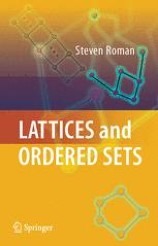
Lattices and Ordered Sets
This book is intended to be a thorough introduction to the subject of ordered sets and lattices, with an emphasis on the latter. It can be used for a course at the graduate or advanced undergraduate level or for independent study. Prerequisites are kept to a minimum, but an introductory course in abstract algebra is highly recommended, since many of the examples are drawn from this area. The book has an excellent choice of topics, including a chapter on well ordering and ordinal numbers, which is not usually found in other texts. The approach is user-friendly and the presentation is lucid. There are more than 240 carefully chosen exercises.
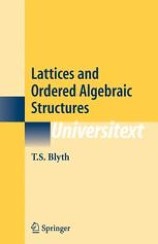
Lattices and Ordered Algebraic Structures
Lattices and Ordered Algebraic Structures provides a lucid and concise introduction to the basic results concerning the notion of an order. Although as a whole it is mainly intended for beginning postgraduates, the prerequisities are minimal and selected parts can profitably be used to broaden the horizon of the advanced undergraduate. The treatment is modern, with a slant towards recent developments in the theory of residuated lattices and ordered regular semigroups.
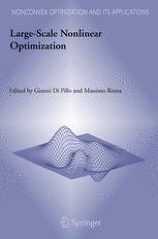
Large-Scale Nonlinear Optimization
Large-Scale Nonlinear Optimization reviews and discusses recent advances in the development of methods and algorithms for nonlinear optimization and its applications, focusing on the large-dimensional case, the current forefront of much research.The chapters of the book including theoretical analysis, algorithmic development, implementation issues and applications.

Language and Automata Theory and Applications ; 2nd International Conference, LATA 2008, Tarragona, Spain, March 13-19, 2008. Revised Papers
This book constitutes the refereed proceedings of the Second International Conference on Language and Automata Theory and Applications, LATA 2008, held in Tarragona, Spain, in March 2008.The 40 revised full papers presented were carefully reviewed and selected from 134 submissions. The papers deal with the various issues related to automata theory and formal languages
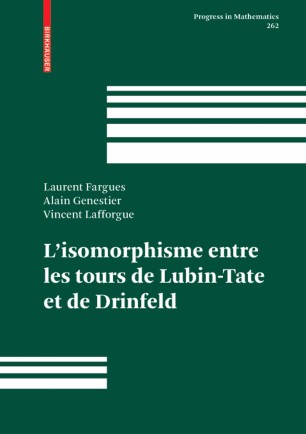
L’isomorphisme entre les tours de Lubin-Tate et de Drinfeld = The isomorphism between the Lubin-Tate and Drinfeld towers
This book contains a detailed and complete demonstration of the existence of an equivariate isomorphism between the Lubin-Tate and Drinfeld p-adic turns. The result is established in equal and unequal characteristics. There is also given as an application a proof that the equivariant cohomologies of these two turns are isomorphic, a result which has applications to the study of the local Langlands correspondence. During the proof, reminders and complements are given on the structure of the two preceding moduli spaces, the p-divisible formal groups and the p-adic rigid analytical geometry.
K-Theory : An Introduction
From the Preface: K-theory was introduced by A. Grothendieck in his formulation of the Riemann- Roch theorem. For each projective algebraic variety, Grothendieck constructed a group from the category of coherent algebraic sheaves, and showed that it had many nice properties. Atiyah and Hirzebruch considered a topological analog defined for any compact space X, a group K{X) constructed from the category of vector bundles on X. It is this ''topological K-theory" that this book will study. Topological K-theory has become an important tool in topology. Using K- theory, Adams and Atiyah were able to give a simple proof that the only spheres which can be provided with H-space structures are S1, S3 and S7. Moreover, it is possible to derive a substantial part of stable homotopy theory from K-theory.
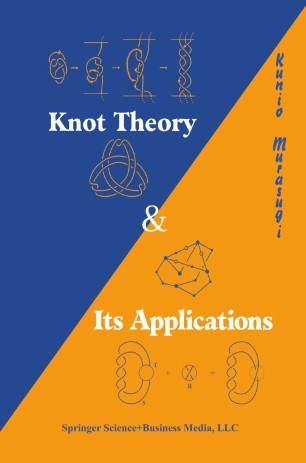
Knot Theory and Its Applications
The book contains most of the fundamental classical facts about the theory, such as knot diagrams, braid representations, Seifert surfaces, tangles, and Alexander polynomials; also included are key newer developments and special topics such as chord diagrams and covering spaces. The work introduces the fascinating study of knots and provides insight into applications to such studies as DNA research and graph theory. In addition, each chapter includes a supplement that consists of interesting historical as well as mathematical comments.
Jacopo da Firenze’s Tractatus Algorismi and Early Italian Abbacus Culture
In the city republics of Renaissance Italy, it was a common practice among the merchant class to send sons for a two-year course of study at an "abbacus school", where they learned practical, mostly commercial mathematics, known as abbaco. From this school institution, several hundred manuscripts survive, all in Italian, often containing not only what the masters needed in their teaching but also algebra or other advanced mathematical material. A signal feature of the book by Jens Høyrup is the first translation of one of these abbacus manuscripts into English.
Iterating Infusion : Clearer Views of Objects, Classes, and Systems
Iterating Infusion presents comprehensive tools for you to best manage and work with object orientation. These include simplified fundamental concepts, popular language comparisons, advanced designing strategies, a broad usage progression, thorough design notations (interaction algebra), and data-oriented (fundamentally-OO) languages. The title, Iterating Infusion, alludes to the fact that any system has multiple, coexisting functional levels and that new levels—both lower and higher—are continually added to the same functional area. The practical effect is to bring processes into focus, always clarifying the vague. The extreme form of this is when separate but compatible technologies are brought together to create advancements; these can be baby-steps or great leaps, with varying amounts of effort. In more general terms, the same thing in a different context can take on much more power. And actually, this phenomenon is at the heart of object-oriented software.
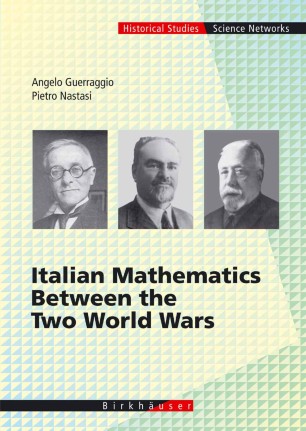
Italian Mathematics Between the Two World Wars
This book describes Italian mathematics in the period between the two World Wars. We analyze its development by focusing on both the interior and the external influences. Italian mathematics in that period was shaped by a colorful array of strong personalities who concentrated their efforts on a select number of fields and won international recognition and respect in an incredibly short time. Italy was also dominated by a fascist regime. This political situation and the social and academic structure of Italian society are included in the analysis as influences external to mathematics itself. The authors have provided a fascinating study of a most difficult time in the history of the world and of mathematics.
Comprehensive mathematics for computer scientists 2 : Calculus and ODEs, splines, probability, fourier and wavelet theory, fractals and neural networks, categories and lambda calculus
This second volume of a comprehensive tour through mathematical core subjects for computer scientists completes the first volume in two - gards: Part III first adds topology, di?erential, and integral calculus to the t- ics of sets, graphs, algebra, formal logic, machines, and linear geometry, of volume 1. With this spectrum of fundamentals in mathematical e- cation, young professionals should be able to successfully attack more involved subjects, which may be relevant to the computational sciences. In a second regard, the end of part III and part IV add a selection of more advanced topics. In view of the overwhelming variety of mathematical approaches in the computational sciences, any selection, even the most empirical, requires a methodological justi?cation. Our primary criterion has been the search for harmonization and optimization of thematic - versity and logical coherence. This is why we have, for instance, bundled such seemingly distant subjects as recursive constructions, ordinary d- ferential equations, and fractals under the unifying perspective of c- traction theory.

Comprehensive mathematics for computer scientists 1 : Sets and numbers, graphs and algebra, logic and machines, linear geometry
This two-volume textbook Comprehensive Mathematics for Computer Scientists is a self-contained comprehensive presentation of mathematics including sets, numbers, graphs, algebra, logic, grammars, machines, linear geometry, calculus, ODEs, and special themes such as neural networks, Fourier theory, wavelets, numerical issues, statistics, categories, and manifolds. The concept framework is streamlined but defining and proving virtually everything.
