



الصفحة 147
الصفحة 147

Arts and health promotion : Tools and bridges for practice, research, and social transformation
This book offers an overview of the beautiful, powerful, and dynamic array of opportunities to promote health through the arts from theoretical, methodological, pedagogical, and critical perspectives. This is the first-known text to connect the disparate inter-disciplinary literatures into a coherent volume for health promotion practitioners, researchers, and teachers. It provides a one-stop depository for using the arts as tools for health promotion in many settings and as bridges across communities, cultures, and sectors.

Artificiality and sustainability in entrepreneurship : Exploring the unforeseen, and paving the way to a sustainable future
Explores the past, present, and future of artificiality and sustainability in entrepreneurship – the unforeseen consequences and ways to advance to a sustainable future. In particular, it connects artificiality, sustainability and entrepreneurship, intertwining artificial with the specific phenomenon of those novel digital technologies that provoke continuous and significant change in our lives and business. Unlike digital entrepreneurship research, which focuses on digital technology development and management, this book covers processes and mechanisms of sustainable adaptability of entrepreneurs, the business logic of start-ups, and the collaborative behaviours under the mass digital transformation, including the prevalence of artificial intelligence. Some of the questions that this book answers are as follows: How has entrepreneurship reacted to such challenges previously? What lessons have been learned and need to be carried forward? How can entrepreneurship and the artefacts of entrepreneurship respond to current challenges? What should be the mindset of the entrepreneur to assure sustainable adaptation? How to embrace and embed the new business logic?

Artificial tears drops
Vision is by far the most used of the five senses and is one of the primary means that we use to gather information from our surroundings. More than 75% of the information we receive about the world around us consists of visual information. The tear film is structurally complex with three distinct layers: a surface lipid layer, a middle aqueous layer and an inner mucus layer. Dry eyes are caused by a variety of reasons that disrupt the healthy tear film...

Artificial oxygen carrier; its frontline
This volume of the Keio University International Symposia for Life Sciences and Medicine contains the proceedings of the 13th symposium held under the sponsorship of the Keio University Medical Science Fund. The fund was est- lished by the generous donation of the late Dr. Mitsunada Sakaguchi. The Keio University International Symposia for Life Sciences and Medicine constitute one of the core activities sponsored by the fund,of which the objective is to contribute to the international community by developing human resources, promoting scienti?c knowledge, and encouraging mutual exchange. Each year, the Committee of the International Symposia for Life Sciences and Medicine selects the most signi?cant symposium topics from applications received from the Keio medical community. The publication of the proce- ings is intended to publicize and distribute the information arising from the lively discussions of the most exciting and current issues presented during the symposium.

Artificial neural networks in Pattern Recognition ; 3d IAPR Workshop, ANNPR 2008 Paris, France, July 2-4, 2008 Proceedings
Constitutes the refereed proceedings of the Third TC3 IAPR Workshop on Artificial Neural Networks in Pattern Recognition, ANNPR 2008, held in Paris, France, in July 2008.

Artificial neural networks in Pattern Recognition ; 2nd IAPR Workshop, ANNPR 2006, Ulm, Germany, August 31-September 2, 2006, Proceedings
This book constitutes the refereed proceedings of the Second IAPR Workshop on Artificial Neural Networks in Pattern Recognition, ANNPR 2006, held in Ulm, Germany in August/September 2006. The 26 revised papers presented were carefully reviewed and selected from 49 submissions. The papers are organized in topical sections on unsupervised learning, semi-supervised learning, supervised learning, support vector learning, multiple classifier systems, visual object recognition, and data mining in bioinformatics

Artificial neural networks : Formal Models and Their Applications – ICANN 2005 ; 15th International Conference, Warsaw, Poland, September 11-15, 2005, Proceedings, Part II
The second volume contains 162 contributions related to Formal Models and their Applications and deals with new neural network models, supervised learning algorithms, ensemble-based learning, unsupervised learning, recurent neural networks, reinforcement learning, bayesian approaches to learning, learning theory, artificial neural networks for system modeling, decision making, optimalization and control, knowledge extraction from neural networks, temporal data analysis, prediction and forecasting, support vector machines and kernel-based methods, soft computing methods for data representation, analysis and processing, data fusion for industrial, medical and environmental applications, non-linear predictive models for speech processing, intelligent multimedia and semantics, applications to natural language processing, various applications, computational intelligence in games, and issues in hardware implementation.

Artificial neural networks : Biological Inspirations – ICANN 2005 ; 15th International Conference, Warsaw, Poland, September 11-15, 2005, Proceedings, Part I
The two volume set LNCS 3696 and LNCS 3697 constitutes the refereed proceedings of the 15th International Conference on Artificial Neural Networks, ICANN 2005, held in Warsaw, Poland in September 2005. The over 600 papers submitted to ICANN 2005 were thoroughly reviewed and carefully selected for presentation. The first volume includes 106 contributions related to Biological Inspirations; topics addressed are modeling the brain and cognitive functions, development of cognitive powers in embodied systems spiking neural networks, associative memory models, models of biological functions, projects in the area of neuroIT, evolutionary and other biological inspirations, self-organizing maps and their applications, computer vision, face recognition and detection, sound and speech recognition, bioinformatics, biomedical applications, and information- theoretic concepts in biomedical data analysis.

Artificial neural networks - ICANN 2008 ; 18th International Conference, Prague, Czech Republic, September 3-6, 2008, Proceedings, Part II
This two volume set LNCS 5163 and LNCS 5164 constitutes the refereed proceedings of the 18th International Conference on Artificial Neural Networks, ICANN 2008, held in Prague Czech Republic, in September 2008.

Artificial neural networks - ICANN 2008 ; 18th International Conference, Prague, Czech Republic, September 3-6, 2008, Proceedings, Part I
This two volume set LNCS 5163 and LNCS 5164 constitutes the refereed proceedings of the 18th International Conference on Artificial Neural Networks, ICANN 2008, held in Prague Czech Republic, in September 2008.

Artificial neural networks – ICANN 2007 ; 17th International Conference, Porto, Portugal, September 9-13, 2007, Proceedings, Part II
It features contributions related to computational neuroscience, neurocognitive studies, applications in biomedicine and bioinformatics, pattern recognition, self-organization, text mining and internet applications, signal and times series processing, vision and image processing, robotics, control, and more.

Artificial neural networks - ICANN 2006 ; Vol.4132 : 16th International Conference, Athens, Greece, September 10-14, 2006, Proceedings, Part II
This book includes the proceedings of the International Conference on Artificial Neural Networks (ICANN 2006) held on September 10-14, 2006 in Athens, Greece, with tutorials being presented on September 10, the main conference taking place during September 11-13 and accompanying workshops on perception, cognition and interaction held on September 14, 2006. The ICANN conference is organized annually by the European Neural Network Society in cooperation with the International Neural Network Society, the Japanese Neural Network Society and the IEEE Computational Intelligence Society. It is the premier European event covering all topics concerned with neural networks and related areas.

Artificial neural networks - ICANN 2006 ; Vol.4131 : 16th International Conference, Athens, Greece, September 10-14, 2006, Proceedings, Part I
This book includes the proceedings of the International Conference on Artificial Neural Networks (ICANN 2006) held on September 10-14, 2006 in Athens, Greece, with tutorials being presented on September 10, the main conference taking place during September 11-13 and accompanying workshops on perception, cognition and interaction held on September 14, 2006. The ICANN conference is organized annually by the European Neural Network Society in cooperation with the International Neural Network Society, the Japanese Neural Network Society and the IEEE Computational Intelligence Society. It is the premier European event covering all topics concerned with neural networks and related areas.

Artificial life models in software
Artificial Life Models in Software presents software tools, environments and realities dealing with creation, imitation and analysis of artefactual, virtual and living forms, written by those who personally design and produce software, hardware and art installations in artificial life, simulated complex systems and virtual worlds. This timely volume offers a nearly exhaustive overview and original analysis of major non-profit artificial life software packages. The carefully selected topics include: · simulation of real and imaginary life forms and their evolution · self-organization · emergent behaviours · swarm intelligence · evolutionary robotics · agent-based simulations · adaptive, complex and biologically inspired ecosystems · creative computer art There has long been a need within the academic and research community for an informal introduction and guidance to modern software tools for modelling and simulation of life-like phenomena – Artificial Life Models in Software fills this gap and provides invaluable information to both professional and amateur readers, offering detailed reviews of contemporary software for artificial life.

Artificial intelligence-based Internet of things systems
Discusses the evolution of future generation technologies through Internet of Things (IoT) in the scope of Artificial Intelligence (AI). The main focus of this volume is to bring all the related technologies in a single platform, so that undergraduate and postgraduate students, researchers, academicians, and industry people can easily understand the AI algorithms, machine learning algorithms, and learning analytics in IoT-enabled technologies. This book uses data and network engineering and intelligent decision support system-by-design principles to design a reliable AI-enabled IoT ecosystem and to implement cyber-physical pervasive infrastructure solutions. This book brings together some of the top IoT-enabled AI experts throughout the world who contribute their knowledge regarding different IoT-based technology aspects. Addresses the complete functional framework workflow in AI-enabled IoT ecosystem; Presents intelligent object identification and object discovery through the IoT ecosystem and its implications to the real world ;Explores security and privacy issues and trustworthy machine learning related to data-intensive technologies in AI-based IoT ecosystems.
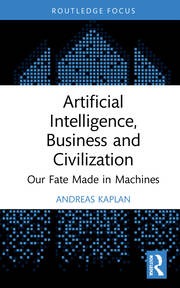
Artificial Intelligence, Business and Civilization : Our Fate Made in Machines
Looks at what exactly artificial intelligence is, how it can be classified, how it differentiates from other concepts such as machine learning, big data, blockchain, or the Internet-of-Things, and how it has evolved and might evolve over time.

Artificial intelligence in theory and practice II : IFIP 20th World Computer Congress, TC 12 : IFIP AI 2008 Stream, September 7-10, 2008, Milano, Italy
The IFIP series publishes state-of-the-art results in the sciences and technologies of information and communication. The principal aim of the IFIP series is to encourage education and the dissemination and exchange of information about all aspects of computing.

Artificial intelligence in theory and practice ; IFIP 19th World Computer Congress, TC 12: IFIP AI 2006 Stream, August 21-24, 2006, Santiago, Chile
The IFIP series publishes state-of-the-art results in the sciences and technologies of information and communication. The scope of the series includes: foundations of computer science; software theory and practice; education; computer applications in technology; communication systems; systems modeling and optimization; information systems; computers and society; computer systems technology; security and protection in information processing systems; artificial intelligence; and human-computer interaction. Proceedings and post-proceedings of referred international conferences in computer science and interdisciplinary fields are featured.

Artificial intelligence in recognition and classification of astrophysical and medical images
This book presents innovative techniques in Recognition and Classification of Astrophysical and Medical Images. The contents include: Introduction to pattern recognition and classification in astrophysical and medical images. Image standardization and enhancement. Region-based methods for pattern recognition in medical and astrophysical images. Advanced information processing using statistical methods. Feature recognition and classification using spectral method

Artificial intelligence in medicine ; 11th Conference on artificial intelligence in medicine in Europe, AIME 2007, Amsterdam, The Netherlands, July 7-11, 2007, Proceedings
This book contains development of theory, systems, and applications of AI in medicine, including the exploitationof AI approachesto molecularmedicine and biomedical informatics.
