



الصفحة 14
الصفحة 14

Computational Intelligence in Multimedia Processing : Recent Advances
This book presents a large number of interesting applications to intelligent multimedia processing of various Computational Intelligence techniques, such as rough sets, Neural Networks; Fuzzy Logic; Evolutionary Computing; Artificial Immune Systems; Swarm Intelligence; Reinforcement Learning and evolutionary computation.

Computational intelligence and bioinspired systems ; 8th International Work-conference on artificial neural networks, IWANN 2005, Vilanova i la Geltrú, Barcelona, Spain, June 8-10, 2005, Proceedings
We present in this volume the collection of finally accepted papers of the eighth edition of the “IWANN” conference (“International Work-Conference on Artificial Neural Networks”). This biennial meeting focuses on the foundations, theory, models and applications of systems inspired by nature (neural networks, fuzzy logic and evolutionary systems). For scientists, engineers and professionals working in the area, this is a very good way to get solid and competitive applications. We are facing a real revolution with the emergence of embedded intelligence in many artificial systems (systems covering diverse fields: industry, domotics, leisure, healthcare, … ). So we are convinced that an enormous amount of work must be, and should be, still done. Many pieces of the puzzle must be built and placed into their proper positions, offering us new and solid theories and models (necessary tools) for the application and praxis of these current paradigms. The above-mentioned concepts were the main reason for the subtitle of the IWANN 2005 edition: “Computational Intelligence and Bioinspired Systems.” papers was addressing the following topics: 1. Mathematical and theoretical methods in computational intelligence.

Computational intelligence : Principles, techniques and applications
The book Computational Intelligence: Principles, Techniques and Applications presents both theories and applications of Computational Intelligence in a clear, precise and highly comprehensive style. The textbook addresses the fundamental aspects of Fuzzy Sets and Logic, Neural Networks, Evolutionary Computing and Belief Networks. The application areas include Fuzzy Databases, Fuzzy Control, Image Understanding, Expert Systems, Object Recognition, Criminal Investigation, Telecommunication Networks and Intelligent Robots. The book contains many numerical examples and homework problems with sufficient hints so that the students can solve them on their own. Emerging areas of Computational Intelligence such as artificial life, particle swarm optimization, artificial immune systems, fuzzy chaos theory, rough sets and granular computing have also been addressed with examples in this book. The book ends with a discussion on a number of open- ended research problems in Computational Intelligence. Graduate students interested to pursue their research in this subject will greatly be benefited with these problems.

Computational intelligence : Methods and techniques
This book focuses on various techniques of computational intelligence, both single ones and those which form hybrid methods. Those techniques are today commonly applied issues of artificial intelligence, e.g. to process speech and natural language, build expert systems and robots.

Computational Geometry : Algorithms and Applications
This introduction to computational geometry focuses on algorithms. Modern insights in computational geometry are used to provide solutions that are both efficient and easy to understand and implement.

Collective Beings
With collective behaviors playing a fundamental role in many scientific and technical disciplines, COLLECTIVE BEINGS focuses its attention on socio-economic applications to be used, the book provides the reader with deep insights into modern conceptual tools of economy based on systemics.

Cognitive Wireless Communication Networks
this book offers a wide range of information on the subject. Topics covered include the fundamental challenges and issues in designing cognitive radio systems to the information-theoretic analysis of such systems, spectrum sensing and co-existence issues, adaptive physical layer protocols and link adaptation techniques for cognitive radio, orthogonal frequency division multiple access (OFDM) and ultra wide band (UWB)-based cognitive radio, different techniques for spectrum access by distributed cognitive radio, cognitive medium access control (MAC) protocols, decentralized learning-based dynamic spectrum access methods as well as macroeconomic models for spectrum management in cognitive radio.

Cognitive Vision ; 4th International Workshop, ICVW 2008, Santorini, Greece, May 12, 2008, Revised Selected Papers
This volume constitutes the post-conference proceedings of the 4th International Cognitive Vision Workshop, ICVW 2008, held in Santorini, Greece, on May 12, 2008.
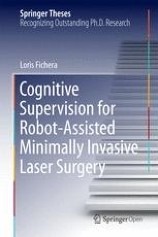
Cognitive Supervision for Robot-Assisted Minimally Invasive Laser Surgery
This thesis lays the groundwork for the automatic supervision of the laser incision process, which aims to complement surgeons’ perception of the state of tissues and enhance their control over laser incisions. The research problem is formulated as the estimation of variables that are representative of the state of tissues during laser cutting. Prior research in this area leveraged numerical computation methods that bear a high computational cost and are not straightforward to use in a surgical setting. This book proposes a novel solution to this problem, using models inspired by the ability of experienced surgeons to perform precise and clean laser cutting. It shows that these new models, which were extracted from experimental data using statistical learning techniques, are straightforward to use in a surgical setup, allowing greater precision in laser-based surgical procedures.
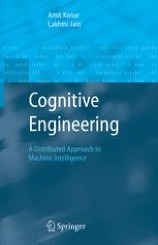
Cognitive engineering : A distributed approach to machine intelligence
Cognitive Engineering: A Distributed Approach to Machine Intelligence explores the design issues of intelligent engineering systems. Beginning with the foundations of psychological modeling of the human mind, the main emphasis is given to parallel and distributed realization of intelligent models for application in reasoning, learning, planning and multi-agent co-ordination problems. The last two chapters provide case studies on human-mood detection and control, and behavioral co-operation of mobile robots. This is the first comprehensive text of its kind, bridging the gap between Cognitive Science and Cognitive Systems Engineering. Each chapter includes plenty of numerical examples and exercises with sufficient hints, so that the reader can solve the exercises on their own. Computer simulations are also included in most chapters to give a clear idea about the application of the algorithms undertaken in the book. In addition, mathematical analysis on convergence and stability of the neuro-fuzzy models will enable the reader to pursue their research career in cognitive engineering.

Code : The Hidden Language of Computer Hardware and Software ; 2nd ed
The classic guide to how computers work, updated with new chapters and interactive graphics Computers are everywhere --- most obviously in our laptops and smartphones, but also our cars, televisions, microwave ovens, alarm clocks, robot vacuum cleaners, and other smart appliances. Have you ever wondered what goes on inside these devices to make our lives easier but occasionally more infuriating? Explores more deeply the bit-by-bit, gate-by-gate construction of the heart of every smart device ― the central processing unit that combines the simplest of basic operations to perform the most complex of feats. Along with new chapters, Petzold created a new website, CodeHiddenLanguage.com, that uses animated interactive graphics to make computers even easier to comprehend.

Manufacturing Systems Control Design : A Matrix-based Approach
The matrix-based approach presented here is a solution to the real-time application of control in discrete event systems and flexible manufacturing systems (FMS), and offers a sound practical basis for the design of controllers for manufacturing systems.

Manufacturing Systems and Technologies for the New Frontier ; The 41st CIRP Conference on Manufacturing Systems May 26–28, 2008, Tokyo, Japan
Manufacturing systems and technology stand on a new frontier, facing up to the challenges posed by the ever-evolving requirements of global sustainability. Value-creation is taking its place alongside more traditional production-process priorities. Collected here are over a hundred papers concerned with all manner of new directions in manufacturing systems and given at the 41st CIRP Conference on Manufacturing Systems. The high-quality material presented in this volume includes reports of work from both scientific and engineering standpoints and several invited and keynote papers addressing the current cutting edge and likely future trends in manufacturing systems.
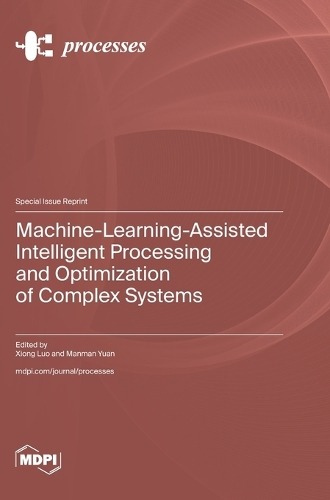
Machine-learning-assisted intelligent processing and optimization of complex systems
Focuses on the most recent developments in intelligent optimization methods and their applications in various test cases. The reprint covers various topics, including distributed multiagent modeling, metaheuristic algorithms, multisource data fusion, mobile computing and mobile sensing, machine learning-based intelligent processing for modeling complex manufacturing systems, and data-driven intelligent modeling
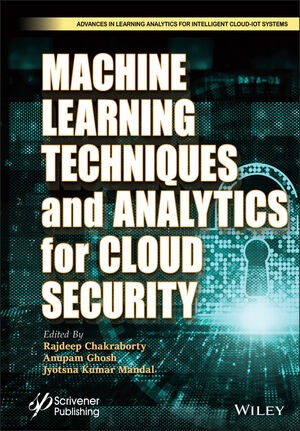
Machine Learning Techniques and Analytics for Cloud Security
covers new methods, surveys, case studies, and policy with almost all machine learning techniques and analytics for cloud security solutions
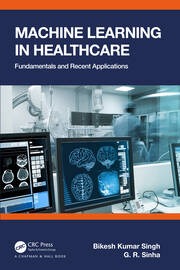
Machine learning in healthcare : Fundamentals and recent applications
Discusses how to build various ML algorithms and how they can be applied to improve healthcare systems. Healthcare applications of AI are innumerable: medical data analysis, early detection and diagnosis of disease, providing objective-based evidence to reduce human errors, curtailing inter- and intra-observer errors, risk identification and interventions for healthcare management, real-time health monitoring, assisting clinicians and patients for selecting appropriate medications, and evaluating drug responses. Extensive demonstrations and discussion on the various principles of machine learning and its application in healthcare is provided, along with solved examples and exercises.
Machine Learning for Cyber Physical Systems : Selected papers from the International Conference ML4CPS 2020
Presents new approaches to Machine Learning for Cyber Physical Systems, experiences and visions. It contains selected papers from the fifth international Conference ML4CPS – Machine Learning for Cyber Physical Systems, which was held in Berlin, March 12-13, 2020.

Machine Learning for Cyber Physical Systems : Selected papers from the International Conference ML4CPS 2018
Presents new approaches to Machine Learning for Cyber Physical Systems, experiences and visions. Cyber Physical Systems are characterized by their ability to adapt and to learn: They analyze their environment and, based on observations, they learn patterns, correlations and predictive models. Typical applications are condition monitoring, predictive maintenance, image processing and diagnosis. Machine Learning is the key technology for these developments.
Machine Learning and Robot Perception
Presents some of the most recent research results in the area of machine learning and robot perception. The chapters represent new ways of solving real-world problems. This book will appeal to researchers, senior undergraduate/postgraduate students, application engineers and scientists.
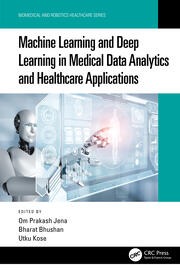
Machine learning and deep learning in medical data analytics and healthcare applications
Introduces and explores a variety of schemes designed to empower, enhance, and represent multi-institutional and multi-disciplinary machine learning (ML) and deep learning (DL) research in healthcare paradigms. Serving as a unique compendium of existing and emerging ML/DL paradigms for the healthcare sector, this book demonstrates the depth, breadth, complexity, and diversity of this multi-disciplinary area. It provides a comprehensive overview of ML/DL algorithms and explores the related use cases in enterprises such as computer-aided medical diagnostics, drug discovery and development, medical imaging, automation, robotic surgery, electronic smart records creation, outbreak prediction, medical image analysis, and radiation treatments.
