



الصفحة 14
الصفحة 14
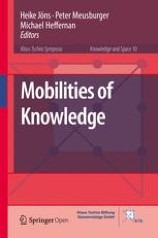
Mobilities of Knowledge
This collection of essays examines how spatial mobilities of people and practices, technologies and objects, knowledge and ideas have shaped the production, circulation, and transfer of knowledge in different historical and geographical contexts. Targeting an interdisciplinary audience, Mobilities of Knowledge combines detailed empirical analyses with innovative conceptual approaches. The first part scrutinizes knowledge circulation, transfer, and adaption, focussing on the interpersonal communication process, early techniques of papermaking, a geographical text, indigenous knowledge in exploration, the genealogy of spatial analysis, and different disciplinary knowledges about the formation of cities, states, and agriculture.

Mobile Wireless Middleware, Operating Systems and Applications ; 9th EAI International Conference, MOBILWARE 2020, Hohhot, China, July 11, 2020, Proceedings
This book constitutes the refereed conference proceedings of the 9th International Conference on Mobile Wireless Middleware, Operating Systems and Applications, MOBILWARE 2020, held in Hohhot, China, in July 2020. Due to COVID-19 pandemic the conference was held virtually. The 21 revised full papers were reviewed and selected from 69 submissions and are organized in tracks on MobilWare; Big data, data mining and artificial intelligence workshop; Blockchain and internet of things workshop.

Mobile Service Innovation and Business Models
Modern economies depend on innovation in services for their future growth. Service innovation increasingly depends on information technology and digitization of information processes. Designing new services is a complex matter, since collaboration with other companies and organizations is necessary. Service innovation is directly related to business models that support these services, i.e. services can only be successful in the long run with a viable business model that creates value for its customers and providers. This book presents a theoretically grounded yet practical approach to designing viable business models for electronic services, including mobile ones, i.e. the STOF model and – based on it – the STOF method. The STOF model provides a ‘holistic’ view on business models with four interrelated perspectives, i.e., Service, Technology, Organization and Finance. It elaborates on critical design issues that ultimately shape the business model and drive its viability.

Mobile Information Systems II ; IFIP Working Conference on Mobile Information Systems, MOBIS 2005, Leeds, UK, December 6-7, 2005
Contains the proceedings of the second IFIP TC8 Working Conference on Mobile Information Systems which was held in December 2005 in Leeds, UK and sponsored by the International Federation of Information Processing (IFIP). Mobile Information Systems II aims to: · Clarify differences and similarities between the development of mobile and more traditional information systems. · Investigate the organizational impact of mobile information systems. · Investigate the 'e to m shift' , for example in m-Commerce relative to e-Commerce. · Investigate mobile commerce applications combined with the advantages of mobile communications technologies, the drivers of which have been identified as ubiquity, accessibility, security, convenience, localization, instant connectivity, and personalization. · Evaluate existing and newly developed approaches for the analysis, design, implementation, and evolution of mobile information systems. · Investigate technical issues and the constraints they impose on mobile information systems functionalities and design.
Mobile Information Systems ; Vol. 158 : IFIP TC 8 Working Conference on Mobile Information Systems (MOBIS) 15-17 September 2004, Oslo, Norway
This book contains the proceedings of the IFIP TC8 Working Conference on Mobile Information Systems, which was held in September 2004 in Oslo, Norway and sponsored by the International Federation for Information Processing (IFIP). Mobile Information Systems aims to: Clarify differences and similarities between the development of mobile vs. more traditional information system. Investigate the organizational impact of mobile information systems Investigate mCommerce relative to eCommerce Investigate mobile commerce applications combined with the advantages of mobile communications technologies, the drivers of which have been identified as ubiquity, reachability, security, convenience, localization, instant connectivity and personalization. Evaluate existing and newly developed approaches for analysis, design, implementation, and evolution of mobile information systems. Investigate technical issues and the constraints they pose on mobile information systems functionalities and design

Mobile computing, applications, and services ; 11th EAI International Conference, MobiCASE 2020, Shanghai, China, September 12, 2020, Proceedings
This book constitutes the thoroughly refereed post-conference proceedings of the 11th International Conference on Mobile Computing, Applications, and Services, MobiCASE 2020, held in Shanghai, China, in September 2020. The conference was held virtually due to the COVID-19 pandemic. The 15 full papers were carefully reviewed and selected from 49 submissions. The papers are organized in topical sections on mobile application and framework; mobile application with data analysis; and AI application.
Mobile and Wireless Communications Networks ; IFIP TC6 / WG6.8 Conference on Mobile and Wireless Communication Networks (MWCN 2004) October 25-27, 2004 Paris, France
Mobile Ad hoc NETworks (MANETs) has attracted great research interest in recent years. A Mobile Ad Hoc Network is a self-organizing multi-hop wireless network where all hosts (often called nodes) participate in the routing and data forwarding process. The dependence on nodes to relay data packets for others makes mobile ad hoc networks extremely susceptible to various malicious and selfish behaviors. This point is largely overlooked during the early stage of MANET research. Many works simply assume nodes are inherently cooperative and benign. However, experiences from the wired world manifest that the reverse is usually true; and many works [3] [10] [9] [8] [12] [19] have pointed out that the impact of malicious and selfish users must be carefully investigated. The goal of this research is to address the cooperation problem and related security issues in wireless ad hoc networks. As a rule of thumb, it is more desirable to include security mechanisms in the design phase rather than continually patching the system for security breaches. As pointed out in [2] [1], there can be both selfish and malicious nodes in a mobile ad hoc network. Selfish nodes are most concerned about their energy consumption and intentionally drop packets to save power. The purpose of malicious nodes, on the other hand, is to attack the network using various intrusive techniques. In general, nodes in an ad hoc network can exhibit Byzantine behaviors.

Mobile and Wireless Communication Networks; IFIP 19th World Computer Congress, TC-6, 8th IFIP/IEEE Conference on Mobile and Wireless Communications Networks, August 20-25, 2006, Santiago, Chile
International Federation for Information Processing The IFIP series publishes state-of-the-art results in the sciences and technologies of information and communication. The scope of the series includes: foundations of computer science; software theory and practice; education; computer applications in technology; communication systems; systems modeling and optimization; information systems; computers and society; computer systems technology; security and protection in information processing systems; artificial intelligence; and human-computer interaction. Proceedings and post-proceedings of referred international conferences in computer science and interdisciplinary fields are featured. These results often precede journal publication and represent the most current research. The principal aim of the IFIP series is to encourage education and the dissemination and exchange of information about all aspects of computing.

Mobile Ad-hoc and Sensor Networks ; Vol. 4325 ; 2nd International Conference, MSN 2006, Hong Kong, China, December 13-15, 2006, Proceedings
This book constitutes the refereed proceedings of the Second International Conference on Mobile Ad-hoc and Sensor Networks, MSN 2006, held in Hong Kong, China in December 2006. The 73 revised full papers address all current issues in mobile ad hoc and sensor networks and are organized in topical sections on routing, network protocols, security, energy efficiency, data processing, and deployment.

mm-Wave Silicon Technology : 60 GHz and Beyond
mm-Wave Silicon Technology: 60GHz and Beyond covers silicon-based millimeter wave circuits and systems. It provides in depth coverage of advanced silicon processing technologies including CMOS and SiGe as well as modeling of active and passive devices on silicon at millimeter waves. It also provides coverage of mm-wave circuit building blocks such as low noise amplifiers, mixers, voltage controlled oscillators, frequency dividers, and power amplifiers that are suitable for integration in silicon. The book contains information on highly integrated mm-wave transceiver architectures with several silicon-based case studies. The book also includes advanced topics such as antenna arrays and beam-forming on silicon.

Mixture Formation in Internal Combustion Engines
This book covers the various approaches to modelling and optimising the spray and mixture formation processes in modern internal combustion engines. Due to their complexity and importance in predicting the temporal and spatial distribution of liquid and gaseous fuel inside the cylinder, special emphasis is put on the detailed description of multi-dimensional CFD-models. The book describes and discusses the most widely used mathematical models for in-cylinder spray and mixture formation processes.
Mission AI: the new system technology
Offers a strategic perspective on AI and the process of embedding it in society. After decades of research, Artificial Intelligence (AI) is now entering society at large. Due to its general purpose character, AI will change society in multiple, fundamental and unpredictable ways. Therefore, the Netherlands Scientific Council for Government Policy (WRR) characterizes AI as a system technology: a rare type of technologies that have a systemic impact on society. Earlier system technologies include electricity, the combustion engine and the computer. The history of these technologies provides us with useful insights about what it takes to direct the introduction of AI in society.

Misch's Contemporary Implant Dentistry
Uses a multidisciplinary approach to cover the industry’s most current processes and surgical procedures. The new edition of this text continues to provide comprehensive, state-of-the-art information on the science and discipline of contemporary implant dentistry. Covering the breadth of dental implant surgery, it includes full-color, in-depth coverage of both simple and complicated clinical cases, with practical guidance on how to apply the latest research, diagnostic tools, treatment planning, implant designs, and materials.

Mineral Deposit Research : Meeting the Global Challenge ; Proceedings of the Eighth Biennial SGA Meeting, Beijing, China, 18 - 21 August 2005
Represents a comprehensive summary of the developments across a range of subject matters that are relevant to the global research, mining and exploration community. This proceedings volume (including CD-ROM) is a compilation of approximately 400 extended abstracts (up to 4 pages long) of presentations given at the 8th Biennial SGA Meeting.

Mind conversation = التنبؤ بالحروف العربية من خلال الإشارات الدماغية
Throughout history, humans have long dreamed of understanding what goes on inside the human mind—what people are thinking or feeling. It seemed like something from a far-off future or a magical realm. But now, thanks to amazing technology called EEG and BCI, this dream is turning into reality. EEG stands for electroencephalography. It's a way of listening to what the brain is up to by placing small sensors on or near the head. These sensors pick up tiny electrical signals produced by the brain's activity. It's like eavesdropping on the brain's conversations with itself. BCI, or Brain-Computer Interface, is like a bridge between the brain and machines. It lets the brain talk to devices or computers. This means people can control things without using their hands or voices. Our system takes advantage of EEG and BCI to create something helpful, a special mobile app. This app is designed for people who can't move their bodies, like those who are paralyzed. It helps them use their phones to express what they are thinking about.

Mid-Infrared Coherent Sources and Applications
Coherent sources of mid-infrared (mid-IR) radiation are of great interest for a wide range of scienti?c and technological applications from spectroscopy and frequency metrology to information technology, industrial process control, pho- chemistry, photobiology and photomedicine. The mid-IR spectrum, which may be de?ned as wavelengths beyond ?2µm, covers important atmospheric windows, and numerous molecular gases, toxic agents, air, water, and soil pollutants, c- ponents of human breath, and several explosive agents have strong absorption ?ngerprints in this region. The development of practical coherent solid-state sources in the mid-IR can thus provide indispensable tools for a variety of - plications in environmental monitoring and pollution control, detection of water and soil contaminants, food quality control, agriculture and life sciences, and n- invasive disease diagnosis and therapy through breath analysis.

Microwave Engineering : Concepts and Fundamentals
Covers everything from wave propagation to reflection and refraction, guided waves, and transmission lines, providing a comprehensive understanding of the underlying principles at the core of microwave engineering. This encyclopedic text not only encompasses nearly all facets of microwave engineering, but also gives all topics—including microwave generation, measurement, and processing—equal emphasis. Packed with illustrations to aid in comprehension. Describes the mathematical theory of waveguides and ferrite devices, devoting an entire chapter to the Smith chart and its applications Discusses different types of microwave components, antennas, tubes, transistors, diodes, and parametric devices Examines various attributes of cavity resonators, semiconductor and RF/microwave devices, and microwave integrated circuits

Microstructuring of Glasses
As microstructured glass becomes increasingly important for microsystems technology, the main application fields include micro-fluidic systems, micro-analysis systems, sensors, micro-actuators and implants. And, because glass has quite distinct properties from silicon, PMMA and metals, applications exist where only glass devices meet the requirements. The main advantages of glass derive from its amorphous nature, the precondition for its - theoretically - direction-independent geometric structurability. Microstructuring of Glasses deals with the amorphous state, various glass compositions and their properties, the interactions between glasses and the electromagnetic waves used to modify it.

Microsoft .NET framework 2.0 web-based client development : MCTS self-paced training Kit (Exam 70-528)
Designed to help you make the most of your study time. Maximize your performance on the exam by learning to: * Create, trace, configure, and deploy Web applications * Integrate data into your application using Microsoft ADO.NET, XML, and data-bound controls * Implement forms authentication, impersonation, and login controls * Configure server controls and create custom Web controls * Use themes, user profiles, and Web parts for customizable, personalized Web sites * Manage server-side and client-side application state PRACTICE TESTS Assess your skills with practice tests on CD. You can work through hundreds of questions using multiple testing modes to meet your specific learning needs. You get detailed explanations for right and wrong answers?including a customized learning path that describes how and where to focus your studies. Your kit includes: * Official self-paced study guide. * Practice tests with multiple, customizable testing options and a learning plan based on your results. *400+ practice and review questions. * Case scenarios and lab exercises. * Microsoft Visual Basic and Visual C# code samples on CD.

Microservices : Science and Engineering
This book describes in contributions by scientists and practitioners the development of scientific concepts, technologies, engineering techniques and tools for a service-based society. The focus is on microservices, i.e cohesive, independent processes deployed in isolation and equipped with dedicated memory persistence tools, which interact via messages.
