



الصفحة 14
الصفحة 14

Corporate financial accounting
This book clearly presents core financial accounting concepts within a meaningful business context, using engaging learning features that ensure a relevant, innovative learning experience. Updated content addresses the latest development and tools in corporate accounting today -- from using data analytics effectively to understanding the impact of discounts and sales in retail accounting. CNOWv2 online resources work with practice opportunities to ensure you understand and can apply key accounting principles.

Cooperative tool
Online collaboration is fast becoming a permanent feature of the modern workplace. Companies and organizations are attracted by the cost-effective technology allowing employees to work together anywhere, at any time using any internet-enabled device. Online collaboration gives team members the tools they need to work with others from any location, including from home and while travelling. This drastically reduces “downtime” and allows people to be productive when it best suits them therefore we propose a website that provides content (videoconference, real-time Chat, whiteboard).

Cooperative stochastic differential games
Numerical Optimization presents a comprehensive and up-to-date description of the most effective methods in continuous optimization. It responds to the growing interest in optimization in engineering, science, and business by focusing on the methods that are best suited to practical problems. There are new chapters on nonlinear interior methods and derivative-free methods for optimization, both of which are used widely in practice and the focus of much current research. Because of the emphasis on practical methods, as well as the extensive illustrations and exercises.

Convergence and Applications of Newton-type Iterations
Recent results in local convergence and semi-local convergence analysis constitute a natural framework for the theoretical study of iterative methods. This monograph provides a comprehensive study of both basic theory and new results in the area. Each chapter contains new theoretical results and important applications in engineering, modeling dynamic economic systems, input-output systems, optimization problems, and nonlinear and linear differential equations. Several classes of operators are considered, including operators without Lipschitz continuous derivatives, operators with high order derivatives, and analytic operators. Each section is self-contained. Examples are used to illustrate the theory and exercises are included at the end of each chapter.

Converged communications : Evolution from telephony to 5G mobile internet
The central theme of the book is to build deeper understanding about incremental technological progress by introducing both state of the art and their predecessor technologies. The book explores four main areas, including fixed telephone systems, data communication systems, mobile cellular systems, and IP multimedia systems. It clearly explains architectures, protocols, and functional procedures, and discusses a variety of topics ranging from physical layer processes to system level interactions. Converged Communications offers: In-depth treatments of fixed telephone and transmission systems, including operation of telephone exchanges and signaling systems Comprehensive explorations of data communication systems, including transmission of data over telephone lines and data network technologies, such as Ethernet and TCP/IP Incisive discussions of mobile cellular systems, including GSM, 3G, LTE, VoLTE and 5G Insightful analysis of incremental system evolution to justify various design choices made The book is supported with extensive online appendices, which covers communication system concepts, an overview of standardization, various technologies used in the past, state-of-the art technologies such as WLAN, cable modems, and FTTx, complementing the other systems described in the book which have evolved from the fixed telephone network.

Controlled Markov Processes and Viscosity Solutions
This book is intended as an introduction to optimal stochastic control for continuous time Markov processes and to the theory of viscosity solutions. Stochastic control problems are treated using the dynamic programming approach. It approachs stochastic control problems by the method of dynamic programming. The fundamental equation of dynamic programming is a nonlinear evolution equation for the value function. For controlled Markov diffusion processes, this becomes a nonlinear partial differential equation of second order, called a Hamilton-Jacobi-Bellman (HJB) equation. Typically, the value function is not smooth enough to satisfy the HJB equation in a classical sense. Viscosity solutions provide framework in which to study HJB equations, and to prove continuous dependence of solutions on problem data. The theory is illustrated by applications from engineering, management science, and financial economics.

Control Theory Tutorial : Basic Concepts Illustrated by Software Examples
Introduces the basic principles of control theory in a concise self-study guide. It complements the classic texts by emphasizing the simple conceptual unity of the subject. A novice can quickly see how and why the different parts fit together. The concepts build slowly and naturally one after another, until the reader soon has a view of the whole. Each concept is illustrated by detailed examples and graphics. The full software code for each example is available, providing the basis for experimenting with various assumptions, learning how to write programs for control analysis, and setting the stage for future research projects. The topics focus on robustness, design trade-offs, and optimality. Most of the book develops classical linear theory. The last part of the book considers robustness with respect to nonlinearity and explicitly nonlinear extensions, as well as advanced topics such as adaptive control and model predictive control.

Control of Sandwich Nonlinear Systems Authors
This unique monograph introduces an important new area of control system research and presents some new methods for solving some typical problems in the field of sandwich nonlinear systems. Sandwiched nonsmooth nonlinearities such as dead-zone, hysteresis and backlash between dynamic blocks are presented, as well as continuous-time control designs. A framework for hybrid control is developed that is used to design control schemes for different cases of the control problem with required modifications. Friction compensation is addressed for systems with sandwiched friction along with sandwiched dynamics. An open problem of the control of sandwich nonlinear systems with actuator failures is introduced by a control design for an illustrative case.
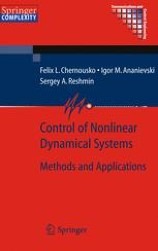
Control of Nonlinear Dynamical Systems : Methods and Applications
This book is devoted to new methods of control for complex dynamical systems and deals with nonlinear control systems having several degrees of freedom, subjected to unknown disturbances, and containing uncertain parameters. Various constraints are imposed on control inputs and state variables or their combinations. The book contains an introduction to the theory of optimal control and the theory of stability of motion, and also a description of some known methods based on these theories.

Control of nonlinear and hybrid process systems : Designs for uncertainty, constraints and time-delays
The book includes many detailed examples which can be easily modified by a control engineer to be tailored to a specific application. This book is useful for researchers in control systems theory, graduate students pursuing their degree in control systems and control engineers.

Control Design Techniques in Power Electronics Devices
The book is introduced through the very important topic of modeling switched power electronics as controlled dynamical systems. Detailed circuit layouts, schematics and actual closed-loop control responses from a representative group of the plants under discussion and generated by applying the theory are included. The control theories which feature in the book are: sliding mode control and feedback control by means of approximate linearization (linear state feedback, static and dynamic proportional-integral-differential (PID control), output feedback trough observer design, Lyapunov-based control and passivity-based control). Nonlinear control design methods represented include: exact feedback linearization, input-output linearization, differential flatness, generalized PID control and, again, passivity-based control.

Control and Observer Design for Nonlinear Finite and Infinite Dimensional Systems
This volume presents a well balanced combination of state-of-the-art theoretical results in the field of nonlinear controller and observer design, combined with industrial applications stemming from mechatronics, electrical, (bio–) chemical engineering, and fluid dynamics. The unique combination of results of finite as well as infinite–dimensional systems makes this book a remarkable contribution addressing postgraduates, researchers, and engineers both at universities and in industry. The contributions to this book were presented at the Symposium on Nonlinear Control and Observer Design: From Theory to Applications (SYNCOD), held September 15–16, 2005, at the University of Stuttgart, Germany.

Contributions to Nonlinear Analysis : A Tribute to D.G. de Figueiredo on the Occasion of his 70th Birthday
This volume represents a broad survey of current research in the fields of nonlinear analysis and nonlinear differential equations.It is concerned with the existence and uniform decay rates of solutions of the waveequation with a sourceterm and subject to nonlinear boundary damping.

Continuous-Time Systems
The book systematically covers major foundations of the systems theory. First, the quantitative and qualitative methods of systems description are presented along with the stability analysis. The representation of linear time-invariant systems in the time domain is provided using the convolution, ordinarily differential equations (ODEs), and state space. In the frequency domain, these systems are analyzed using the Fourier and Laplace transforms. The linear time-varying systems are represented using the general convolution, ODEs, and state space. The nonlinear time-invariant systems are described employing the Taylor and Volterra series expansions, ODEs, state space, and approximate methods such as averaging, equivalent linearization, and describing function. Finally, the representation of nonlinear time-varying systems is given using the Taylor and Volterra series, ODEs, modulation functions method, and state space modelling.

Continuous Optimization : Current Trends and Modern Applications
The search for the best possible performance is inherent in human nature. Individuals, enterprises and governments all seek optimal—that is, the best—possible solutions of problems that they meet. Evidently, continuous optimization plays an increasingly significant role in everyday management and technical decisions in science, engineering and commerce. The collection of 16 refereed papers in this book covers a diverse number of topics and provides a good picture of recent research in continuous optimization. The first part of the book presents substantive survey articles in a number of important topic areas of continuous optimization. Most of the papers in the second part present results on the theoretical aspects as well as numerical methods of continuous optimization. The papers in the third part are mainly concerned with applications of continuous optimization.

Conceptual Modeling of Information Systems
When designing an information system, conceptual modeling is the activity that elicits and describes the general knowledge the system needs to know. This description, called the conceptual schema, is necessary in order to develop an information system.textbook explains in detail the principles of conceptual modeling independently from particular methods and languages and shows how to apply them in real-world projects. It covers all aspects of the engineering process from structural modeling over behavioral modeling to meta-modeling, and completes the presentation with an extensive case study based on the osCommerce system, an online store-management software program freely available under the GNU General Public License. His presentation is based on well-known industry standards like UML and OCL as a particular conceptual modeling language, yet also delivers the basics of the formal logical language background.

Computer supported cooperative work and social computing ; 15th CCF Conference, ChineseCSCW 2020, Shenzhen, China, November 7–9, 2020, Revised Selected Papers
This book constitutes the refereed post-conference proceedings of the 15th CCF Conference on Computer Supported Cooperative Work and Social Computing, ChineseCSCW 2020, held in Shenzhen, China, in November 2020. The 40 revised full papers and 15 revised short papers were carefully reviewed and selected from 137 submissions. The papers of this volume are organized in topical sections on: crowdsourcing, crowd intelligence, and crowd cooperative computing; domain-specific collaborative applications; collaborative mechanisms, models, approaches, algorithms, and systems; social media and online communities; and short papers.

Computational Mind : A Complex Dynamics Perspective
Computational Mind: A Complex Dynamics Perspective is a graduate–level monographic textbook in the field of Computational Intelligence. It presents a modern dynamical theory of the computational mind, combining cognitive psychology, artificial and computational intelligence, and chaos theory with quantum consciousness and computation. The book introduces to human and computational mind, comparing and contrasting main themes of cognitive psychology, artificial and computational intelligence. It presents brain/mind dynamics from the chaos theory perspective, including sections on chaos in human EEG, basics of nonlinear dynamics and chaos, techniques of chaos control, synchronization in chaotic systems and complexity in humanoid robots. This book presents modern theory of quantum computational mind, including sections on Dirac–Feynman quantum dynamics, quantum consciousness, and quantum computation using Josephson junctions. The book is designed as a one–semester course for computer scientists, engineers, physicists and applied mathematicians, both in industry and academia. It includes a strong bibliography on the subject and detailed index.

Computational Mechanics of the Classical Guitar
This book performs a state-of-the-art finite-difference calculation of the complete geometry of the classical guitar as a time-stepping application. It provides insight into the overall behaviour as well as the finite structure mechanisms of this musical instrument. Fundamental problems of coupling, nonlinearities, noise or time reversion, complex modelling solutions, and modern signal processing tools are discussed. Also musicologists, musicians or instrument builders can find explanations and may also be inspired by aspects of musical timbre, the sounding and time-dependent qualities of the different guitar parts. The work helps to suggest new geometrical and timbral solutions in modern guitar performance.

Combinatorial optimization and applications ; 14th International Conference, COCOA 2020, Dallas, TX, USA, December 11–13, 2020, Proceedings
This volume constitutes the proceedings of the 14th International Conference on Combinatorial Optimization and Applications, COCOA 2020, held in Dallas, TX, USA, in December 2020. The 55 full papers presented in this volume were carefully reviewed and selected from 104 submissions. The papers are grouped into the following topics: Approximation Algorithms; Scheduling; Network Optimization; Complexity and Logic; Search, Facility and Graphs; Geometric Problem; Sensors, Vehicles and Graphs; and Graph Problems.
