



الصفحة 14
الصفحة 14

Foundations of information and knowledge systems ; 5th International Symposium, FoIKS 2008, Pisa, Italy, February 11-15, 2008. Proceedings
This book constitutes the refereed proceedings of the 5th International Symposium on Foundations of Information and Knowledge Systems, FoIKS 2008 held in Pisa, Italy, in February 2008. The 13 revised full papers presented together with 9 revised short papers and 3 invited lectures were carefully selected during two rounds of reviewing and improvement from from 79 submissions. The papers deal with any foundational aspect of information and knowledge systems, including submissions from researchers working in fields such as discrete mathematics, logic and algebra, model theory, information theory, complexity theory, algorithmics and computation, geometry, analysis, statistics and optimisation who are interested in applying their ideas, theories and methods to research on information and knowledge systems.

Foundations of Hyperbolic Manifolds
The book is divided into three parts. The first part is concerned with hyperbolic geometry and discrete groups. The main results are the characterization of hyperbolic reflection groups and Euclidean crystallographic groups. The second part is devoted to the theory of hyperbolic manifolds. The main results are Mostow’s rigidity theorem and the determination of the global geometry of hyperbolic manifolds of finite volume. The third part integrates the first two parts in a development of the theory of hyperbolic orbifolds. The main result is Poincare«s fundamental polyhedron theorem.

Foundations of C++/CLI : The Visual C++ Language for .NET 3.5
Foundations of C++/CLI: The Visual C++ Language for .NET 3.5 introduces C++/CLI, Microsoft's extensions to the C++ syntax that allow you to target the common language runtime, the key to the heart of the .NET Framework 3.5. This book gives you a small, fast–paced primer that will kick–start your journey into the world of C++/CLI. In 13 no–fluff chapters, Microsoft insiders take readers into the core of the C++/CLI language and explain both how the language elements work and how Microsoft intends them to be used. This book is a beginner's guide, but it assumes a familiarity with programming basics. And it concentrates on explaining the aspects of C++/CLI that make it the most powerful and fun language of the .NET Framework. As such, this book is ideal if you're thinking of migrating to C++/CLI from another language.
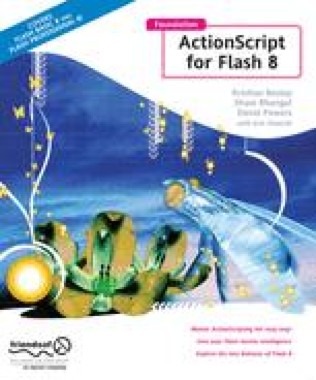
Foundation ActionScript for Flash 8
This book contains all you need to understand and make use of ActionScript, and to have some fun while learning. The Foundation series teaching style is ideal if you're a non-programmer who wants to learn Flash programming quickly and thoroughly. The authors teach the basics, and provide an all-around proficiency in ActionScript, as well as Flash components within Flash 8. You'll gain the practical skills to build ActionScript based Flash projects, including making initial design decisions, structuring code, and testing. An ongoing case study means that by the end of the book, you'll have constructed a cutting-edge Flash site to showcase your newly learned skills.
Formal Methods for Open Object-Based Distributed Systems ; Vol. 3535 ; 7th IFIP WG 6.1 International Conference, FMOODS 2005, Athens, Greece, June 15-17, 2005, Proceedings
This volume contains the proceedings of FMOODS2005, the 7th IFIPWG6. 1 International Conference on Formal Methods for Open Object-Based Distributed Systems. The conference was held in Athens, Greece on June 15-17, 2005. The eventwasthe seventh meeting ofthis conference series, whichis held roughly every year and a half, with the earlier events held respectively in Paris, Canterbury, Florence, Stanford, Twente, and Paris. The goal of the FMOOD Sseries of conferences is to bring together researchers whose work encompasses three important and related fields: - formal methods; - distributed systems; - object-based technology. Sucha convergenceis representative of recent advances in the field of distributed systems, and provides links between several scientific and technological communities, as represented by the conferences FORTE, CONCUR, and ECOOP. The objective of FMOODS is to provide an integrated forum for the pres- tation of research in the above-mentioned fields, and the exchange of ideas and experiences in the topics concerned with the formal methods support for open object-based distributed systems.
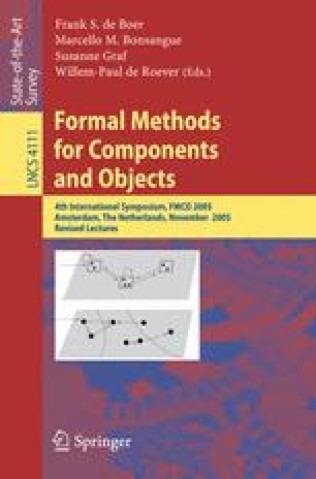
Formal Methods for Components and Objects ; Vol. 4111 ; 4th International Symposium, FMCO 2005, Amsterdam, The Netherlands, November 1-4, 2005, Revised Lectures
This book presents 19 revised invited keynote lectures and revised tutorial lectures given by top-researchers at the 4th International Symposium on Formal Methods for Components and Objects, FMCO 2005, held in Amsterdam, Netherlands, in November 2005. The book provides a unique combination of ideas on software engineering and formal methods that reflect the current interest in the application or development of formal methods for large scale software systems such as component-based systems and object systems.
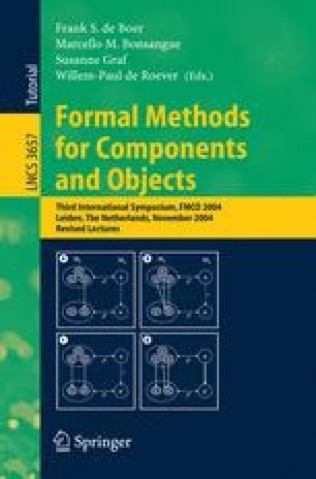
Formal Methods for Components and Objects ; Vol. 3657 ; 3rd International Symposium, FMCO 2004, Leiden, The Netherlands, November 2-5, 2004, Revised Lectures
This book presents revised tutorial lectures given by invited speakers at the Third International Symposium on Formal Methods for Components and Objects, FMCO 2004, held in Leiden, The Netherlands, in November 2004. The 14 revised lectures by leading researchers present a comprehensive account of the potential of formal methods applied to large and complex software systems such as component-based systems and object systems. The book provides an unique combination of ideas on software engineering and formal methods that reflect the expanding body of knowledge on modern software systems.

Formal Methods for Components and Objects ; 5th International Symposium, FMCO 2006, Amsterdam, Netherlands, November 7-10,2006, Revised Lectures
The book provides a unique combination of ideas on software engineering and formal methods that reflect the current interest in the application or development of formal methods for large scale software systems.

Form and structure in Interior Architecture : Basics interior architecture
This volume examines the basic ideas that underpin the design and remodelling of interior space, from the establishment of a relationship between the existing building and the new components that inhabit it, to the careful positioning and design of significant elements within the space

Forest Inventory : Methodology and Applications
This book has been developed as a forest inventory textbook for students and can also serve as a handbook for practical foresters. The book is divided into four sections. The first section deals mostly with sampling issues. First, we present the basic sampling designs at a fairly non-technical mathematical level. In addition, we present some more advanced sampling issues often needed in forest inventory. Those include for instance problems with systematic sampling, and methods for sampling vegetation or rare populations. Forest inventory also includes issues that are unique to forestry, like problems in measuring sample plots in the field, or utilising sample tree measurements. These issues include highly sophisticated methodology, but we try to present these also such that forestry students can grasp the ideas behind them. Each method is presented with examples. For foresters who need more details, references are given to more advanced scientific papers and books in the fields of statistics and biometrics.

Forensic Psychiatry : Influences of Evil
In Forensic Psychiatry: Influences of Evil, Tom Mason brings together an international panel of experts from diverse specialties to examine the idea of "evil" in a medical context, specifically a mental health setting, to consider how the concept can be usefully interpreted, and to elucidate its relationship to forensic psychiatry. The authors challenge the belief that the concept of "evil" plays no role in "scientific" psychiatry and is not helpful to our understanding of aberrant human thinking and behavior.

Food addiction
This approach acknowledges the apparent parallels between substance use disorders and overeating of highly palatable, high-caloric foods. Although this idea seems to be relatively new, research on food addiction actually encompasses several decades, a fact that often remains unrecognized. Scientific use of the term addiction in reference to chocolate even dates back to the 19th century. In the 20th century, food addiction research underwent several paradigm shifts, which include changing foci on anorexia nervosa, bulimia nervosa, obesity, or binge eating disorder. Thus, the purpose of this review is to describe the history and state of the art of food addiction research and to demonstrate its development and refinement of definitions and methodologies

Fluent Python : Clear, Concise, and Effective Programming
You’ll learn how to write effective, modern Python 3 code by leveraging its best ideas. Don’t waste time bending Python to fit patterns you learned in other languages. Discover and apply idiomatic Python 3 features beyond your past experience. Author Luciano Ramalho guides you through Python’s core language features and libraries and teaches you how to make your code shorter, faster, and more readable.

Flow Shop Lot Streaming Problems
Lot streaming is a process of breaking a batch of jobs into smaller lots, and then processing these in an overlapping fashion on the machines. This important concept can significantly improve the overall performance of a production process, and thereby make the operation of a manufacturing system lean. Flow Shop Lot Streaming introduces the reader to this significant production process, presents various analysis techniques, and allows the reader to quickly become conversant with the state-of-the-art techniques necessary to embark on new research directions. This text begins with an introduction to and a brief historical perspective of the lot streaming problem, and continues with generic mathematical models for this problem. Flow Shop Lot Streaming presents systematic analysis, algorithms, key ideas and illustrative examples using 2-machine, 3-machine, and the general m-machine flow shop lot streaming problems.

Fitzpatrick's therapeutics : A clinician's guide to dermatologic treatment
It is the gold-standard textbook in dermatology and is designed to be read by practicing clinicians, medical trainees, and skin scientists when they want a complete and extensive overview of any dermatologic topic. Although comprehensive, the patient management sections in Fitzpatrick’s Dermatology are not presented in a format that facilitates easy and quick access for busy practicing clinicians who want to review treatment options at the bedside. The idea for Fitzpatrick’s Therapeutics arose to fill this gap.
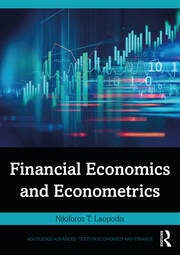
Financial economics and econometrics
Covers financial data and univariate models; asset returns; interest rates, yields and spreads; volatility and correlation; and corporate finance and policy. Each chapter begins with a theory in financial economics, followed by econometric methodologies which have been used to explore the theory. Next, the chapter presents empirical evidence and discusses seminal papers on the topic. Boxes offer insights on how an idea can be applied to other disciplines such as management, marketing and medicine, showing the relevance of the material beyond finance. Readers are supported with plenty of worked examples and intuitive explanations throughout the book, while key takeaways, ‘test your knowledge’ and ‘test your intuition’ features at the end of each chapter also aid student learning.

Field Arithmetic ; 3rd ed.
Field Arithmetic explores Diophantine fields through their absolute Galois groups. This largely self-contained treatment starts with techniques from algebraic geometry, number theory, and profinite groups. Graduate students can effectively learn generalizations of finite field ideas. We use Haar measure on the absolute Galois group to replace counting arguments. New Chebotarev density variants interpret diophantine properties. Here we have the only complete treatment of Galois stratifications, used by Denef and Loeser, et al, to study Chow motives of Diophantine statements.

Field Arithmetic ; 2nd ed.
Field Arithmetic explores Diophantine fields through their absolute Galois groups. This largely self-contained treatment starts with techniques from algebraic geometry, number theory, and profinite groups. Graduate students can effectively learn generalizations of finite field ideas. We use Haar measure on the absolute Galois group to replace counting arguments. New Chebotarev density variants interpret diophantine properties. Here we have the only complete treatment of Galois stratifications, used by Denef and Loeser, et al, to study Chow motives of Diophantine statements.Now we know they include valuable Galois extensions of the rationals that present its absolute Galois group through known groups. PAC fields have projective absolute Galois group. Those that are Hilbertian are characterized by this group being pro-free. These last decade results are tools for studying fields by their relation to those with projective absolute group. There are still mysterious problems to guide a new generation: Is the solvable closure of the rationals PAC; and do projective Hilbertian fields have pro-free absolute Galois group (includes Shafarevich's conjecture)?

Feature Extraction : Foundations and Applications
This book is both a reference for engineers and scientists and a teaching resource, featuring tutorial chapters and research papers on feature extraction. "This book compiles some very promising techniques, coming from an extremely smart collection of researchers, delivering their best ideas in a competitive environment."

Fading Foundations : Probability and the Regress Problem
This book addresses the age-old problem of infinite regresses in epistemology. How can we ever come to know something if knowing requires having good reasons, and reasons can only be good if they are backed by good reasons in turn? The problem has puzzled philosophers ever since antiquity, giving rise to what is often called Agrippa's Trilemma. The current volume approaches the old problem in a provocative and thoroughly contemporary way. Taking seriously the idea that good reasons are typically probabilistic in character, it develops and defends a new solution that challenges venerable philosophical intuitions and explains why they were mistakenly held. Key to the new solution is the phenomenon of fading foundations, according to which distant reasons are less important than those that are nearby.
