



الصفحة 137
الصفحة 137

Applying the building code : Step-by-step guidance for design and building professionals
The IBC and its complementary codes provide design and construction professionals with a complete set of comprehensive, coordinated building safety and fire prevention regulations in order to safeguard the public health and general welfare of the occupants of new and existing buildings and structures. Adopted throughout most of the United States and its territories, it is referenced by federal agencies, such as the General Services Administration, National Park Service, Department of State, U.S. Forest Service, and the Department of Defense. For architects and other design and construction professionals, it is particularly important that they understand how to apply the IBC and how code officials view buildings, so that they integrate code-required provisions in the earliest design stages of any project.
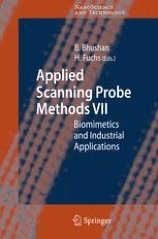
Applied scanning probe methodsVII : Biomimetics and industrial applications
The present volumes cover three main areas: novel probes and techniques (Vol. V), charactarization (Vol. VI), and biomimetics and industrial applications (Vol. VII). Volume V includes an overview of probe and sensor technologies including integrated cantilever concepts, electrostatic microscanners, low-noise methods and improved dynamic force microscopy techniques, high-resonance dynamic force - croscopy and the torsional resonance method, modelling of tip cantilever systems, scanning probe methods, approaches for elasticity and adhesion measurements on the nanometer scale as well as optical applications of scanning probe techniques based on near?eld Raman spectroscopy and imaging.
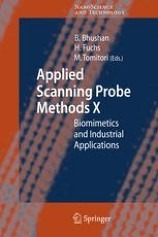
Applied scanning probe methods X : Biomimetics and industrial applications
The success of the Springer Series Applied Scanning Probe Methods I–VII and the rapidly expanding activities in scanning probe development and applications worldwide made it a natural step to collect further speci c results in the elds of development of scanning probe microscopy techniques (Vol. VIII), characterization (Vol. IX), and biomimetics and industrial applications (Vol. X). These three volumes complement the previous set of volumes under the subject topics and give insight into the recent work of leading specialists in their respective elds. Following the tradition of the series, the chapters are arranged around techniques, characterization and biomimetics and industrial applications. Volume VIII focuses on novel scanning probe techniques and the understanding of tip/sample interactions. Topics include near eld imaging, advanced AFM, specialized scanning probe methods in life sciences including new self sensing cantilever systems, combinations of AFM sensors and scanning electron and ion microscopes, calibration methods, frequency modulation AFM for application in liquids, Kelvin probe force microscopy, scanning capacitance microscopy, and the measurement of electrical transport properties at the nanometer scale.
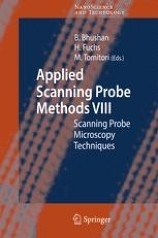
Applied scanning probe methods VIII : Scanning probe microscopy techniques
The success of the Springer Series Applied Scanning Probe Methods I–VII and the rapidly expanding activities in scanning probe development and applications worldwide made it a natural step to collect further speci c results in the elds of development of scanning probe microscopy techniques (Vol. VIII), characterization (Vol. IX), and biomimetics and industrial applications (Vol. X). These three volumes complement the previous set of volumes under the subject topics and give insight into the recent work of leading specialists in their respective elds. Following the tradition of the series, the chapters are arranged around techniques, characterization and biomimetics and industrial applications. Volume VIII focuses on novel scanning probe techniques and the understanding of tip/sample interactions. Topics include near eld imaging, advanced AFM, s- cializedscanningprobemethodsinlifesciencesincludingnewselfsensingcantilever systems, combinations of AFM sensors and scanning electron and ion microscopes, calibration methods, frequency modulation AFM for application in liquids, Kelvin probe force microscopy, scanning capacitance microscopy, and the measurement of electrical transport properties at the nanometer scale.

Applied scanning probe methods VI : Characterization
The scanning probe microscopy feld has been rapidly expanding. It is a demanding task to collect a timely overview of this feld with an emphasis on technical dev- opments and industrial applications. It became evident while editing Vols. I–IV that a large number of technical and applicational aspects are present and rapidly - veloping worldwide. Considering the success of Vols. I–IV and the fact that further colleagues from leading laboratories were ready to contribute their latest achie- ments, we decided to expand the series with articles touching felds not covered in the previous volumes. The response and support of our colleagues were excellent, making it possible to edit another three volumes of the series
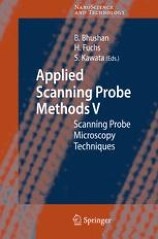
Applied scanning probe methods V : Scanning probe microscopy techniques
The scanning probe microscopy ?eld has been rapidly expanding. It is a demanding task to collect a timely overview of this ?eld with an emphasis on technical dev- opments and industrial applications. It became evident while editing Vols. I–IV that a large number of technical and applicational aspects are present and rapidly - veloping worldwide. Considering the success of Vols. I–IV and the fact that further colleagues from leading laboratories were ready to contribute their latest achie- ments, we decided to expand the series with articles touching ?elds not covered in the previous volumes. The response and support of our colleagues were excellent, making it possible to edit another three volumes of the series.
Applied scanning probe methods IX : Characterization
The success of the Springer Series Applied Scanning Probe Methods I–VII and the rapidly expanding activities in scanning probe development and applications worldwide made it a natural step to collect further speci c results in the elds of development of scanning probe microscopy techniques (Vol. VIII), characterization (Vol. IX), and biomimetics and industrial applications (Vol. X). These three volumes complement the previous set of volumes under the subject topics and give insight into the recent work of leading specialists in their respective elds. Following the tradition of the series, the chapters are arranged around techniques, characterization and biomimetics and industrial applications. Volume VIII focuses on novel scanning probe techniques and the understanding of tip/sample interactions. Topics include near eld imaging, advanced AFM, s- cializedscanningprobemethodsinlifesciencesincludingnewselfsensingcantilever systems, combinations of AFM sensors and scanning electron and ion microscopes, calibration methods, frequency modulation AFM for application in liquids, Kelvin probe force microscopy, scanning capacitance microscopy, and the measurement of electrical transport properties at the nanometer scale.

Applied Research in Environmental Economics
Sustainable development, climate policy, and biodiversity conservation are examples of issues on the current political agenda in many countries. These themes are also subject to economic research, and economic insights are increasingly finding their way into the design of environmental policy. Still, the reception of academic findings by policy makers as well as the timely identification of policy-relevant questions by economic researchers often seem to be problematic. This volume attempts to vitalise the exchange between policy makers and academics. It offers a snapshot of environmental economic research on a range of policy-relevant problems.

Applied Probability and Statistics
This text is designed for a one-semester course on Probability and Statistics. The exposition unfolds systematically from an introductory chapter to such topics as random variables and vectors, stochastic processes, estimation, testing and regression. The topics are well chosen and the presentation is enriched by many examples from real life. Following every chapter, the reader will find many original, solved and unsolved problems and hundreds of multiple choice questions, enabling those unfamiliar with the topics to master them. Additionally appealing are the interesting historical notes on the mathematicians mentioned throughout and a useful bibliography. A distinguishing character of the book is the thorough and succinct handling of the various topics.

Applied pharmacology for the dental hygienist ; 8th ed.
Provides you with an in-depth understanding of the pharmacologic principles needed for safe and effective dental treatment and oral health care. It discusses drug properties and mechanisms of action, dosages, intended effects, interactions, and adverse reactions - both for the medications a patient may already be taking and for the drugs prescribed by the dentist. This new edition has been updated throughout to give you a firm foundation in pharmacology in order to assess and educate patients so they can maintain optimal oral health!

Applied Peritoneal Dialysis : Improving Patient Outcomes
This book offers a comprehensive guide to peritoneal dialysis (PD). Home dialysis, and more specifically PD, is growing in popularity in the US. By conservative estimates, experts suggest that 45 percent of dialysis patients in the US can be on home dialysis. However, the current penetration rate is only 10 percent. This is changing with an expected major increase in the next 5 years. One of the reasons for the low uptake is that many nephrologists lack comfort and confidence in using PD as a dialysis modality.
Applied Mathematics for Restructured Electric Power Systems : Optimization, Control, and Computational Intellige
Discusses the use of applied mathematics to solve challenging power system problems. This book covers such areas as: control, optimization, and computational intelligence. It follows a three-part format: a description of an important power system problem or problems; the practice and/or particular research approaches; and, research directions.
Applied Mathematical Demography
it focus on applications of demographic models, while extending its scope to matrix models for stage-classified populations.first introduce the life table to describe age-specific mortality, and then use it to develop theory for stable populations and the rate of population increase. This theory is then revisited in the context of matrix models, for stage-classified as well as age-classified populations. Reproductive value and the stable equivalent population are introduced in both contexts, and Markov chain methods are presented to describe the movement of individuals through the life cycle. Applications of mathematical demography to population projection and forecasting, kinship, microdemography, heterogeneity, and multi-state models are considered.
Applied Geometry for Computer Graphics and CAD
Focusing on the manipulation and representation of geometrical objects, this book explores the application of geometry to computer graphics and computer-aided design (CAD). An introduction to transformations of the plane and three-dimensional space describes how objects can be constructed from geometric primitives and manipulated. This leads into a treatment of projections and the method of rendering objects on a computer screen by application of the complete viewing operation. Subsequently, the emphasis is on the two principal curve and surface representations, namely, Bézier and B-spline (including NURBS).
Applied Econometrics with R
This is the first book on applied econometrics using the R system for statistical computing and graphics. It presents hands-on examples for a wide range of econometric models, from classical linear regression models for cross-section, time series or panel data and the common non-linear models of microeconometrics such as logit, probit and tobit models, to recent semiparametric extensions. In addition, it provides a chapter on programming, including simulations, optimization, and an introduction to R tools enabling reproducible econometric research.
Applied cryptography and network security Workshops ; ACNS 2020 Satellite Workshops, AIBlock, AIHWS, AIoTS, Cloud S&P, SCI, SecMT, and SiMLA, Rome, Italy, October 19–22, 2020, Proceedings
This book constitutes the proceedings of the satellite workshops held around the 18th International Conference on Applied Cryptography and Network Security, ACNS 2020, in Rome, Italy, in October 2020.

Applied biophysics for drug discovery
It is a guide to new techniques and approaches to identifying and characterizing small molecules in early drug discovery. Biophysical methods are reasserting their utility in drug discovery and through a combination of the rise of fragment-based drug discovery and an increased focus on more nuanced characterisation of small molecule binding, these methods are playing an increasing role in discovery campaigns.

Applications of three-dimensional imaging for craniofacial region
Provides sound knowledge of 3D imaging of dentofacial craniofacial region. It guides the students and faculty for understanding the dentofacial craniofacial region in depth. It incorporates the latest techniques, frameworks and technologies in the imaging area of oral health. The book emphasizes on the dentofacial and craniofacial region and thus fills the gap in the medical imaging literature.

Applications of Synchrotron Radiation : Micro Beams in Cell Micro Biology and Medicine
This book demonstrates the applications of synchrotron radiation in certain aspects of cell microbiology, specifically non-destructive elemental analyses, chemical-state analyses and imaging (distribution) of the elements within a cell. The basics for understanding and applications of synchrotron radiation are also described to make the contents easier to be understood for a wide group of researchers in medical and biological sciences who might not be familiar with the physics of synchrotron radiation. The two main techniques that are discussed in this book are the x-ray fluorescence spectroscopy (XRF) and the x-ray fine structure analysis (XAFS).
Applications of Specification and Design Languages for SoCs : Selected papers from FDL 2005
This book provides detailed insights into recent works dealing with a large spectrum of issues in system-on-chip design, namely: assertion-based design, mapping on network-on-chip architectures, use of C/C++/SystemC design methodologies, hardware/software integration, mixing heterogeneous models of computation, analog/mixed-signal/mixed-technology system design and verification, UML/XML-based synthesis of analog and mixed-signal systems, UML to VHDL mapping, UML-based performance modeling, model transformation and formal verification, real-time system models, and Model Driven Architecture.
