



الصفحة 13
الصفحة 13

Nanotechnology in Intelligent Food Packaging
This book is a state-of-the-art exposition of nanotechnology and food packaging which is undergoing rapid advancement. This book is specially designed with an emphasis on the state-of-the-art in nanotechnology and food packaging. It offers fascinating techniques for producing smart and active food packaging and also discusses its toxicity and the role that nanosensors play in detecting different pathogens in food packaging. The concluding chapters also explain recent developments concerning the incorporation of health supplements in food packaging and their future role in producing intelligent food packaging.

Nanotechnology for Smart Concrete
Nanomaterials can markedly improve the mechanical properties of concrete, as well as reduce the porosity and enhance the durability of concrete. The application of nanotechnology in concrete is still in its infancy. However, an ever-growing demand for ultra-high-performance concrete and recurring environmental pollution caused by ordinary Portland cement has encouraged engineers to exploit nanotechnology in the construction industry. Nanotechnology for Smart Concrete discusses the advantages and applications of nanomaterials in the concrete industry, including high-strength performance, microstructural improvement, self-healing, energy storage, and coatings. The book: Analyses the linkage of concrete materials with nanomaterials and nanostructures / Discusses the applications of nanomaterials in the concrete industry, including energy storage in green buildings, anti-corrosive coatings, and inhibiting pathogens and viruses / Covers self-healing concrete / Explores safety considerations, sustainability, and environmental impact of nanoconcrete / Includes an appendix of solved questions

Nanotechnology for Oral Drug Delivery : From Concept to Applications
Discusses the current challenges of oral drug delivery, broadly revising the different physicochemical barriers faced by nanotechnolgy-based oral drug delivery systems, and highlighting the challenges of improving intestinal permeability and drug absorption. Oral delivery is the most widely used form of drug administration due to ease of ingestion, cost effectiveness, and versatility, by allowing for the accommodation of different types of drugs, having the highest patient compliance.

Nanotechnology for Environmental Remediation
The newly discovered advanced oxidation technology using nanoscale zero-valent iron, which is reported in this book, could be widely used to treat pesticides, herbicides, and industrial chemicals as well as to purify contaminated water for domestic use. In addition, it can contribute to advancing science and technology and providing valuable information to all readers - researchers, scientists, engineers, and students - in this field for their further research and studies.

Nanotechnology applied To pharmaceutical technology
Focuses on devising innovative nanopharmaceutical products and solutions to treat such diseases as cancer, infections, eye diseases, and in tackling multi-drug resistance threats. Nanotechnology Applied to Pharmaceutical Technology consists of four sections that include coverage of biosynthesis of nanoparticles, nano-material based formulations and toxicity, and safety issues.

Nanotechnology and Occupational Health
Nanotechnology is rapidly invading many aspects of modern society - from science, research and engineering to industrial and commercial applications and, inevitably, to man and his environment. One of the biggest challenges, therefore, is managing environmental, health and safety risks of nanomaterials. Yet, the information necessary to assess their longterm effects is scarce. Systematic research into what potentially makes engineered nanomaterials hazardous, how this translates into risk, and how these can be managed will be vital and involves interdisciplinary collaboration.

Nanotechnology : Societal Implications ; I : Maximising Benefits for Humanity ; II : Individual Perspectives
This book includes a collection of essays by leading scientists, engineers, and social scientists reviewing the possible uses of these impending technical developments in various industrial, medical, and national security applications, and the corresponding ethical, legal, social, economic, and educational issues that they raise. The report outlines potential areas for research into societal implications of nanotechnology, as well as some preliminary suggestions for how potential positive impacts of nanotechnology can be maximized, while minimizing any possible negative impacts, real or imagined. This book also provides the beginning of a blueprint for how one should address second-order consequences of the new technology, either positive implications or potential risks.

Nanotechnologies, Hazards and Resource Efficiency : A Three-Tiered Approach to Assessing the Implications of Nanotechnology and Influencing its Development
Nanotechnology is frequently described as an enabling technology and 1 fundamental innovation, i.e. it is expected to lead to numerous innovative developments in the most diverse fields of technology and areas of app- cation in society and the marketplace. The technology, it is believed, has the potential for far-reaching changes that will eventually affect all areas of life. Such changes will doubtlessly have strong repercussions for society and the environment and bring with them not only the desired and intended effects such as innovations in the form of improvements to products, pr- esses and materials; economic growth; new jobs for skilled workers; relief for the environment; and further steps toward sustainable business, but also unexpected and undesirable side effects and consequences.

Nanostructured Soft Matter : Experiment, Theory, Simulation and Perspectives
This book provides an interdisciplinary overview of a new and broad class of materials under the unifying name Nanostructured Soft Matter. It covers materials ranging from short amphiphilic molecules to block copolymers, proteins, colloids and their composites, microemulsions and bio-inspired systems.

Nanostructured Materials by High-Pressure Severe Plastic Deformation
Recently, it was reported that nanostructured materials processed under high pressure by HPT and ECAP have an extraordinary combination of both high strength and high ductility, which are two desirable, but rarely co-existing properties. These findings indicate that high-pressure is a critical factor that can be employed to process nanostructured materials with superior mechanical, and possibly also physical, properties. It is the objective of this workshop to review our current knowledge, identify issues for future research, and discuss future directions on the processing and properties of nanostructured materials via SPD techniques, with a special emphasis on high-pressure effects.

Nanostructured Coatings
Controlling the performance of structures and components of all sizes and shapes through the use of engineered coatings has long been a key strategy in materials processing and technological design. The ever-increasing sophistication of en- neered coatings and the rapid trend toward producing increasingly smaller devices with greater demands on their fabrication, properties and performance have led to signicant progress in the science and technology of coatings, particularly in the last decade or two. Nanostructured coatings constitute a major area of sci- ti?c exploration and technological pursuit in this development.Nanostructured coatings demand study in a highly interdisciplinary research arena which encompasses: surface and interface science study of defects modern characterization methodologies cutting-edge experimental developments to deposit.

Nanostructured and advanced materials for applications in sensor, optoelectronic and photovoltaic technology ; Proceedings of the NATO Advanced Study Institute on nanostructured and advanced materials for applications in sensors, optoelectronic and photovoltaic technology ; Sozopol, Bulgaria, 6-17 September 2004
Nanotechnology is an emerging scientific field receiving significant worldwide attention. On a nanometer scale, materials or structures may possess new and unique physical properties. Some of these are now known to the scientific community, but there may well be many properties not yet known to us, rendering it as a fascinating area of research and a suitable subject for a NATO ASI. Yet another aspect of the field is the possibility for creating meta-stable phases with unconventional properties and the ultra-miniaturization of current devices, sensors, and machines. Such nanotechnological and related advanced materials have an extremely wide range of potential applications, viz. nanoscale electronics, sensors, optoelectronics, photonics, nano-biological systems, na- medicine, energy storage systems, etc. This is a wide-ranging subject area and therefore requires the formation of multi-disciplinary teams of physicists, chemists, materials scientists, engineers, molecular biologists, pharmacologists, and others to work together on the synthesis and processing of materials and structures, the understanding of their physical properties, the design and fabrication of devices.

Nanoscale Photonic Imaging
This book, edited and authored by a team of world-leading researchers, provides a broad overview of advanced photonic methods for nanoscale visualization, as well as describing a range of fascinating in-depth studies.

Nanoscale Phenomena : Basic Science to Device Applications
Nanotechnology is the result of the continuing technological trend toward device miniaturization and the characterization, manipulation, and fine control of structure and function at diminishing length scales. A large class of nanoscale materials can be stable even though they are far from the lowest-energy thermodynamic state, and many possess novel properties unattainable in bulk. These trends are supported by the increasing sophistication of characterization and fabrication tools such as the scanning tunneling microscope and the transmission electron microscope, which allow the resolution and manipulation of single atoms and molecules.

Nanoparticles in Biomedical Imaging : Emerging Technologies and Applications
Fundamental Biomedical Technologies features titles in multidisciplinary, technology-driven areas, providing the foundations for breakthrough advances in medicine and biology. The term technology refers, in a vigorously unrestrictive sense, to a broad array of engineering disciplines, the sciences of computation and informatics, mathematical models exploiting and advancing methods of mathematical physics, and the development of novel, experimental discovery devices. Titles in this series are designed and selected to provide high-level visionary input for specialists, while presenting overviews of emerging fields for those in related areas. Volumes in this series aim to provide technologists with the material to gain competent entry into biomedical research and biomedical researchers to understand and embrace novel technological foundations and tools.

Nanoparticle-Based Drug Delivery in Cancer Treatment
Discusses nanotechnological developments of interfering RNA-based nanoparticles, delivery vehicles, and validated therapeutic RNAi–molecular target interactions and explains the results of clinical and preclinical trials. The book also gives strategies for universal methods of constructing hybrid organic–inorganic nanomaterials that can be widely applied in the biomedical field. Focuses on : Recent advances of nanoparticle-mediated siRNA delivery systems and their application in clinical trials for cancer therapy Material platforms that establish NPs and both localized and controlled gene silencing The most promising systems for clinical application Surveys progress in nanoparticle-based nanomedicine in cancer treatment The most advanced of the nonviral nanocarriers for delivery of oligonucleotides to malignant blood cancer cells
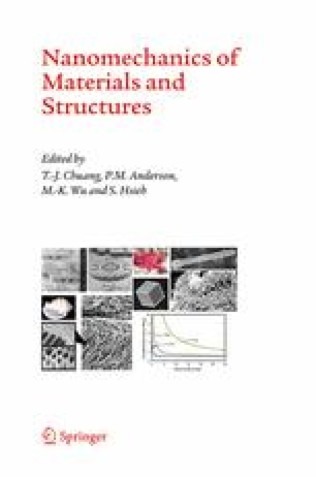
Nanomechanics of Materials and Structures
This book is derived from the proceedings of the International Workshop on Nanomechanics held at Asilomar Conference Grounds in Pacific Grove, California on July 14-17, 2004. The main objective was to convene leading researchers in the nanotechnology community to assess the current state-of-the-art and disseminate recent progress, critical issues, barriers to applications, and directions for future research in nanomechanics.
Nanomaterials in dental medicine
Presents varied clinical applications of nanomaterials in dentistry ranging from diagnostics to therapeutics. it discusses role of nanomaterials in clinical applications and future needs. Contributors are international luminaries in their respective research area. The topics covered in this book are role of nanomaterials in oral and dental diagnosis, dental disease prevention, pain free dentistry, dental implantology. It also discusses the therapeutic applications of nanoparticles in oral cancer therapy. This book will be a valuable reference for researchers, clinicians, students and professionals working in the areas of nanotechnology and health sciences. It will also be of interest to the students and researchers primarily working in the field of materials science, applied chemistry, applied physics, and biotechnology.

Nanomaterials in clinical therapeutics : Synthesis and applications
Nanotechnology-based applications is a rapidly growing field encompassing a diverse range of disciplines that impact our daily lives. Nanotechnology is being used to carry out large-scale reactions in practically every field of biotechnology and healthcare. The incredible progress being made in these applications is particularly true for the healthcare sector, where they are used in cancer detection and treatment, medical implants, tissue engineering, and so forth. Expansions in this discipline are expected to continue in the future, resulting in the creation of a variety of life-saving medical technology and treatment procedures.

Nanoformulations in Human Health: Challenges and Approaches
This book is an amalgamation of knowledge, experience, and expertise in various aspects of nanotechnology, by experts who are proficient in designing novel nanoformulations that are used in the treatment of various challenging and prevalent diseases. It is an exhaustive compilation of the multi-faceted arena of nanoformulations and the healthcare system that caters to the needs of academicians, scholars, researchers, etc. The most important aspect of the book covers various types of nanoformulations and their applications in the treatment of communicable and non-communicable diseases. Each chapter focuses on a particular nanoformulation as well as a disease including the pathophysiology of the disease, the current treatment modalities of diseases, the role of nanoformulation in treatment and other future aspects and directions for further work. Coverage includes neuropathic pain, colon targeting, nose-to-brain drug delivery, cancer, arthritis and tuberculosis.
