



الصفحة 13
الصفحة 13

Interacting particle systems
This book presents a complete treatment of a new class of random processes, which have been studied intensively during the last fifteen years.The first monographic presentation of this important and rapidly developing theory.

Intelligent Virtual Agents ; 8th International Conference, IVA 2008, Tokyo, Japan, September 1-3, 2008. Proceedings
This book constitutes the refereed proceedings of the 8th International Workshop on Intelligent Virtual Agents, IVA 2008, held in Tokyo, Japan, in September 2008.The 18 revised full papers and 28 revised short papers presented together 42 poster papers were carefully reviewed and selected from 99 submissions. The papers are organized in topical sections on motion and empathy; narrative and augmented reality; conversation and negotiation; nonverbal behavior; models of culture and personality; markup and representation languages; architectures for robotic agents; cognitive architectures; agents for healthcare and training; and agents in games, museums and virtual worlds.

Intelligent Virtual Agents ; 7th International Working Conference, IVA 2007, Paris, France, September 17-19, 2007, Proceedings
The 19 revised full papers and 12 revised short papers presented together with five invited talks and the abstracts of 32 poster papers are organized in topical sections on rendering and analysis, culture and identity, behavior models, feedback models, dialogues, applications, evaluation, gaze models and emotions.

Intelligent tutoring systems ; 9th International Conference, ITS 2008, Montreal, Canada, June 23-27, 2008 Proceedings
This book constitutes the refereed proceedings of the 9th International Conference on Intelligent Tutoring Systems, ITS 2008, held in Montreal, Canada, in June 2008.The 63 revised full papers and 61 poster papers presented together with abstracts of 5 keynote talks were carefully reviewed and selected from 207 submissions. The papers are organized in topical sections on emotion and affect, tutor evaluation, student modeling, machine learning, authoring tools , tutor feedback and intervention, data mining, e-learning and Web-based ITS, natural language techniques and dialogue, narrative tutors and games, semantic Web and ontology, cognitive models, and collaboration.

Intelligent Tutoring Systems ; 8th International Conference, ITS 2006, Jhongli, Taiwan, June 26-30, 2006 Proceedings
This book constitutes the refereed proceedings of the 8th International Conference on Intelligent Tutoring Systems, ITS 2006, held in Jhongli, Taiwan in June 2006. The 67 revised full papers and 40 poster papers presented together with abstracts of 6 keynote talks were carefully reviewed and selected from over 200 submissions. The papers are organized in topical sections on assessment, authoring tools, bayesian reasoning and decision-theoretic approaches, case-based and analogical reasoning, cognitive models, collaborative learning, elearning and web-based intelligent tutoring systems, error detection and handling, feedback, gaming behavior, learner models, motivation, natural language techniques for intelligent tutoring systems, scaffolding, simulation, as well as tutorial dialogue and narrative.

Intelligent Systems for Sustainable Person-Centered Healthcare
This book establishes a dialog among the medical and intelligent system domains for igniting transition toward a sustainable and cost-effective healthcare. The Person-Centered Care (PCC) positions a person in the center of a healthcare system, instead of defining a patient as a set of diagnoses and treatment episodes. The book discusses intelligent systems and their applications for healthcare data analysis, decision making and process design tasks. The measurement systems and efficiency evaluation models analyze ability of intelligent healthcare system to monitor person health and improving quality of life.

Intelligent Organizations : Powerful Models for Systemic Management
This innovative book opens a path to overcoming the crisis of management in the face of complexity. The systems approach on which this work is grounded enables the development of the new kind of intelligent organizations so urgently needed. Powerful models, grounded in organizational cybernetics and system dynamics

Intelligent Computing Everywhere
Intelligent Computing Everywhere investigates the relevance and relationship artificial intelligence maintains with "modern strands of computing" i.e. pervasive computing and ambient intelligence, bioinformatics, neuroinformatics, computing and the mind, non-classical computing and novel computing models, as well as DNA computing and quantum computing.

Intelligent Algorithms for Packing and Cutting Problem
Introduces intelligent solving algorithms for classical packing and cutting problem and their variants / Investigates novel methods, e.g. reinforcement learning algorithms, for rectangular and irregular packing problems / Presents practical engineering application cases in combination of theory and practice / investigates in detail the two-dimensional packing and cutting problems in the field of operations research and management science. It introduces the mathematical models and intelligent solving algorithms for these problems, as well as their engineering applications. Most intelligent methods reported in this book have already been applied in reality, which can provide reference for the engineers. The presented novel methods for the two-dimensional packing problem provide a new way to solve the problem for researchers interested in operations research or computer science. This book also introduces three new variants of packing problems and their solving methods, which offer a different research direction.
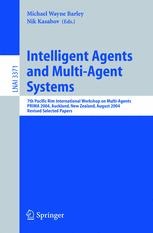
Intelligent Agents and Multi-Agent Systems ; 7th Pacific Rim International Workshop on Multi-Agents, PRIMA 2004, Auckland, New Zealand, August 8-13, 2004, Revised Selected Papers
A Combined System for Update Logic and Belief Revision.- Using Messaging Structure to Evolve Agents Roles in Electronic Markets.- Specifying DIMA Multi-agents Models Using Maude.- picoPlangent: An Intelligent Mobile Agent System for Ubiquitous Computing.- An Approach to Safe Continuous Planning.- Modeling e-Procurement as Co-adaptive Matchmaking with Mutual Relevance Feedback.- Price Determination and Profit Sharing for Bidding Groups in Agent-Mediated Auctions.- Agent Based Risk Management Methods for Speculative Actions.- Handling Emergent Resource Use Oscillations.- The Role of Agents in Intelligent Mobile Services.

Integrated Water Resources Management and Security in the Middle East
Integrated Water Resources Management and Security in the Middle East brings together diverse voices relating to the critical issue of water management in one of the world’s most politically volatile areas: the Middle East. The book brings together Palestinian, Israeli, Jordanian and international expert opinions on creating a holistic and comprehensive view of water management challenges and strategies in an area of conflict and resource scarcity.The book takes security studies to the next level beyond military preparedness to address the security implications of the most fundamental of resources, that of water. Indeed, the book delves deeply into the underlying ideological underpinnings of various water regimes and possible opportunities for new decision-making models and regional cooperation.This book serves an important place in the scholarly literature on this topic for its breadth of participants and perspectives and its concrete steps forward. It moves the academic discourse beyond pointing fingers and toward constructive solutions and dialogue.

Integrated System-Level Modeling of Network-on-Chip enabled Multi-Processor Platforms
Integrated System-Level Modeling of Network-on-Chip Enabled Multi-Processor Platforms first gives a comprehensive update on recent developments in the area of SoC platforms and ESL design methodologies. The main contribution is the rigorous definition of a framework for modeling at the timing approximate level of abstraction. Subsequently this book presents a set of tools for the creation and exploration of timing approximate SoC platform models.

Integrated Research in GRID Computing : CoreGRID Integration Workshop 2005 (Selected Papers) November 28-30, Pisa, Italy
Integrated Research in Grid Computing presents a selection of the best papers presented at the CoreGRID Integration Workshop (CGIW2005). The aim of CoreGRID is to strengthen and advance scientific and technological excellence in the area of Grid and Peer-to-Peer technologies in order to overcome the current fragmentation and duplication of effort in this area.

Integrated Reaction and Separation Operations : Modelling and experimental validation
The book presents the latest developments in simulation of integrated processes as well as new methods of process synthesis and process control. It shows details of experimental approaches for model validation, determining of model parameters and measurement techniques. The combination of sophisticated modelling, optimisation methods and experimental results has not ben published up to now. The book gives deep insights into the overall evaluation of integrated processes as well as development of methods for a systematic design and optimisation of integrated reaction and separation processes. Potentials for process integration and the technical as well as economic limitations have been identified. The book covers several case studies of reactive distillation, reactive extraction, reactive gas-adsorption and chromatographic reactors which have been investigated from the modelling and experimental point of view. Based on validated models process simulation was used to optimize these processes. Following the concept of integrated process design approaches have been developed for model predictive control and process optimisation during production. Another new and very important focus of the book is systematic synthesis of integrated processes.

Integrated Market and Credit Portfolio Models : Risk Measurement and Computational Aspects
Due to their business activities, banks are exposed to many different risk types. Aggregating various risk exposures to a comprehensive risk position is an important but up-to-date not satisfactorily solved task. This shortfall goes back to conceptual problems of constructing an appropriate risk model and to the computational burden of determining a loss distribution that comprises all relevant risk types. Peter Grundke deals with both problems. On the one hand, he extends a standard credit portfolio model by correlated interest rate and credit spread risk. The analysis shows that the economic capital needed as a buffer to absorb unexpected losses in a portfolio can be severely underestimated when relevant market risk factors are neglected. On the other hand, computational aspects are addressed.

Integrated Management of Diseases Caused by Fungi, Phytoplasma and Bacteria
This book is about stone fruit and apple diseases, grapevine and fruit crops phytoplasma, Phytophthora on citrus, chestnut diseases, esca complex on grapevine and Rosellinia necatrix root rot. Includes models for potato late blight management and management of bacteria and DNA fingerprinting.

Integrated Groundwater Management : Concepts, Approaches and Challenges
The aim of this book is to document for the first time the dimensions and requirements of effective integrated groundwater management (IGM). Groundwater management is a formidable challenge, one that remains one of humanity’s foremost priorities. It has become a largely non-renewable resource that is overexploited in many parts of the world. In the 21st century, the issue moves from how to simply obtain the water we need to how we manage it sustainably for future generations, future economies, and future ecosystems. The focus then becomes one of understanding the drivers and current state of the groundwater resource, and restoring equilibrium to at-risk aquifers. Many interrelated dimensions, however, come to bear when trying to manage groundwater effectively. An integrated approach to groundwater necessarily involves many factors beyond the aquifer itself, such as surface water, water use, water quality, and ecohydrology.

Integral Methods in Science and Engineering : Theoretical and Practical Aspects
The quantitative and qualitative study of the physical world makes use of many mathematical models governed by a great diversity of ordinary, partial differential, integral, and integro-differential equations. An essential step in such investigations is the solution of these types of equations, which sometimes can be performed analytically, while at other times only numerically. This edited, self-contained volume presents a series of state-of-the-art analytic and numerical methods of solution constructed for important problems arising in science and engineering, all based on the powerful operation of (exact or approximate) integration.It covers a wide variety of topics, from the theoretical development of boundary integral methods to the application of integration-based analytic and numerical techniques that include integral equations, finite and boundary elements, conservation laws, hybrid approaches, and other procedures.

Integral Methods in Science and Engineering : Techniques and Applications
The physical world is studied by means of mathematical models, which consist of differential, integral, and integro-differential equations accompanied by a large assortment of initial and boundary conditions. In certain circumstances, such models yield exact analytic solutions. When they do not, they are solved numerically by means of various approximation schemes. Whether analytic or numerical, these solutions share a common feature: they are constructed by means of the powerful tool of integration—the focus of this self-contained book. This work illustrates the application of integral methods to diverse problems in mathematics, physics, biology, and engineering. The thirty two chapters of the book, written by scientists with established credentials in their fields, contain state-of-the-art information on current research in a variety of important practical disciplines.

Integral Foam Molding of Light Metals : Technology, Foam Physics and Foam Simulation
This book shows in three parts the technology, the fundamentals and the simulation models for the Integral Foam Molding of Light Metals Part I: “Technology” shows for the first time that foaming of metals is possible by applying molding techniques very similar to polymer integral foam molding. Part II: “Physics” is devoted to the physics of foaming with special emphasis on the very short time scale which is characteristic for integral foam molding. Part III: “Numerical Simulation” presents a new lattice Boltzmann approach for the treatment of free surfaces is developed and applied on foam evolution problems. For the first time, the numerical simulation of foam evolution starting from nucleation until decay is accessible.
