



الصفحة 13
الصفحة 13

Modeling of Adhesively Bonded Joints
A lot of recent developments have been made about adhesively bonded joints modeling using various methods of analysis. The increasing application of adhesives in industry is partly due to the increased sophistication and reliability of adhesive joints modeling. The book proposed intends to provide the designer with the most advanced stress analyses techniques in adhesive joints to reinforce the use of this promising bonding technique.

Modeling in Biopharmaceutics, Pharmacokinetics and Pharmacodynamics : Homogeneous and Heterogeneous Approaches
The state of the art in Biopharmaceutics, Pharmacokinetics, and Pharmacodynamics Modeling is presented in this book. It shows how advanced physical and mathematical methods can expand classical models in order to cover heterogeneous drug-biological processes and therapeutic effects in the body. The book is divided into four parts; the first deals with the fundamental principles of fractals, diffusion and nonlinear dynamics; the second with drug dissolution, release, and absorption; the third with empirical, compartmental, and stochastic pharmacokinetic models, and the fourth mainly with nonclassical aspects of pharmacodynamics. The classical models that have relevance and application to these sciences are also considered throughout. Many examples are used to illustrate the intrinsic complexity of drug administration related phenomena in the human, justifying the use of advanced modeling methods.

Modeling Financial Time Series with S-PLUS®
This book represents an integration of theory, methods, and examples using the S-PLUS statistical modeling language and the S+FinMetrics module to facilitate the practice of financial econometrics. This is the first book to show the power of S-PLUS for the analysis of time series data.It covers S+FinMetrics 2.0 and includes new chapters on copulas, nonlinear regime switching models, continuous-time financial models, generalized method of moments, semi-nonparametric conditional density models, and the efficient method of moments.

Modeling Excitable Tissue : The EMI Framework
This volume presents a novel computational framework for understanding how collections of excitable cells work. The key approach in the text is to model excitable tissue by representing the individual cells constituting the tissue. This is in stark contrast to the common approach where homogenization is used to develop models where the cells are not explicitly present. The approach allows for very detailed analysis of small collections of excitable cells, but computational challenges limit the applicability in the presence of large collections of cells.

Modeling Complex Living Systems : A Kinetic Theory and Stochastic Game Approach
Using tools from mathematical kinetic theory and stochastic game theory, this work deals with the modeling of large complex systems in the applied sciences, particularly those comprised of several interacting individuals whose dynamics follow rules determined by some organized, or even "intelligent" ability. Traditionally, methods of mathematical kinetic theory have been applied to model the evolution of large systems of interacting classical or quantum particles. This book, on the other hand, examines the modeling of living systems as opposed to inert systems.
Modeling and Simulation for RF System Design
The focus of Modeling and Simulation for RF System Design lies on RF specific modeling and simulation methods and the consideration of system and circuit level descriptions. It contains application-oriented training material for RF designers which combines the presentation of a mixed-signal design flow.

Modeling and Control of Antennas and Telescopes
Modeling and Control of Antennas and Telescopes presents the author’s research and field experience in the area of antenna modeling, dynamics, and control. The required spacecraft tracking accuracy of 1 mdeg was the impetus for the new approaches to the antenna controls that use model based controllers (LQG and H¥ ). Consequently, modeling also required a new approach using system identification techniques. Most of the material presented is new in the telescope industry. The methods have been not only analyzed and tested, but actually implemented, giving confidence in the final result, which is significantly increased antenna pointing accuracy.

Modeling and computations in electromagnetics ; A volume dedicated to Jean-Claude Nédélec
Modeling and computations in electromagnetics is a quite novel and growing discipline, expanding as a result of the steadily increasing demand for designing electrical devices, modeling electromagnetic materials, and simulating electromagnetic fields in nanoscale structures. The aim of this volume is to bring together prominent worldwide experts to review state-of-the-art developments and future trends of modeling and computations in electromagnetics. This volume is devoted to merging the expertise of scientists working in this dynamic discipline, and to raising interest for challenging issues. The most significant advances in computational techniques have been made only in the last few years, and several challenging technological applications are presented in this volume.

Modeling and computation of boundary-layer flows : Laminar, turbulent and transitional boundary layers in incompressible and compressible flows
This second edition of our book extends the modeling and calculation of boundary-layer flows to include compressible flows. The subjects cover laminar, transitional and turbulent boundary layers for two- and three-dimensional incompressible and compressible flows. The viscous-inviscid coupling between the boundary layer and the inviscid flow is also addressed. The book has a large number of homework problems.

Modeling and Analysis of Transient Processes in Open Resonant Structures : New Methods and Techniques
The principal goal of the book is to describe new accurate and robust algorithms for open resonant structures with substantially increased efficiency. The book presents a systematic approach to the study of electromagnetic waves scattering which can be introduced in undergraduate/postgraduate education in theoretical and applied radiophysics and different advanced engineering courses on antenna and wave-guide technology.
Model-Based Testing of Reactive Systems : Advanced Lectures
This book is based on a seminar held in Dagstuhl Castle, Germany, in January 2004. It presents 19 carefully reviewed and revised lectures given at the seminar in a well-balanced way ensuring competent complementary coverage of all relevant aspects. An appendix provides a glossary for model-based testing and basics on finite state machines and on labelled transition systems. The lectures are presented in topical sections on testing of finite state machines, testing of labelled transition systems, model-based test case generation, tools and case studies, standardized test notation and execution architectures, and beyond testing.

Model-based Geostatistics
Geostatistics is concerned with estimation and prediction problems for spatially continuous phenomena, using data obtained at a limited number of spatial locations. The name reflects its origins in mineral exploration, but the methods are now used in a wide range of settings including public health and the physical and environmental sciences. Model-based geostatistics refers to the application of general statistical principles of modeling and inference to geostatistical problems. This volume is the first book-length treatment of model-based geostatistics. The authors have written an expository text, emphasizing statistical methods and applications rather than the underlying mathematical theory. Analyses of datasets from a range of scientific contexts feature prominently, and simulations are used to illustrate theoretical results. Readers can reproduce most of the computational results in the book by using the authors' R-based software package, geoR, whose usage is illustrated in a computation section at the end of each chapter.

Model-based Fault Diagnosis Techniques : Design Schemes, Algorithms, and Tools
The objective of this book is to introduce basic model-based FDI schemes, advanced analysis and design algorithms and the needed mathematical and control theory tools at a level for graduate students and researchers as well as for engineers.
Model driven Engineering Languages and Systems; 10th International Conference, MoDELS 2007, Nashville, USA, September 30 - October 5, 2007, Proceedings
This book constitutes the refereed proceedings of the 10th International Conference on Model Driven Engineering Languages and Systems (formerly the UML series of conferences), MODELS 2007, held in Nashville, USA, September 30 - October 5, 2007. The 45 revised full papers were carefully reviewed and selected from 158 initial submissions.
Model Driven Engineering Languages and Systems ; Vol. 3713 : 8th International Conference, MoDELS 2005, Montego Bay, Jamaica, October 2-7, 2005, Proceedings
Constitutes the proceedings of the 8th International Conference on Model Driven Engineering Languages and Systems, MoDELS 2005, held in Montego Bay, Jamaica, in October 2005. This book includes 52 papers and 2 keynote abstracts. It covers such topics as process modelling, product families, state/behavioral modeling, design strategies and more.
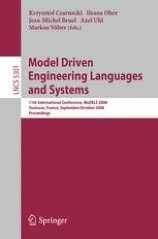
Model Driven Engineering Languages and Systems ; 11th International Conference, MoDELS 2008, Toulouse, France, September 28 - October 3, 2008. Proceedings
The book also contains three keynote speeches and contributions to workshops, symposia, tutorials and panels at the conference. The papers are organized in topical sections on Model Transformation: Foundations; Requirements Modeling; Domain-Specific Modeling; Model Transformation: Techniques, Composition and Analysis of Behavioral Models; Model Comprehension; Model Management; Behavioral Conformance and Refinement; Metamodeling and Modularity; Constraints; Model Analysis; Service-Oriented Architectures; Adaptive and Autonomic Systems; Empirical Studies; Evolution and Reverse Engineering; Modeling Language Semantics; Dependability Analysis and Testing; Aspect-Oriented Modeling; Structural Modeling;and Embedded Systems.
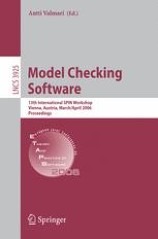
Model Checking Software ; Vol. 3925 ; 13th International SPIN Workshop, Vienna, Austria, March 30 - April 1, 2006, Proceedings
he name “SPIN” refers both to a workshopon model checking and to a famous model checking tool. The SPIN workshop is an annual forum for practitioners and researchersinterested in state space-based techniques for the validation and analysis of software and hardware systems, including communication protocols. It focuses on techniques based on explicit representations of state spaces, as implemented in the SPIN model checker or other tools, and techniques based on a combination of explicit representations with other representations. The SPIN model checker has proven to be particularly suited for the analysis of concurrent asynchronous systems. The workshop aims to encourage interaction and exchange of ideas with all related areas in software engineering.

Model Checking Software ; Vol. 3639 : 12th International SPIN Workshop, San Francisco, CA, USA, August 22-24, 2005, Proceedings
Constitutes the refereed proceedings of the 12th International SPIN workshop on Model Checking Software, SPIN 2005, held in San Francisco, USA in August 2005. The papers are organized in topical sections on state representation and abstraction, dealing with concurrency, dealing with complex data, checking temporal properties, and more.
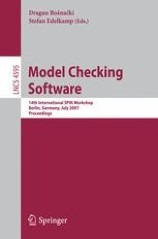
Model checking software ; 14th International SPIN Workshop, Berlin, Germany, July 1-3, 2007, Proceedings
This book presents the proceedings of the 14th International SPIN workshop on Model Checking Software, held in Berlin, Germany. The papers are organized into topical sections covering directed model checking, partial order reduction, program analysis, exploration advances, modeling and case studies, and tool demonstrations.

Model Based Learning and Instruction in Science
This book describes new, model based teaching methods for science instruction. It presents research that describes these new methods in a very diverse group of settings: middle school biology, high school physics, and college chemistry classrooms. Mental models in these areas such as understanding the structure of the lungs or cells, molecular structures and reaction mechanisms in chemistry, or causes of current flow in electricity are notoriously difficult for many students to learn. Yet these lie at the core of conceptual understanding in these areas. The studies focus on a variety of teaching strategies such as discrepant questioning, analogies, animations, model competition, and hands on activities.
