



الصفحة 13
الصفحة 13

Digital business strategies in blockchain ecosystems : Transformational design and future of global business
Analyzes the effects of the latest technological advances in blockchain and artificial intelligence (AI) on business operations and strategies. Adopting an interdisciplinary approach, the contributions examine new developments that change the rules of traditional management. The chapters focus mainly on blockchain technologies and digital business in the "Industry 4.0" context, covering such topics as accounting, digitalization and use of AI in business operations and cybercrime.

Developments in spatial data handling ; 11th International Symposium on Spatial Data Handling
The International Symposium on Spatial Data Handling is the premier research forum for Geographic Information Science. The papers published in this volume are carefully refereed by an international programme committee composed of experts in various areas of GIS who are especially renowned for their scientific innovation.

Developments in Risk-based Approaches to Safety ; Proceedings of the Fourteenth Safety-citical Systems Symposium, Bristol, UK, 7-9 February 2006
The papers included in this volume address the most critical topics in the field of safety-critical systems. The focus this year, considered from various perspectives, is on recent developments in risk-based approaches. Subjects discussed include innovation in risk analysis, management risk, the safety case, software safety, language development and the creation of systems for complex control functions.

Development of geopolymer from pond ash-thermal power plant waste : Novel constructional materials for civil engineers
Demonstrates how to utilize fly ash/pond ash (waste materials from thermal power plants) to produce a novel material called 'Geopolymer' (GP). Red mud, slags, etc., are mixed with fly ash to produce GP with enhanced strength. As shown in a few European countries, GP can replace cement, and some permanent structures constructed with GP are now appearing in a few advanced countries. GP, and geopolymer concrete, is considered suitable for the construction of roads, buildings, etc., and will eventually, fully or partially, replace cement.

Designing Ubiquitous Information Environments : Socio-Technical Issues and Challenges; IFIP TC8 WG 8.2 International Working Conference, August 1-3, 2005, Cleveland, Ohio, U.S.A.
The book brings in diverse perspectives on ubiquitous information environments, from computer-supported collaborative work, institutional perspective, diffusion of innovation, management, sociology, individual cognition, and software engineering. It also covers a variety of technologies that make up ubiquitous information environments including RFID, wireless grid, GPS, mobile phones, and wireless local area network. The papers cover many contexts of ubiquitous computing including personal use, library, automobile, healthcare, police, professional knowledge work, remote diagnostics of machines, and marketing, attesting to the wide range of potential of ubiquitous information environments.

Designing the successful corporate accelerator
The first half of the book takes a broader look at corporate innovation as a whole and how accelerators fit in, then the second half offers practical advice for how to launch, run, and manage world-class accelerator programs.

Designing Sustainable Technologies, Products and Policies : From Science to Innovation
This open access book provides insight into the implementation of Life Cycle approaches along the entire business value chain, supporting environmental, social and economic sustainability related to the development of industrial technologies, products, services and policies; and the development and management of smart agricultural systems, smart mobility systems, urban infrastructures and energy for the built environment. The book is based on papers presented at the 8th International Life Cycle Management Conference that took place from September 3-6, 2017 in Luxembourg, and which was organized by the Luxembourg Institute of Science and Technology (LIST) and the University of Luxembourg in the framework of the LCM Conference Series.

Designing Organizations : 21st Century Approaches
The design of organizations has been an ongoing concern of management theory and practice over the past several decades. Over this time, there has been little change in the fundamental theory, principles and concepts of Organization Design (OD). Recently organizational life has changed dramatically with the advent of: new communication systems, adaptive mechanisms, information technology, knowledge management systems, innovation processes and more. This book systemically examines these developments and their impact on OD with contributions from leading scholars in the area. Also featured in the book are the practical issues with implementing OD in organizations. The individual chapters are organized into five sections: (1) Putting Contingency Theory in its Place, (2) Focus on Individuals Who Make up the Organization, (3) Innovation Processes and Organization Design, (4) Adaptation and Technology, and (5) Design for Performance. Each chapter examines aspects of the book’s threefold theme: (1) core issues in organization design, (2) emerging theoretical perspectives in OD, and (3) new developments and directions in OD. A special feature of each chapter is: 1) implications for theory, and 2) implications for practice.

Designing Intelligent Construction Projects
Readers will find: Illuminating case study material that highlights how change management methodologies, game theory, and collaborative contractual design can deliver results Strategies for achieving lean, viable, and digitally oriented construction leadership fit for the modern market Rigorous discussions of the current and potential future impact of digitization on construction firms

Designing Digital Work : Concepts and Methods for Human-centered Digitization
This book could well be the most comprehensive collection to date of integrated ideas on the elicitation, representation, integration and digitization of work processes and collaboration. The authors take a heavily human-centered approach while never losing sight of engineering aspects involved. Rooted in relevant theories, they present a set of practice-oriented tools and methods that will help bring work and work support into the hyper connected, data-driven era we are now entering.

Designed for Digital : How to Architect Your Business for Sustained Success
Designed for Digital offers practical advice on digital transformation, with examples that include Amazon, BNY Mellon, DBS Bank, LEGO, Philips, Schneider Electric, USAA, and many other global organizations. Drawing on five years of research and in-depth case studies, the book is an essential guide for companies that want to disrupt rather than be disrupted in the new digital landscape.

Design thinking : understanding how designers think and work
Detailed case studies provide commentary on specific examples of design innovation and development, with interspersed chapters providing research-based overviews of design cognition. This new edition expands on the previous book with more emphasis on teamwork and co-design, and updated and expanded case studies and examples - including the development of a Formula One car and a backpack for mountain biking - as well as a new glossary of key terms. Written for all those wanting to understand more about how good designers work, regardless of discipline

Design for Personalisation
Presents taxonomy of personalisation, and its potential consequences for the design profession as well as its ethical and political dimensions through a collection of essays from a range of academic perspectives. The thought-provoking introduction, conclusion and nine chapters present a well-balanced mixture of in-depth literature review and practical examples to deepen our understanding of the consequences of personalisation for our professional and personal lives. Collectively, this book points towards the implications of personalisation for design-led social innovation.

Design Added Value : How Design Increases Value for Architects and Engineers
Enables architects, engineers, contractors and owner-clients of buildings to benefit from extraordinary design and construction features. It explains the rationale and motivation for D-AV methodology, outlines and illustrates this methodology with examples, provides complete and detailed examples of how the key analysis techniques work through historical case studies, and describes specific methods used in application of the D-AV methodology, such as Bayesian statistics, cost benefit analysis, pairwise comparison techniques, cognitive walkthroughs, and optimization.

Dentine Hypersensitivity: Advances in Diagnosis, Management, and Treatment
Provides wide-ranging information on the progress achieved in the diagnosis, treatment and management of dentine hypersensitivity during the past few years. Recent advances in research, including innovations in the development of desensitizing agents, are fully described and detailed attention is paid to novel clinical approaches and potential future strategies in product development.

Deliberative public engagement with science : An empirical investigation
This compact open access reference delves beyond popular concepts of educated consumers and an informed public by examining the science behind deliberative engagement. Using data from four longitudinal studies, the authors assess public engagement methods in deliberative discussions of ethical, legal, and social issues concerning innovations in nanotechnology. Coverage includes the theoretical origins of the studies, forms of engagement and variations used, and in-depth details on cognitive, affective, and social components that go into the critical thinking process and forming of opinions. Not only are the findings intriguing in and of themselves, but researchers from varied fields will also find them useful in pursuing their own projects.

Deep Data Analytics for New Product Development
The benefits of reading this book are twofold. The first is an understanding of the stages of a new product development process from ideation through launching and tracking, each supported by information about customers. The second benefit is an understanding of the deep data analytics for extracting that information from data. These analytics, drawn from the statistics, econometrics, market research, and machine learning spaces, are developed in detail and illustrated at each stage of the process with simulated data. The stages of new product development and the supporting deep data analytics at each stage are not presented in isolation of each other, but are presented as a synergistic whole.

Decision Modeling and Behavior in Complex and Uncertain Environments
Devoted to examining new research at the interface of operations research, behavioral and cognitive sciences, and decision analysis. In these 14 self-contained chapters, four themes emerge, providing the reader with a variety of perspectives both theoretic and applied to meet the challenges of devising models to understand the decision-making process. The main broad topics include: the integration of decision analysis and behavioral models / innovations in behavioral models / exploring descriptive behavior models / experimental studies
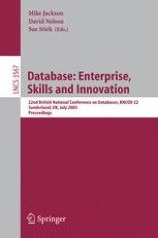
Database : Enterprise, skills and innovation; 22nd British national conference on databases, BNCOD 22, Sunderland, UK, July 5-7, 2005, Proceedings
The British National Conference on Databases (BNCOD) was established in 1980 as a forum for research into the theory and practice of databases. The original conference in the series took place at the University of Aberdeen. To be precise, this conference was in fact entitled ICOD which stood for International Conference on Databases. It was the intention, when the series began, that an ICOD would take place every two years, whilst a BNCOD would run in the years in between. As the record shows ICOD was only held in 1980 and 1983. The more junior conference has managed to acquire a lifetime much longer than that of its senior relative! If truth wereknown,however,BNCOD has,overthe years,growninto ICOD and although the conference is still titled “British National,” it is, in fact, an international conference that takes place on a yearly basis. Proof of this can be obtained simply by looking at the table of contents of these proceeding which clearlyshowthatthe majorityofpaperspresentedatthis year’sconferencecame from contributors whose a?liations are outside the UK. Despitetherangeofpapersono?er,BNCODstillretainsitsuniquelyBritish ?avor. The Programme Committee is drawn from UK academics and the c- ference is always held at a British university (or in earlier years a polytechnic!).

Data Warehousing and Knowledge Discovery ; Vol.4081 ; 8th International Conference, DaWaK 2006, Krakow, Poland, September 4-8, 2006, Proceedings
DaWaK aimed at providing the right and logical balance between data warehousing and knowledge discovery. In data warehousing the papers cover different research problems, such as advanced techniques in OLAP visuali- tion and multidimensional modelling, innovation of ETL processes and integration problems, materialized view optimization, very large data warehouse processing, data warehouses and data mining applications integration, data warehousing for real-life applications, e. g. , medical applications and spatial applications. In data mining and knowledge discovery, papers are focused on a variety of topics from data streams analysis and mining, ontology-based mining techniques, mining frequent item sets, clustering, association and classification, patterns and so on.
