



الصفحة 12
الصفحة 12
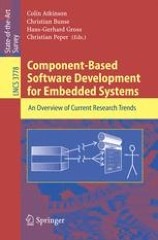
Component-Based Software Development for Embedded Systems : An Overview of Current Research Trends
Embedded systems are ubiquitous. They appear in cell phones, microwave ovens, refrigerators, consumer electronics, cars, and jets. Some of these embedded s- tems are safety- or security-critical such as in medical equipment, nuclear plants, and X-by-wire control systems in naval, ground and aerospace transportation - hicles. With the continuing shift from hardware to software, embedded systems are increasingly dominated by embedded software. Embedded software is complex. Its engineering inherently involves a mul- disciplinary interplay with the physics of the embedding system or environment. Embedded software also comes in ever larger quantity and diversity. The next generation of premium automobiles will carry around one gigabyte of binary code. The proposed US DDX submarine is e?ectively a ?oating embedded so- ware system, comprising 30 billion lines of code written in over 100 programming languages. Embedded software is expensive. Cost estimates are quoted at around US$15– 30 per line (from commencement to shipping). In the defense realm, costs can range up to $100, while for highly critical applications, such as the Space Shuttle, the cost per line approximates $1,000. In view of the exponential increase in complexity, the projected costs of future embedded software are staggering.

Complex Computing-Networks : Brain-like and Wave-oriented Electrodynamic Algorithms
This book uniquely combines new advances in the electromagnetic and the circuits&systems theory. It integrates both fields regarding computational aspects of common interest. Emphasized subjects are those methods which mimic brain-like and electrodynamic behaviour; among these are cellular neural networks, chaos and chaotic dynamics, attractor-based computation and stream ciphers.

Compiler construction ; Vol. 3443 : 14th International Conference, CC 2005, Held as Part of the Joint European Conferences on Theory and Practice of Software, ETAPS 2005, Edinburgh, UK, April 4-8, 2005. Proceedings
"This book constitutes the refereed proceedings of 14th International Conference, CC 2005, Held as Part of the Joint European Conferences on Theory and Practice of Software, ETAPS 2005, including Topics Programming Languages, Compilers, Interpreters Logics and Meanings of Programs / Mathematical Logic and Formal Languages / Software Engineering / Artificial Intelligence"

Compiler construction ; 17th International Conference, CC 2008, Held as Part of the Joint European Conferences on Theory and Practice of Software, ETAPS 2008, Budapest, Hungary, March 29 - April 6, 2008. Proceedings
This book constitutes the proceedings of the 17th International Conference on Compiler Construction, CC 2008. It covers analysis and transformations, compiling for parallel architectures, runtime techniques and tools, analyses, and atomicity and transactions.

Central European Functional Programming School ; 1st Central European Summer School, CEFP 2005, Budapest, Hungary, July 4-15, 2005, Revised Selected Lectures
This volume presents eight carefully revised texts of selected lectures given by leading researchers of the field at the first Central European Functional Programming School, CEFP 2005, held in Budapest, Hungary, in July 2005. The eight revised full papers presented were carefully selected during two rounds of reviewing and improvement for inclusion in the book. The lectures cover a wide range of topics such as new programming language concepts for subtyping.
Brainlesion: Glioma, Multiple Sclerosis, Stroke and Traumatic Brain Injuries ; 7th International Workshop, BrainLes 2021, Held in Conjunction with MICCAI 2021, Virtual Event, September 27, 2021, Revised Selected Papers, Part I
The content of thebook covers the current state-of-the-art literature on federated learning applications for cancer research and Vclinical oncology analysis, as well as an overview of the deep learning approaches improving the current standard of care for brain lesions and current neuroimaging challenges. It is also focusing on the accepted BrainLes workshop submissions, is to provide an overview of new advances of medical image analysis in all the aforementioned brain pathologies. It brings together researchers from the medical image analysis domain, neurologists, and radiologists working on at least one of these diseases. The aim is to consider neuroimaging biomarkers used for one disease applied to the other diseases.

Biometrics and Identity Management ; 1st European Workshop, BIOID 2008, Roskilde, Denmark, May 7-9, 2008. Revised Selected Papers
This volume constitutes the post-conference proceedings of the First European Workshop on Biometrics and Identity Management, BIOID 2008, held in Roskilde, Denmark, during May 7-9, 2008.

Bioinformatics : Problem Solving Paradigms
This book highlights basic paradigms of problem analysis and algorithm design in the context of core bioinformatics problems. Mathematically demanding themes are put across to the reader by properly chosen representations with the aid of lots of illustrations.

Bayesian networks and Influence diagrams : A guide to construction and analysis
Probabilistic networks, also known as Bayesian networks and influence diagrams, have become one of the most promising technologies in the area of applied artificial intelligence, offering intuitive, efficient, and reliable methods for diagnosis, prediction, decision making, classification, troubleshooting, and data mining under uncertainty. Bayesian Networks and Influence Diagrams: A Guide to Construction and Analysis provides a comprehensive guide for practitioners who wish to understand, construct, and analyze intelligent systems for decision support based on probabilistic networks. Intended primarily for practitioners, this book does not require sophisticated mathematical skills or deep understanding of the underlying theory and methods nor does it discuss alternative technologies for reasoning under uncertainty.

B 2007 : Formal Specification and Development in B ; 7th International Conference of B Users, Besancon, France, January 7-19, 2007, Proceedings
These proceedingsrecordthe papers presented at the Seventh InternationalC- ference of B Users (B 2007), held in the city of Besan¸ con in the east of France. All the submitted papers in these proceedings were peer reviewed by at least three reviewers drawn from the B committee, depending on the subject matter of the paper. The authorsof the papersforB 2007werefrom Australia,Canada, Finland, Germany, France, Switzerland, and the UK. The conference featured a rangeof contributions by distinguished invited speakers drawn from both ind- try and academia.

Automated technology for verification and analysis ; 6th International Symposium, ATVA 2008, Seoul, Korea, October 20-23, 2008. Proceedings
This book constitutes the refereed proceedings of the 6th International Symposium on Automated Technology for Verification and Analysis, ATVA 2008, held in Seoul, Korea, in October 2008.

Automated technology for verification and analysis ; 5th International Symposium, ATVA 2007 Tokyo, Japan, October 22-25, 2007 Proceedings
This book presented theoretical methods to achieve correct software or hardware systems, including both functional and non functional aspects

Automated technology for verification and analysis ; 4th International Symposium, ATVA 2006, Beijing, China, October 23-26, 2006, Proceedings
The Automated Technology for Veri?cation and Analysis (ATVA) international symposium series was initiated in 2003, The main topics of the symposium include th- ries useful for providing designers with automated support for obtaining correct software or hardware systems, as well as the implementation of such theories in tools or their application. In the end, 35 papers were selected for inclusion in the program. ATVA 2006 had three keynote speeches given respectively by Thomas Ball, Jin Yang, and Mihalis Yannakakis. The main symposium was preceded by a tutorial day, consisting of three two-hourlectures given by the keynotespeakers.

Automated technology for verification and analysis ; 3rd International Symposium, ATVA 2005, Taipei, Taiwan, October 4-7, 2005, Proceedings
The Automated Technology for Veri?cation and Analysis (ATVA) international symposium series was initiated in 2003, responding to a growing interest in formal veri?cation spurred by the booming IT industry, particularly hardware design and manufacturing in East Asia. Its purpose is to promote research on automated veri?cation and analysis in the region by providing a forum for int- action between the regional and the international research/industrial commu- ties of the ?eld. ATVA 2005, the third of the ATVA series, was held in Taipei, Taiwan, 2005. The main theme of the symposium encompasses - sign, complexities, tools, and applications of automated methods for veri?cation and analysis. This book constitutes the refereed proceedings of the symposium .

Automated technology for verification and analysis ; 18th International Symposium, ATVA 2020, Hanoi, Vietnam, October 19–23, 2020, Proceedings
This book constitutes the refereed proceedings of the 18th International Symposium on Automated Technology for Verification and Analysis, ATVA 2020, held in Hanoi, Vietnam, in October 2020. The 27 regular papers presented together with 5 tool papers and 2 invited papers were carefully reviewed and selected from 75 submissions.
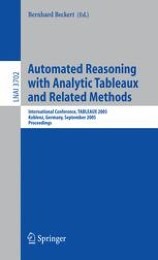
Automated reasoning with analytic tableaux and related methods ; International Conference, TABLEAUX 2005, Koblenz, Germany, September 14-17, 2005, Proceedings
This volume contains the research papers presented at the International C- ference on Automated Reasoning with Analytic Tableaux and Related Methods (TABLEAUX2005)heldSeptember 2005inKoblenz,Germany. which included conferences covering a broad spectrum of topics and intere- ing ?elds of application for tableau-based methods: arti?cial intelligence (KI), multi-agent systems (MATES), automated reasoning and knowledge represen- tion (FTP), and software engineering and formal methods (SEFM).
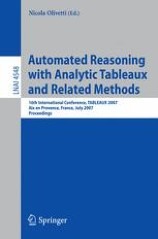
Automated Reasoning with Analytic Tableaux and Related Methods ; 16th International Conference, TABLEAUX 2007, Aix en Provence, France, July 3-6, 2007, Proceedings
It covers the wide range of logics, from intuitionistic and substructural logics to modal logics (including temporal and dynamic logics), from many-valued logics to nonmonotonic logics, and from classical first-order logic to description logics.
Automated reasoning ; 4th International Joint Conference, IJCAR 2008 Sydney, Australia, August 12-15, 2008 Proceedings
This book constitutes the refereed proceedings of the 4th International Joint Conference on Automated Reasoning, IJCAR 2008, held in Sydney, Australia, in August 2008.
Automated reasoning ; 3rd International Joint Conference, IJCAR 2006, Seattle, WA, USA, August 17-20, 2006, Proceedings
This book constitutes the refereed proceedings of the Third International Joint Conference on Automated Reasoning,The papers address the entire spectrum of research in automated reasoning including formalization of mathematics, proof theory, proof search, description logics, interactive proof checking, higher-order logic, combination methods, satisfiability procedures, and rewriting. The papers are organized in topical sections on proofs, search, higher-order logic, proof theory, search, proof checking, combination, decision procedures, CASC-J3, rewriting, and description logic.

Automated deduction in Geometry ; 6th International Workshop, ADG 2006, Pontevedra, Spain, August 31-September 2, 2006, Revised Papers
The book show the lively variety of topics and methods and the current applicability of automated deduction in geometry to different branches of mathematics and to other sciences and technologies.
