



الصفحة 12
الصفحة 12

High-Frequency Oscillator Design for Integrated Transceivers
High-Frequency Oscillator Design for Integrated Transceivers covers the analysis and design of all high-frequency oscillators required to realize integrated transceivers for wireless and wired applications.

High resolution numerical modelling of the atmosphere and ocean
This book includes 15 individual papers that highlight the emerging research in atmospheric and oceanic science that has been made possible by exploiting newly available computational resources. Results from regional atmospheric, global atmospheric, global ocean, and global coupled ocean-atmosphere models are discussed in the various contributions.

High performance computing on vector systems 2007 ; Conference proceedings
The following book presents contributions from the 6th TERAFLOP Workshop which was hosted by Tohoku University in Sendai, Japan in Autumn 2006 and the 7th Workshop in Stuttgart which was held in spring 2007 in Stuttgart. Focus is layed on current applications and future requirements, as well as developments of next generation hardware architectures and installations. The papers presented in this book lay out the wide range of fields in which sustained performance can be achieved if engineering knowledge, numerical mathematics and computer science skills are brought together. With the advent of hybrid systems, the Teraflop workbench project will continue the support of leading edge computations for future applications.

High performance computing on vector systems 2006 ; Proceedings of the High Performance Computing Center Stuttgart, March 2006
With this second issue of "High Performance Computing on Vector Systems ~ Proceedings of the High Performance Computing Center Stuttgart" we con tinue our publication of most recent results in high performance computing and innovative architecture. Together with our book series on "High Perfor mance Computing in Science and Engineering'06 - Transactions of the High Performance Computing Center Stuttgart" this book gives an overview of the most recent developments in high performance computing and its use in scientific and engineering applications. This second issue covers presentations and papers given by scientists in two workshops held at Stuttgart and Tokyo in spring and summer 2006.

High performance computing on vector systems ; Proceedings of the High Performance Computing Center Stuttgart, March 2005
The book presents the state of the art in high performance computing and simulation on modern supercomputer architectures. Innovative application fields like multiphysics simulations and material science are presented.

High performance computing in science and engineering, Munich 2004 ; Transactions of the 2nd Joint HLRB and KONWIHR Status and Result Workshop, March 2-3, 2004, Technical University of Munich, and Leibniz-Rechenzentrum Munich, Germany
Three of the 38 papers deal with computer science, 11 with computational fluid dynamics, two with bio-sciences, six with chemistry, nine with solid-state physics, one with geophysics, four with fundamental physics and two with astrophysics. At a workshop on high performance computing papers should not only have a high scientific quality of the subject addressed, e.g. CFD (Computational Fluid Dynamics), physics, chemistry, but should ecially emphasize the necessity to have access to a high performance computer in order to solve the problem. It should also contain information about the simulation techniques used and about the performance of the computer when using distinc algorithms.

High performance computing in science and engineering 07 ; Transactions of the High Performance Computing Center, Stuttgart (HLRS) 2007
This book presents the state-of-the-art in simulation on supercomputers. Presenting results for both vector-based and microprocessor-based systems, the book allows comparison between performance levels and usability of various architectures.
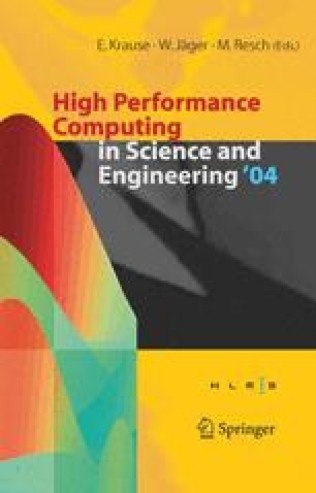
High performance computing in science and engineering 04 ; Transactions of the High Performance Computing Center, Stuttgart (HLRS) 2004
This book presents the state-of-the-art in modelling and simulation on supercomputers. Leading German research groups present their results achieved on high-end systems of the High Performance Computing Center Stuttgart (HLRS) for the year 2004. The reports cover all fields of computational science and engineering ranging from computational fluid dynamics via computational physics and chemistry to computer science. Special emphasis is given to industrially relevant applications. Presenting results for both vector-systems and micro-processor based systems the book allows to compare performance levels and usability of a variety of supercomputer architectures. In the light of the success of the Japanese Earth-Simulator this book may serve as a guide book for a US response

High performance computing in science and engineering 06 ; Transactions of the High Performance Computing Center, Stuttgart (HLRS) 2006
In July 2005, the new building for HLRS as well as Stuttgart’s new NEC supercomputer – which is still leading edge in G- many – have been inaugurated. In these days, the SSC Karlsruhe is ?nalizing the installation of a very large high performance system complex from HP, built from hundreds of Intel Itanium processors and more than three th- sand AMD Opteron cores. Additionally, the fast network connection – with a bandwidth of 40Gbit/s and thus one of the frst installations of this kind in Germany – brings the machine rooms of HLRS and SSC Karlsruhe very close together.

High performance computing in science and engineering 05 ; Transactions of the High Performance Computing Center, Stuttgart (HLRS) 2005
This book presents the state-of-the-art in simulation on supercomputers. Leading researchers present results achieved on systems of the High Performance Computing Center Stuttgart (HLRS) for the year 2006. The reports cover all fields of computational science and engineering ranging from CFD via computational physics and chemistry to computer science with a special emphasis on industrially relevant applications. Presenting results for both vector-systems and micro-processor based systems the book allows to compare performance levels and usability of various architectures. As HLRS operates the largest NEC SX-8 vector system in the world this book gives an excellent insight into the potential of vector systems.

High performance computing for drug discovery and biomedicine
Explores the application of high-performance computing (HPC) technologies to computational drug discovery (CDD) and biomedicine. Collects CDD approaches that, together with HPC, can revolutionize and automate drug discovery process, such as knowledge graphs, natural language processing (NLP), Bayesian optimization, automated virtual screening platforms, alchemical free energy workflows, fragment-molecular orbitals (FMO), HPC-adapted molecular dynamic simulation (MD-HPC), and the potential of cloud computing for drug discovery. And delves into computational algorithms and workflows for biomedicine, featuring an HPC framework to assess drug-induced arrhythmic risk, digital patient applications relevant to the clinic, virtual human simulations, cellular and whole-body blood flow modeling for stroke treatments, prediction of the femoral bone strength from CT data, and many more subjects.
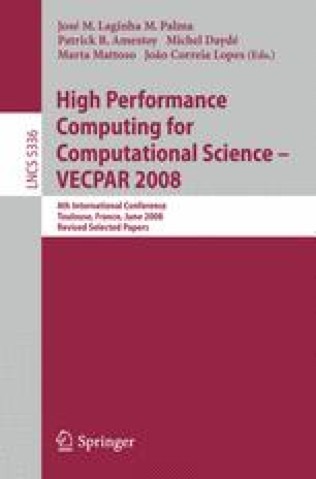
High performance computing for computational science - VECPAR 2008 ; 8th International Conference, Toulouse, France, June 24-27, 2008. Revised Selected Papers
This book constitutes the thoroughly refereed post-conference proceedings of the 8th International Conference on High Performance Computing for Computational Science, VECPAR 2008, held in Toulouse, France, in June 2008.The 51 revised full papers presented together with the abstract of a surveying and look-ahead talk were carefully reviewed and selected from 73 submissions. The papers are organized in topical sections on parallel and distributed computing, cluster and grid computing, problem solving environment and data centric, numerical methods, linear algebra, computing in geosciences and biosciences, imaging and graphics.

High performance computing ; 4th International Symposium, ISHPC 2002, Kansai Science City, Japan, May 15-17, 2002. Proceedings
The objective of this symposium is to exchange the latest research results in software, architecture, and applications in HPC in a more informal and friendly atmosphere. I am delighted that the symposium is, like past successful ISHPCs, comprised of excellent invited talks, panels, workshops, as well as high-quality technical papers on various aspects of HPC. We hope that the symposium will provide an excellent opportunity for lively exchange and discussion about - rections in HPC technologies and all the participants will enjoy not only the symposium but also their stay in Kansai Science City.

High Frequency Financial Econometrics : Recent Developments
This exciting volume presents cutting-edge developments in high frequency financial econometrics, spanning a diverse range of topics: market microstructure, tick-by-tick data, bond and foreign exchange markets and large dimensional volatility modelling. The chapters on market microstructure deal with liquidity, asymmetries of information, and limit order aggressiveness in pure limit order book markets. The chapters on tick-by-tick data present statistical techniques for the analysis of the discrete nature of price movements, the intraday seasonal patterns of financial durations, and the joint probability law of prices, volume and durations. Bond markets are brought into focus through the analysis of macroeconomic announcements in the future bond market as a function of the business cycle.

Heterogeneous Objects Modelling and Applications : Collection of Papers on Foundations and Practice
Heterogeneous object modelling is a new and quickly developing research area. This book is one of the first attempts to systematically cover the most relevant themes and problems of this new and challenging subject area. It is a collection of invited papers and papers co-authored by the editors. Each chapter presents either new research results or a survey on the following topics:Formal models and abstractions of heterogeneous objects including geometric, topological, discrete and continuous models, operations forming special algebras and conversions between different model types.
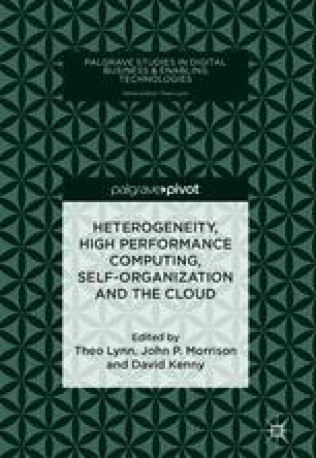
Heterogeneity, high performance computing, self-organization and the cloud
Addresses the most recent developments in cloud computing such as HPC in the Cloud, heterogeneous cloud, self-organising and self-management, and discusses the business implications of cloud computing adoption. Establishing the need for a new architecture for cloud computing, it discusses a novel cloud management and delivery architecture based on the principles of self-organisation and self-management. This focus shifts the deployment and optimisation effort from the consumer to the software stack running on the cloud infrastructure. It also outlines validation challenges and introduces a novel generalised extensible simulation framework to illustrate the effectiveness, performance and scalability of self-organising and self-managing delivery models on hyperscale cloud infrastructures. It concludes with a number of potential use cases for self-organising, self-managing clouds and the impact on those businesses.

Hemodynamical Flows : Modeling, Analysis and Simulation
This book surveys research results on the physical and mathematical modeling, as well as the numerical simulation of complex fluid and structural mechanical processes occurring in the human blood circulation system. Topics treated include continuum mechanical description; choice of suitable liquid and wall models; mathematical analysis of coupled models; numerical methods for flow simulation; parameter identification and model calibration; fluid-solid interaction; mathematical analysis of piping systems; particle transport in channels and pipes; artificial boundary conditions, and many more.
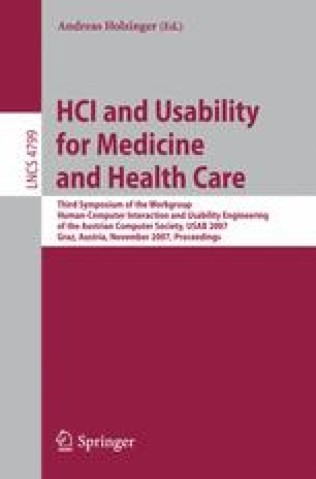
HCI and usability for medicine and health care ; 3rd Symposium of the Workgroup Human-computer interaction and usability engineering of the Austrian Computer Society, USAB 2007 Graz, Austria, November, 22, 2007, Proceedings
The work group Human–Computer Interaction & Usability Engineering (HCI&UE) of the Austrian Computer Society (OCG) serves as a platform for interdisciplinary exchange, research and development. Our 2007 topic was “Human–Computer Interaction for Medicine and Health Care” (HCI4MED), Medical information systems are already extremely sophisticated and technological performance increases exponentially.
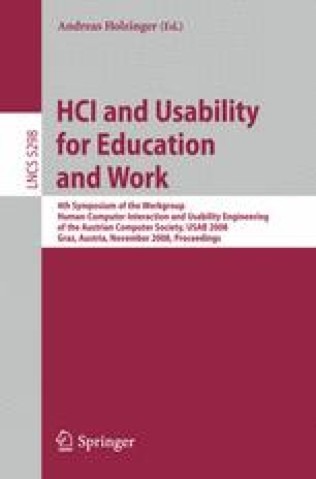
HCI and usability for education and work ; 4th Symposium of the Workgroup Human-Computer Interaction and Usability Engineering of the Austrian Computer Society, USAB 2008, Graz, Austria, November 20-21, 2008. Proceedings
This book constitutes the refereed proceedings of the 4th Usability Symposium of the Human-Computer Interaction and Usability Engineering Workgroup of the Austrian Computer Society, USAB 2008, held in Graz, Austria, in November 2008.The 7 revised full papers and 26 revised short papers presented were carefully reviewed and selected from 85 submissions. The papers are organized in topical sections on cognitive processes and end user experience, social software and collaborative knowledge development, knowledge processing, assessment and human performance.

Hardware and software : Verification and testing ; 3rd International Haifa Verification Conference, HVC 2007, Haifa, Israel, October 23-25, 2007. Proceedings
These are the conference proceedings of the 4th Haifa Verifcation Conference, held October 27–30, 2008 in Haifa, Israel. This international conference is a unique venue that brings together leading researchers and practitioners of both formal and dynamic verifcation, for both hardware and software systems. This year’s conference extended the successes of the previous years, with a largejumpinthenumberofsubmitted papers. with many more high-quality papers than we had room to accept. Submissions came from 19 di?erent countries, re?ecting the growing international visibility of the conference. Of the 49 submissions, 43 were regular papers, 2 of which were later withdrawn, and 6 were tool papers. After a rigorous review process.
