



الصفحة 12
الصفحة 12
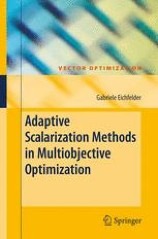
Adaptive Scalarization Methods in Multiobjective Optimization
This book presents new adaptive solution methods for multiobjective optimization problems based on parameter dependent scalarizations. With the help of sensitivity results an adaptive parameter control is developed so that high-quality approximations of the efficient set are generated. These examinations are based on a general scalarization approach for arbitrary partial orderings defined by a closed pointed convex cone in the objective space. The application of the results to many other well-known scalarization methods is also presented. Background material of multiobjective optimization and scalarization approaches is concisely summarized at the beginning. The effectiveness of these new methods is demonstrated by test problems and a recent problem in intensity-modulated radiotherapy. The book concludes with a further application: a procedure for solving multiobjective bilevel optimization problems.
Adaptive Machine Learning Algorithms with Python : Solve Data Analytics and Machine Learing Problems on Edge Devices
Learn to use adaptive algorithms to solve real-world streaming data problems. This book covers a multitude of data processing challenges, ranging from the simple to the complex. At each step, you will gain insight into real-world use cases, find solutions, explore code used to solve these problems, and create new algorithms for your own use. You will: Apply adaptive algorithms to practical applications and examples / Understand the relevant data representation features and computational models for time-varying multi-dimensional data / Derive adaptive algorithms for mean, median, covariance, eigenvectors (PCA) and generalized eigenvectors with experiments on real data / Speed up your algorithms and put them to use on real-world stationary and non-stationary data / Master the applications of adaptive algorithms on critical edge device computation applications
Adaptive and Natural Computing Algorithms ; 8th International Conference, ICANNGA 2007, Warsaw, Poland, April 11-14, 2007, Proceedings, Part I
Constitutes the refereed proceedings of the 8th International Conference on Adaptive and Natural Computing Algorithms, ICANNGA 2007, held in Warsaw, Poland, in April 2007. The 178 revised full papers presented were carefully reviewed and selected from a total of 474 submissions. The 94 papers of the first volume are organized in topical sections on evolutionary computation, genetic algorithms, particle swarm optimization, learning, optimization and games, fuzzy and rough systems, just as classification and clustering. The second volume contains 84 contributions related to neural networks, support vector machines, biomedical signal and image processing, biometrics, computer vision, as well as to control and robotics.
Active mining ; 2nd International workshop, AM 2003, Maebashi, Japan, October 28, 2003, revised selected papers
"This volume contains the papers selected for presentation at the 2nd Inter- tional Workshop on Active Mining (AM 2003) which was organized in conju- tion with the 14th International Symposium on Methodologies for Intelligent Systems (ISMIS 2003), The workshop was organized by the Maebashi Institute of Technology for shed light on the future development of active mining. "This volume contains : Topics Database Management / Artificial Intelligence / Algorithm Analysis and Problem Complexity / Health Informatics / Bioinformatics

Abord clinique des urgences traumatiques au cabinet du généraliste = Clinical approach to traumatic emergencies in the general practitioner's office
Cet ouvrage a été conçu comme une aide pour le médecin généraliste, confronté quotidiennement à la pathologie traumatique. Les deux auteurs, urgentistes expérimentés, apportent des réponses claires, concises et pratiques aux problèmes que posent les lésions traumatiques. Des gestes simples, un abord clinique détaillé, la nécessité de recourir ou non à des examens complémentaires ou à un avis spécialisé sont ici expliqués et justifiés. Le style est précis, concis, et un lexique complète les définitions et les matériels cités dans le texte. Les auteurs se sont entourés des avis de généralistes et de spécialistes pour définir des conduites à tenir simples et compatibles avec les nécessités du terrain.
A Matrix Algebra Approach to Artificial Intelligence
The book consists of two parts: the first discusses the fundamentals of matrix algebra in detail, while the second focuses on the applications of matrix algebra approaches in AI. Highlighting matrix algebra in graph-based learning and embedding, network embedding, convolutional neural networks and Pareto optimization theory, and discussing recent topics and advances, the book offers a valuable resource for scientists, engineers, and graduate students in various disciplines
A Mathematical Introduction to Conformal Field Theory
The first part of this book gives a detailed, self-contained and mathematically rigorous exposition of classical conformal symmetry in n dimensions and its quantization in two dimensions. In particular, the conformal groups are determined and the appearance of the Virasoro algebra in the context of the quantization of two-dimensional conformal symmetry is explained via the classification of central extensions of Lie algebras and groups. The second part surveys some more advanced topics of conformal field theory, such as the representation theory of the Virasoro algebra, conformal symmetry within string theory, an axiomatic approach to Euclidean conformally covariant quantum field theory and a mathematical interpretation of the Verlinde formula in the context of moduli spaces of holomorphic vector bundles on a Riemann surface.

A History of Abstract Algebra
This presentation provides an account of the intellectual lineage behind many of the basic concepts, results, and theories of abstract algebra.The development of abstract algebra was propelled by the need for new tools to address certain classical problems that appeared unsolvable by classical means. A major theme of the approach in this book is to show how abstract algebra has arisen in attempts to solve some of these classical problems, providing context from which the reader may gain a deeper appreciation of the mathematics involved.

A Geometric Approach to Differential Forms
The modern subject of differential forms subsumes classical vector calculus. This text presents differential forms from a geometric perspective accessible at the undergraduate level. The book begins with basic concepts such as partial differentiation and multiple integration and gently develops the entire machinery of differential forms. Each new concept is presented with a natural picture that students can easily grasp. Algebraic properties then follow. This facilitates the development of differential forms without assuming a background in linear algebra. Throughout the text, emphasis is placed on applications in 3 dimensions, but all definitions are given so as to be easily generalized to higher dimensions. A centerpiece of the text is the generalized Stokes' theorem. Although this theorem implies all of the classical integral theorems of vector calculus, it is far easier for students to both comprehend and remember.
